How Deep Flaming Gorge Guides Fish for Lake Trout
One of the biggest head-scratchers for anglers heading to Wyoming's vast Flaming Gorge Reservoir is figuring out just how deep those elusive lake trout hang out. It's not like they're just cruising the surface, especially when you're after those monstrous lunkers. This guide is going to pull back the curtain on the depths Flaming Gorge guides target for lake trout, revealing the strategies and gear they use to consistently put clients on big fish in this incredible, deep-water fishery.
Understanding Lake Trout Behavior in Flaming Gorge
Flaming Gorge Reservoir is a truly special place, a deep, cold-water haven that supports a thriving population of lake trout, or Mackinaw as they're often called. But these fish aren't just swimming around aimlessly; their behavior is heavily influenced by factors like water temperature, oxygen levels, and the availability of their favorite food sources. If you've ever spent hours trolling the Gorge without a bite, you know how frustrating it can be when you're not dialed into their patterns.
The Deep, Cold Habitat Lake Trout Crave
Lake trout are fundamentally cold-water fish, and Flaming Gorge provides them with exactly what they need: vast expanses of deep, oxygen-rich water that stays consistently chilly, even during the scorching Wyoming summer. They don't just tolerate cold water; they thrive in it. When surface temperatures climb, these fish will retreat to the deepest, coolest parts of the reservoir, often congregating around underwater structures where they can find both comfort and cover. This means that a lot of the time, especially from late spring through early fall, you're going to be looking for them in significant depths. It’s a common misconception that deep fish are lazy; in reality, they’re just following their biological needs to comfortable zones.
In these deep haunts, lake trout become apex predators, constantly searching for schools of kokanee salmon, which are a primary food source in Flaming Gorge. They'll also feast on smaller trout, chubs, and other baitfish. Knowing their preferred diet helps guides understand where to look for them, as the lake trout will often be found shadowing these baitfish schools. Targeting these deeper, colder sections is crucial, but it's not simply a matter of dropping a line; it requires precision and a deep understanding of the lake's unique topography. This is why having a robust understanding of What Lake Trout Eat in Wyoming Reservoirs is so vital for success.
Seasonal Movements and Depth Changes
While lake trout generally prefer deep, cold water, their specific depths can shift throughout the year based on the seasons. It's not a static environment, and the best guides are constantly adjusting their strategies.
- Spring: As the ice comes off (usually April/May), lake trout might be found in shallower waters, sometimes as shallow as 20-40 feet, especially if there's a good baitfish presence or if they're coming out of a colder, less active winter period. This is often a great time for aggressive strikes.
- Summer: This is when they go deep. As the sun beats down and the surface warms up, lake trout will migrate to the thermocline or even below it, often holding anywhere from 60 to 150 feet, and sometimes even deeper, down to 200 feet or more in certain areas. This is the prime time for downrigging and getting your lures right into their comfort zone. Finding these deeper fish is where the true challenge—and reward—lies.
- Fall: As water temperatures begin to cool in September and October, lake trout might start to move up a bit shallower again, particularly as kokanee salmon begin their spawning runs. While still typically deep by most standards, you might find them in the 40-100 foot range more consistently. They're also preparing for their own spawn, often occurring in very deep water on rocky shoals.
- Winter (Ice Fishing): Even under the ice, lake trout can still be found in significant depths, though they might also utilize shallower humps and structures more readily. Ice anglers often target them in 40-100 feet of water, employing specific jigging techniques.
Understanding these seasonal shifts is paramount. A guide on Wyoming's Flaming Gorge Reservoir Fishing Guide won't just guess; they'll have years of experience tracking these movements. For instance, a spot that was hot at 80 feet in July might be completely barren in October, requiring a shift to 40 feet or even 120 feet in a different location.
Essential Gear and Techniques Guides Employ
You can't effectively fish for lake trout in Flaming Gorge without the right tools, and guides have refined their setups over years to maximize their chances. It's not just about having a fishing rod; it's about a complete system designed to present lures at precise depths. If you're considering a guided trip, companies often list what's included, which usually covers all this specialized equipment, meaning you don't have to invest in it yourself. This is one of the many benefits of booking through services like FishingBooker, where you can see what gear guides provide.
The Art of Downrigging and Trolling
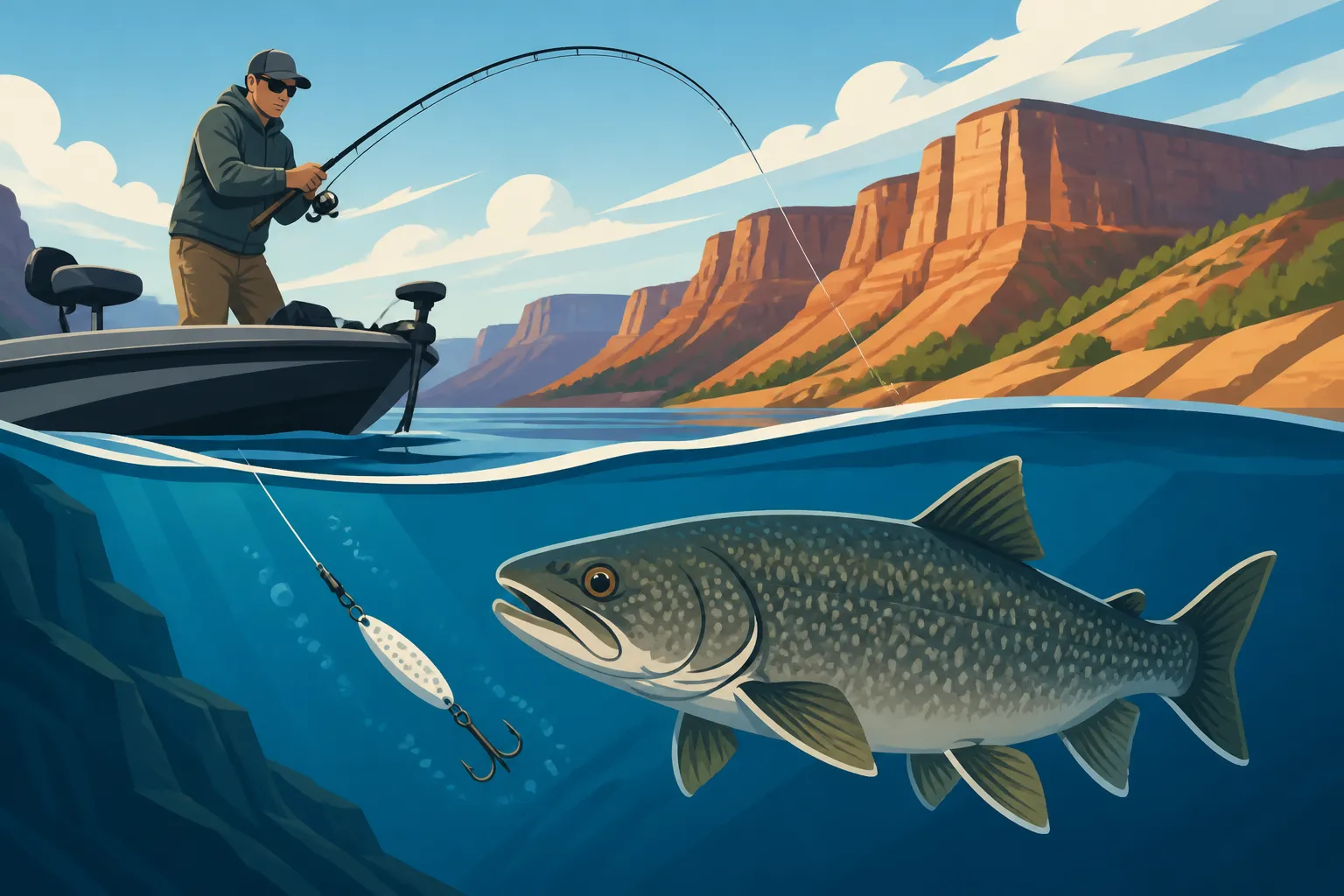
For consistently hitting those deep-water lakers, downriggers are non-negotiable. These mechanical marvels allow guides to send lures down to very specific depths, sometimes over 150 feet, and keep them there while trolling.
The typical setup involves:
- Downrigger Ball: A heavy lead weight (usually 8-15 lbs) attached to a cable that drops straight down from the boat.
- Release Clip: Your fishing line clips into this, and it holds the line at the desired depth until a fish strikes, at which point the line releases, allowing you to fight the fish directly.
- Lure: Often large spoons, plugs, or even baitfish imitations like herring or chub patterns.
- Trolling Speed: Guides carefully control boat speed (often 1.5 to 3 mph) to impart the right action on the lure, making it irresistible to hungry lake trout.
Guides use multiple downriggers, staggering depths and lure types until they find what the fish are keying in on. For instance, one rod might be at 80 feet with a large spoon, another at 100 feet with a jig-and-squid combo, and a third at 120 feet with a swimbait. This "spread" allows them to cover more of the water column and experiment with different presentations. They might even deploy planer boards to spread lines horizontally, but for the deepest lake trout, downriggers are the workhorses. This is fundamental to Trolling Techniques for Wyoming Reservoirs and specifically Downrigger Basics for Wyoming Reservoir Trout.
Advanced Sonar and Electronics
Modern sonar and GPS units are the eyes and brains of a deep-water lake trout guide. You simply can't effectively target these fish without them. High-definition sonar can paint a remarkably clear picture of the underwater world, showing:
- Thermocline: The distinct boundary between warm surface water and cold deep water. Lake trout often suspend around or just below this layer.
- Fish Arches: Not just showing individual fish, but sometimes entire schools of baitfish, and the larger, more distinctive arcs of lurking lake trout.
- Structure: Underwater humps, ledges, old river channels, and even submerged timber—all prime spots where lake trout ambush prey.
- Depth: Precisely telling the guide the current depth, which is critical for setting downrigger balls to the right level.
Integrated GPS systems allow guides to mark "waypoints" where they've found fish or promising structure. They can then repeatedly troll over these productive areas with incredible accuracy, sometimes down to a few feet. A good guide isn't just looking at the screen; they're interpreting the data, mentally mapping the underwater topography, and making real-time adjustments to their trolling paths and depths. It's a blend of technology and intuition that only comes with years of experience on the water.
Jigging and Vertical Presentation
While trolling is often the primary method for covering water and finding active fish, jigging can be incredibly effective, especially when fish are concentrated in specific areas, such as over a submerged hump or around a dense bait ball. This technique involves dropping a heavy jig or spoon directly over the fish, detected on sonar, and working it vertically.
Common jigging presentations for Flaming Gorge lake trout include:
- Tube Jigs: Large, soft plastic tubes, often white or glow-in-the-dark, rigged with heavy jig heads. These mimic chub or kokanee.
- Vertical Jigs/Spoons: Metal jigs like Crippled Herrings, Kastmasters, or specialized vertical jigs that flutter and fall with an enticing action.
- Sucker Meat Rigs: Sometimes a piece of sucker meat is added to a large jig or hook, particularly when targeting truly giant, sluggish lake trout.
The key to successful jigging is finding the fish on your sonar first, then positioning the boat directly overhead. The guide will instruct clients to drop their jigs down to the precise depth where the fish are holding, often "seeing" their jig on the sonar screen alongside the fish. Then, it's a matter of working the jig with various lifts, drops, and pauses to trigger a strike. It's a more active, hands-on approach than trolling, and can be incredibly rewarding when those deep-dwelling giants decide to smash a jig. This can even be adapted from tactics like Jigging for Walleye at Boysen Reservoir, applying similar principles of vertical presentation to different species.
Reading the Water Like a Pro
Understanding the lake trout, knowing your gear, and mastering techniques are all essential, but without the ability to "read the water," you're often just fishing blind. This isn't just about looking at the surface; it's about interpreting every piece of information the reservoir offers, both above and below the waterline.
Identifying Structure and Forage
The bottom topography of Flaming Gorge is a complex underwater landscape of ancient riverbeds, towering cliffs, and expansive flats. Lake trout, like most predators, are drawn to structure.
- Humps and Ledges: These underwater features create current breaks and ambush points. Baitfish will often congregate around them, and lake trout will position themselves to strike. Guides spend countless hours mapping these features with their sonar.
- Points and Submerged Islands: Similar to humps, points that extend far out into the reservoir, or completely submerged islands, are magnets for both bait and predators.
- Channels and Canyons: The old Green River channel winds its way through Flaming Gorge, creating natural travel corridors and deep-water holding areas for large lake trout.
Beyond structure, identifying forage is paramount. Are there schools of kokanee salmon present? How deep are they? Where are they moving? Lake trout are always where the food is. Guides are constantly watching their sonar for dense clouds of baitfish, as this is often the fastest way to locate active feeding zones. Seeing these bait schools is often the precursor to finding the large arches of lake trout that are hunting them. Many a good day of fishing begins by locating these smaller fish.
The Role of Water Temperature and Oxygen
We've touched on it before, but water temperature and dissolved oxygen are critical factors that dictate where lake trout can and will be found.
- Temperature Stratification: During warmer months, Flaming Gorge develops distinct layers of water with different temperatures: the warm epilimnion on top, the transitional thermocline in the middle, and the cold hypolimnion at the bottom. Lake trout prefer the cold, oxygen-rich waters of the hypolimnion or just above the thermocline, typically in the 45-55°F range. A guide's sonar often shows the thermocline clearly, helping them narrow down the target depth.
- Oxygen Levels: While typically excellent in Flaming Gorge's deep waters, extreme depths or stagnant areas can sometimes have lower oxygen. Lake trout will avoid these "dead zones." Guides will be aware of areas that might suffer from this, though it's less common in the main body of the Gorge. They know that fish need both cold water and oxygen to thrive.
The guide's ability to interpret these environmental factors, combining them with sonar readings of structure and baitfish, is what allows them to precisely determine How Deep Lake Trout Live in Flaming Gorge at any given time. It's not just a guess; it's a calculated decision based on a wealth of information and experience, often informed by years of tracking changes on the reservoir. This deep understanding is exactly what you pay for when you book with a seasoned professional.
Why a Guided Trip Makes a Difference
For a fishery as vast and complex as Flaming Gorge, going it alone, especially when targeting deep-dwelling lake trout, can be incredibly daunting. Many anglers find themselves spending more time searching than fishing. This is where a professional guide truly shines.
Leveraging Local Knowledge and Experience
There's simply no substitute for thousands of hours spent on a specific body of water. A Flaming Gorge guide isn't just someone who owns a boat; they are a walking encyclopedia of the reservoir. They know:
- Secret Spots: Those obscure humps, ledges, or deep channels that don't show up on standard maps but consistently hold big fish.
- Seasonal Patterns: The nuanced shifts in fish behavior throughout the year, from pre-spawn staging to post-spawn lethargy and seasonal migrations. They know where fish were yesterday, and where they'll likely be tomorrow.
- Local Baitfish Movements: Which bays the kokanee are running into, or where the chub schools are congregating at different times.
- Weather and Water Conditions: How wind direction affects fishing, how changes in water clarity impact lure selection, and what to do when a cold front rolls through.
- Safety: Navigating the sometimes unpredictable conditions of a large reservoir, especially during high winds or sudden storms.
This deep well of local knowledge means less time guessing for you and more time with a line in the water, targeting trophy lake trout. A service like FishingBooker can help you find guides who specialize in Flaming Gorge, giving you access to this critical local expertise. You are not just paying for a boat ride; you are paying for years of accumulated wisdom.
Equipment and Safety Advantages
Investing in all the specialized gear needed for deep-water lake trout fishing can be incredibly expensive. Downriggers, high-end sonar, specialized rods and reels, and a full tackle box of deep-diving lures add up quickly.
- Top-Notch Gear: Guides provide all the necessary, high-quality gear, impeccably maintained. This includes rods, reels, line, downriggers, and a vast array of proven lures. You just show up ready to fish.
- Modern Electronics: Their boats are outfitted with the latest and most sophisticated sonar and GPS units, giving them an unparalleled view of the underwater world.
- Safety First: Professional guides prioritize safety. They have all the required safety equipment (life jackets, first-aid, marine radio), are well-versed in emergency procedures, and constantly monitor weather conditions. They know the safe channels and how to handle unexpected gusts that can make a large reservoir dangerous. They also maintain their vessels meticulously.
Booking a guided trip, especially a Guided Lake Trout Trips at Wyoming's Flaming Gorge outing, removes the financial burden and logistical headaches of acquiring and maintaining this specialized equipment. It allows you to experience the thrill of deep-water lake trout fishing without the enormous upfront investment, making a world-class fishery like Flaming Gorge accessible to everyone. Moreover, their experience ensures you are adhering to all local regulations, including possession limits and size restrictions, keeping your trip compliant and enjoyable.
| Aspect | DIY Angler (Without Guide) | Guided Trip (With Guide) |
|---|---|---|
| Depth Finding | Guesswork, basic sonar, trial & error | Advanced sonar, real-time interpretation, expert knowledge of thermocline and structure |
| Lure Presentation | Limited downrigger knowledge, basic lures | Multiple downriggers, diverse lure spread, precise depth control, seasonal patterns |
| Fish Location | Random trolling, hope for the best | Targeted search based on fish behavior, baitfish schools, and marked waypoints |
| Gear & Equipment | Personal investment, often suboptimal | Provided high-end specialized equipment, maintained and ready to use |
| Local Knowledge | Online research, general maps | Decades of personal experience on the specific water, secret spots, nuanced patterns |
| Safety & Regulations | Self-reliance, risk of non-compliance | Licensed, insured professional, full safety gear, expert on all regulations |
| Efficiency | More time searching, less time fishing | Maximized fishing time, higher success rate |
| Learning Opportunity | Self-taught, slow process | Direct instruction, accelerated learning of advanced techniques |
Disclaimer
This article is for general informational purposes only and does not constitute professional advice. Laws, prices and regulations vary by location and change over time. Consult a qualified professional for guidance on your specific situation.