Downrigger Basics for Wyoming Reservoir Trout
There’s a real challenge when you’re out on a vast Wyoming reservoir, staring at that endless expanse of water, knowing full well that the big, beautiful trout you’re after are often hanging out in the deep, cool zones you just can’t reach with traditional casting methods. It's frustrating to see fish on your sonar but not be able to get your lure in front of them. This guide is all about demystifying the downrigger, a piece of equipment that will literally pull your fishing game to new depths, helping you consistently target those hard-to-reach lakers, rainbows, and browns that thrive in the cold, clear waters of Wyoming’s largest lakes and reservoirs.
Understanding the Downrigger: Your Depth Advantage
Think about fishing your favorite Wyoming reservoir, like Flaming Gorge or Jackson Lake. You know those trophy lake trout, or even the bigger rainbows and brown trout, aren't hanging out on the surface in the middle of a sunny day. They're down deep, often seeking cooler water and structure. That's where a downrigger comes into play – it's your secret weapon for precise depth control.
Why Downriggers Are Essential for Reservoir Trout
The biggest hurdle for reservoir trout anglers is accurately presenting a lure or bait at a specific depth, especially when that depth is 30, 50, or even 100 feet down. Without a downrigger, your lure's depth is largely determined by line weight, lure type, trolling speed, and current, making it incredibly hard to keep it in the strike zone consistently. This usually means a lot of guesswork and even more missed opportunities. Downriggers eliminate that guesswork entirely. They allow you to put your offering exactly where you see fish on your sonar, or where you know they should be based on factors like the thermocline or bottom structure. This precision is invaluable, particularly when targeting finicky fish or working specific contours or depths over vast areas, which is often the case when you're fishing for species like the Lake Trout (Mackinaw) Fishing in Wyoming.
How Downriggers Mechanically Work
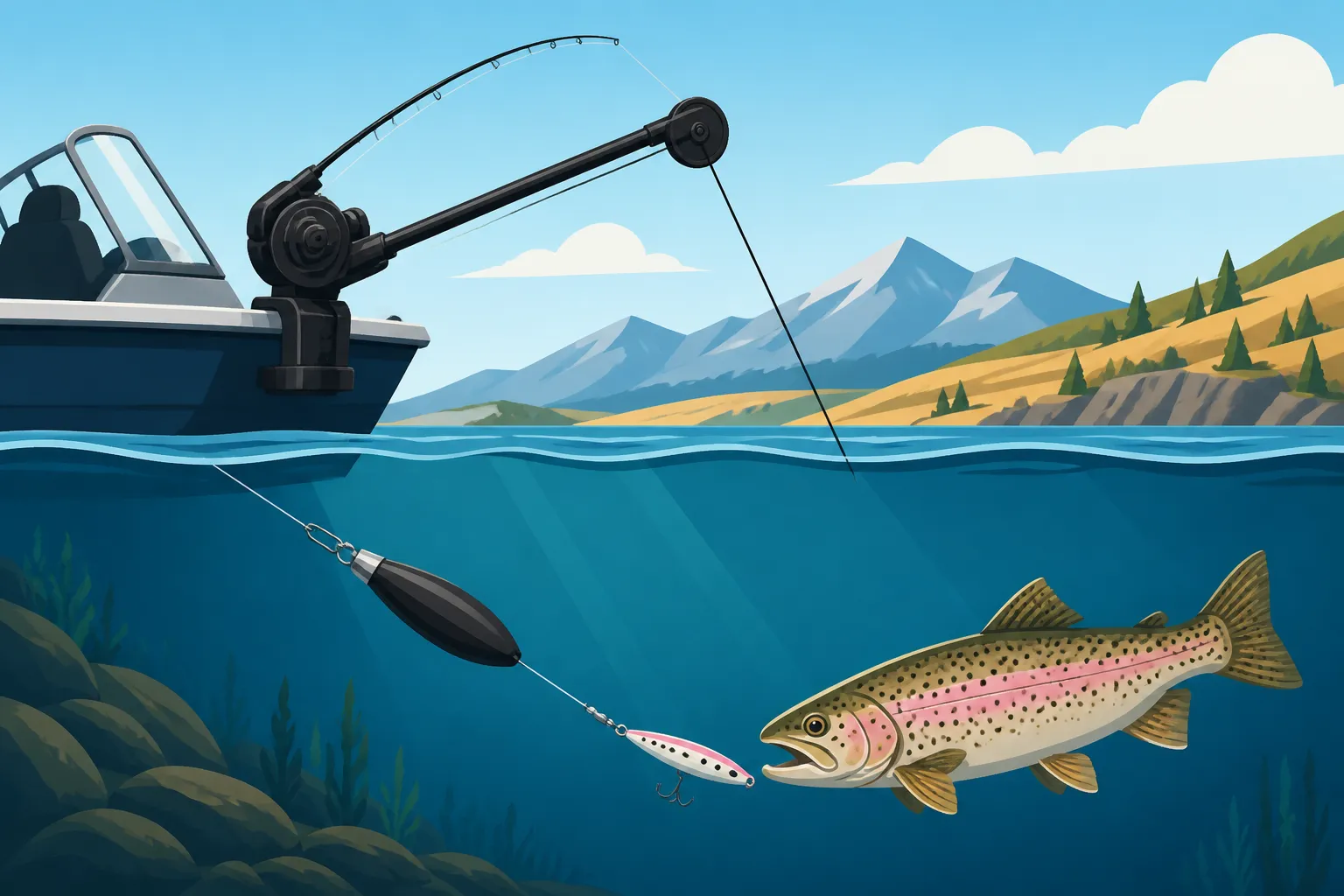
At its core, a downrigger is a sophisticated clip system designed to take your fishing line to a predetermined depth. It consists of a sturdy boom that extends out from your boat, a spool of steel cable or heavy-duty braid, and a heavy cannonball-shaped weight (the downrigger ball). Your fishing line, with your lure or bait attached, is clipped to this cannonball via a release clip. As you lower the ball, your fishing line and lure go down with it. When a fish strikes your lure, the tension causes your fishing line to "release" from the clip, allowing you to fight the fish directly on your fishing rod without the added weight of the cannonball. It’s an ingenious setup that makes deep-water trolling not just possible, but incredibly efficient. The downrigger itself keeps the heavy weight separate from your fishing line until a strike, providing a pure fight experience.
Types of Downriggers: Manual vs. Electric
When you're looking to get into downrigging, you'll primarily encounter two types: manual and electric. Each has its pros and cons, and your choice will likely depend on your budget, boat size, and how often you plan to deploy them.
Manual downriggers are typically more affordable and simpler in design. They operate with a hand crank, meaning you physically reel the downrigger ball up and down. For anglers with smaller boats, or those just looking to experiment with downrigging without a huge investment, a manual downrigger can be an excellent entry point. Brands like Scotty and Cannon offer reliable manual models that are very popular. The downside, of course, is the effort involved, especially if you're frequently checking baits or pulling the weight up from significant depths. It can become a real workout after a few hours of fishing.
Electric downriggers, on the other hand, offer the ultimate in convenience. With the push of a button, these units power the ball up and down, often with advanced features like auto-stop at the surface, depth memory presets, and even cycle modes that automatically raise and lower your bait to trigger strikes. While they come with a higher price tag and require a 12V power source on your boat, the ease of use is a game-changer for serious deep-water anglers or those who plan on doing a lot of downrigger fishing. If you're targeting those deep-dwelling giants in places like Flaming Gorge where you might be fishing at 80+ feet all day, an electric downrigger really earns its keep. You can find a wide range of electric downriggers on platforms like Amazon, making it easy to compare features and prices.
Building Your Downrigger Arsenal: Components and Gear
Getting started with downriggers isn't just about buying the main unit; it's about understanding the entire system. Each component plays a crucial role in your success, from the downrigger itself to the rod and reel you'll be using.
Choosing the Right Downrigger for Your Boat and Budget
Selecting the right downrigger starts with assessing your boat and how you fish. For smaller craft, a compact manual downrigger that clamps to the transom might be perfect. These are easy to install and remove, and they don't take up much space. If you've got a larger boat with dedicated gunwale space, a more robust electric downrigger with a swivel base might be ideal, allowing you to easily reposition it. Consider the boom length – a longer boom keeps the downrigger ball and cable away from your prop and other lines, reducing tangles. Also, think about the maximum depth you plan to fish. Most downriggers are rated for specific depths, and while many will handle the 50-100 foot range common for Trolling Techniques for Wyoming Reservoirs, if you're chasing truly monster lake trout at 150+ feet, you'll need a heavy-duty unit. Don't forget to factor in accessory costs like mounting plates and extra release clips.
Downrigger Balls and Releases: The Critical Connection
The downrigger ball is the heavy weight that pulls your line to depth. They typically range from 6 to 12 pounds, with 8-10 pounds being a popular choice for most reservoir applications in Wyoming. Heavier balls run straighter and are less affected by current or trolling speed, but they also require more effort to retrieve (especially with manual units). Shape matters too; some are traditional cannonball, others are fish-shaped or pancake-style designed to reduce blowback (how much the ball trails behind the boat).
The release clip is arguably the most important component as it’s what connects your fishing line to the downrigger cable. There are various styles:
- Stacker Releases: These allow you to run multiple lines off a single downrigger cable, presenting lures at different depths. This can be particularly effective when fish are scattered or you're trying to determine their feeding zone.
- Adjustable Tension Clips: Most clips allow you to adjust the tension, which is crucial. You want it tight enough to hold your line without premature releases from current or smaller bumps, but loose enough for a fish strike to pull your line free. Experimentation is key here; a good quality clip like those from Offshore Tackle or Scotty will offer fine-tuned adjustments.
- Heavy Duty Releases: For big, hard-hitting fish or heavier lines, you'll need a more robust clip to prevent accidental releases.
Choosing the right ball and clip for your target species and conditions is essential for successful downrigger fishing.
Rods, Reels, and Line for Downrigger Trolling
While you can use your regular spinning or casting gear, dedicated downrigger rods and reels will significantly enhance your experience and success.
- Rods: Look for a rod with a soft, sensitive tip that transitions into a strong backbone. The soft tip allows the rod to "load up" or bend into a deep arc when attached to the downrigger clip, often referred to as "loading the rod." When a fish strikes and your line releases, that bent rod snaps straight, acting as a natural indicator of a strike. A length of 7-9 feet is common. A medium-heavy power is usually sufficient for most trout, including the larger Brown Trout Fishing in Wyoming or Rainbow Trout Fishing in Wyoming.
- Reels: A sturdy baitcasting or conventional reel with a reliable drag system and a line counter is a massive asset. The line counter helps you know exactly how much line is out, aiding in replicating successful patterns. Capacity is important too; you'll want enough line for deep dives and long runs from big fish. Brands like Daiwa and Penn offer excellent choices for this setup.
- Line: For your fishing line, 15-25 pound test monofilament or fluorocarbon is a popular choice for its stretch, which acts as a shock absorber. Some anglers prefer braided line for its sensitivity and lack of stretch, especially in deeper water, but if you go with braid, make sure to use a monofilament or fluorocarbon leader to absorb shock and provide some invisibility. The downrigger cable itself is typically 150-300 pound test stainless steel wire or heavy-duty synthetic braid, designed to be strong and thin to minimize water resistance.
Setting Up for Success: Rigging Your Downrigger System
Once you've got all your gear, setting it up correctly is paramount. A properly rigged downrigger system will perform flawlessly, while a hasty setup can lead to frustrating tangles and missed fish.
Mounting and Initial Setup on Your Boat
First things first: secure mounting. Downriggers, especially when loaded with a heavy ball and under load, exert significant force. Most downriggers come with a mounting base that needs to be bolted through your boat's transom or gunwale, or sometimes clamped on with a heavy-duty clamp. Ensure the mounting point is strong enough to handle the stress. If you're uncertain, it's always best to consult your boat manufacturer or a marine professional. Position your downrigger(s) to maximize your fishing spread, keeping them clear of your outboard motor and other lines. Many anglers use a pair of downriggers, one on each side of the boat, for optimal coverage. Make sure the boom can extend outward, allowing the downrigger ball and line to run clear of your hull. Once mounted, spool your downrigger cable onto the reel, ensuring it's spooled tightly and evenly to prevent kinks or tangles down the line. Don't forget to attach a snubber – a heavy-duty elastic shock absorber – between your downrigger cable and the downrigger ball. This small but mighty piece reduces jarring on your downrigger and helps prevent the ball from tangling with your fishing line.
Attaching the Downrigger Ball and Release Clip
With the downrigger mounted and spooled, attach your chosen downrigger ball to the end of the cable, typically using a heavy-duty snap swivel. Then, attach your release clip to the downrigger cable, generally about 6-10 feet above the ball. This distance can be adjusted based on how far you want your lure from the main cable. Some anglers prefer to attach the release clip directly to the ball itself, especially if using a specific type of clip like the stacker release or a very sensitive one. Experiment with what works best for your setup. The key is to ensure the release clip is securely fastened to the cable but can still slide if needed (for stacker applications). Ensure all connections are strong and free of potential failure points.
Tying the Leader and Lure/Bait
Now for the exciting part – getting your lure ready. For reservoir trout, a fluorocarbon leader is highly recommended. It’s virtually invisible underwater and incredibly abrasion-resistant, crucial when you're dealing with big fish or sharp structure. A leader of 6-10 feet, tied directly to your main fishing line with a strong knot like a double uni-knot or an Albright knot, is a good starting point. You want your leader to be slightly lighter than your main line in case of a snag, allowing you to break off just the lure and leader rather than your entire main line.
Attach your chosen lure or bait to the end of your leader. For species like Cutthroat Trout Fishing in Wyoming or lake trout in reservoirs, popular choices include dodgers and hootchies, spoons, plugs, or even live bait rigs. When using dodgers or flashers, make sure you have the correct leader length behind them – usually 12-24 inches for hootchies, and often longer for spoons, to allow the lure to swim naturally behind the action of the flasher. Once your lure is tied on, you're ready to deploy.
Mastering the Art of Downrigger Trolling in Wyoming
Operating a downrigger isn't just about dropping a weight; it's a strategic dance that combines boat control, sonar interpretation, and an understanding of fish behavior.
Finding the Right Depth: Sonar and Thermocline Reading
This is where your fishfinder becomes your best friend. Modern sonar units can show you not only fish arches but also bait balls, bottom structure, and even the thermocline. The thermocline is a layer of water where the temperature rapidly changes, and it's often where baitfish congregate, attracting predatory trout. Being able to pinpoint this layer and then precisely drop your lure into it is a huge advantage. As an angler, learning How Water Temperature Changes Wyoming Trout Behavior is critical. For instance, in mid-summer, trout will often be found below the thermocline where the water is cooler and oxygen levels are still good.
Start by marking fish on your sonar. Are they suspended at 40 feet? Are they hugging the bottom at 70 feet? Once you know their depth, adjust your downrigger ball to that exact depth. Pay attention to how the fish react; sometimes they'll be a few feet above or below a certain depth. Don't be afraid to experiment, running one lure right at the depth you mark fish, and another 5-10 feet above or below, especially if you're using multiple downriggers.
Controlling Your Spread and Speed
When trolling, especially with multiple lines, maintaining a proper spread is crucial to prevent tangles and cover more water. Downriggers help immensely here.
- Boat Speed: Your trolling speed will dramatically affect your lure's action and how much "blowback" (the angle your downrigger ball trails behind the boat) you experience. Slower speeds (1.5-2.5 mph) are often effective for trout, allowing spoons and plugs to flutter enticingly. Faster speeds can activate some lures better and cover more water, but also increase blowback, making it harder to determine your true lure depth. Watch your downrigger's depth readout if it has one, or use a depth calculator app, to account for blowback.
- Spreading Your Lines: If running two downriggers, deploy them on opposite sides of the boat. You can run one ball a bit deeper than the other, or stagger them slightly in distance behind the boat by adjusting boom length if your downrigger allows. Remember to run flat lines (lines without downriggers) further back and high, or use planer boards, to create a wide spread. This way, you minimize the chance of tangles and maximize your chances of encountering fish, which is especially important on expansive waters like those highlighted in the Wyoming's Flaming Gorge Reservoir Fishing Guide.
The Strike: What to Expect and How to React
The moment of truth! When a fish hits a downrigger lure, it will pull the fishing line free from the release clip. This causes your heavily loaded downrigger rod to snap violently upright, often with an audible thwack as the rod springs back. This is your immediate, unmistakable sign of a strike.
- Reaction: Don't hesitate. Grab the rod immediately and start reeling. There's no need to set the hook hard, as the fish has already pulled the line free. Just reel quickly to take up any slack and maintain tension. Keep the rod tip up, and let your drag system do its job.
- Fighting the Fish: Remember, you're fighting the fish directly, not the downrigger ball. Enjoy the pure fight! If you have multiple downriggers, keep an eye on them; sometimes a strike on one line can trigger another. Be prepared for a strong fight, especially if you hook into a large lake trout in places like Wyoming's Jackson Lake Fishing Guide.
Advanced Downrigger Tactics and Troubleshooting
Once you've got the basics down, there are always ways to refine your technique and tackle common problems that inevitably arise.
Stacking Lines and Using Snubbers
One of the great advantages of downriggers is the ability to "stack" lines, allowing you to present multiple lures at different depths from a single downrigger cable. This is achieved using special stacker release clips. You attach your primary fishing line to the release clip closest to the downrigger ball, and then you attach a second release clip (and a second fishing line) higher up on the downrigger cable. This lets you target fish at two different depths simultaneously. It’s a fantastic way to experiment with depth or present different lures without deploying more downrigger units.
Snubbers, as mentioned before, are not just for basic setup; they're an advanced tactic in their own right. The elastic nature of a snubber absorbs shock, reducing wear and tear on your downrigger and protecting your gear from sudden jerks, especially in rough water or during a violent strike. They also keep your downrigger ball from bouncing as much, which can cause erratic lure action. If you're consistently getting accidental releases, check your snubber for wear, or consider adjusting the tension on your release clip.
Dealing with Fouled Lines and Tangles
Tangles are the bane of every troller's existence, and downrigging isn't immune. One of the most common issues is your fishing line tangling with the downrigger cable itself. This often happens if your trolling speed is too fast, causing too much blowback, or if your boat turns too sharply. To mitigate this:
- Watch Your Turns: Make wide, sweeping turns rather than sharp ones. This keeps your lines from swinging inward and potentially crossing.
- Adjust Speed and Weight: If you notice excessive blowback, try slowing down or increasing the weight of your downrigger ball.
- Proper Deployment: Always ensure your lure is running freely behind the boat before clipping your line into the downrigger release. Lower the ball steadily, avoiding sudden drops.
- Line Monitoring: Periodically check your lines, especially after a turn or if you suspect a bite you didn't see.
If you do get a tangle, stop the boat, retrieve the affected lines, and carefully untangle them. Sometimes, a full reset of the lines is the quickest solution. Patience is a virtue here, as trying to rush a tangle usually makes it worse.
Adapting to Changing Conditions and Fish Behavior
Wyoming's weather and fish behavior can change in an instant, and successful downrigger anglers adapt.
- Weather Changes: A sudden cold front might push fish deeper, while an overcast day might bring them higher in the water column. Always be observing and adjusting.
- Baitfish Movement: Keep an eye on your sonar for baitfish schools. Trout are usually close by. If the bait moves, your target species likely will too.
- Sunlight: Bright sunlight often drives trout deeper, especially in clear reservoirs, making downriggers even more critical. During low light conditions, such as early morning or late evening, fish might move shallower, and you might find success with a Fishing Wyoming Streams at First Light approach or by reducing your downrigger depth significantly.
- Experimentation: Don't be afraid to change lures, leader lengths, or even trolling directions if you're not getting bites. A slight variation can often be the key. If you're using a specific lure that is recommended as one of the Best Lures for Wyoming Rainbow Trout, but not getting results, try a different color or size before giving up on that depth. Sometimes a subtle change in action is all it takes.
Maintaining Your Investment and Ensuring Safety
Downriggers are an investment, and like any fishing gear, they require proper care. Safety on the water is also paramount, especially when operating heavy equipment.
Seasonal Maintenance and Storage Tips
Taking care of your downriggers will ensure they last for many seasons of productive fishing.
- Rinse After Use: Always rinse your downriggers thoroughly with fresh water after each trip, especially if you've been fishing in saltwater or brackish water (though most Wyoming reservoirs are fresh). This removes salt, dirt, and grime that can cause corrosion.
- Lubrication: Periodically lubricate moving parts, such as the gears, pulleys, and the main shaft. Use a marine-grade grease or oil recommended by the manufacturer. This prevents seizing and ensures smooth operation.
- Cable Inspection: Regularly inspect your downrigger cable for kinks, fraying, or corrosion. A damaged cable can snap, resulting in the loss of your expensive downrigger ball. If you see any signs of wear, replace the cable immediately. You can find replacement downrigger cables and accessories on Amazon.
- Release Clip Care: Clean your release clips regularly. Dirt and debris can affect their tension and release reliability. Check for worn pads or springs and replace them as needed.
- Winter Storage: Before storing your downriggers for the off-season, give them a thorough cleaning, lubrication, and inspection. Store them in a dry, protected area, ideally indoors, to prevent exposure to extreme temperatures and moisture.
Navigational Awareness and Downrigger Safety
Operating downriggers adds another layer to boat operation.
- Awareness: Always be aware of your surroundings. Downrigger cables, especially in murky water, are invisible to other boaters. Avoid sharp turns in crowded areas.
- Prop Clearance: Ensure your downrigger ball and cable are always clear of your boat's propeller. Lowering a ball too close to the prop can cause serious damage to your motor and the downrigger.
- Line Handling: When deploying or retrieving lines, be mindful of where the heavy downrigger ball is swinging. Keep hands and fingers clear of moving parts.
- Electrical Safety: If using electric downriggers, ensure all wiring is properly installed and secured, with appropriate fuses. Check for any exposed wires or corrosion regularly.
- Personal Flotation: Always wear a PFD, especially when you're moving around the boat, deploying, or retrieving lines. You’re out on the water, and safety should always come first, even if you're just focused on finding that perfect deep spot for walleye in Fishing Wyoming Reservoirs Before Ice-Up or lake trout.
By understanding these basics, you’ll be well on your way to adding a powerful tool to your Wyoming fishing arsenal, turning those frustrating deep-water puzzles into rewarding catches.
Disclaimer
The information provided in this guide is for general informational purposes only and does not constitute professional advice. Fishing regulations, conditions, and best practices can change. Always consult the most current Wyoming Game and Fish Department regulations before fishing and prioritize personal safety on the water.