Best Bait for Brown Trout in Fall
As the crisp air of autumn descends upon Wyoming, many anglers find themselves captivated by the allure of brown trout, knowing that these cunning fish can offer some of the most rewarding, yet frustrating, battles of the year. The challenge isn't just finding them, but figuring out what, in their changing fall mood, will finally entice a strike. This guide will dive deep into the specific baits and strategies that will significantly increase your chances of landing those magnificent, fall-colored brown trout, addressing the very real struggle of cracking their seasonal code.
Understanding Fall Brown Trout Behavior
Fall is a season of transformation for brown trout, driven primarily by their ancient spawning instincts. This isn't just about cooler water; it's about a complete shift in their priorities and aggression levels, making them behave quite differently than they might in spring or summer. If you approach them with the same tactics year-round, you're likely to be disappointed.
The Autumn Spawning Run: Why They're Different
Once autumn arrives and water temperatures drop, brown trout, especially the larger, more mature individuals, begin their annual migration from larger lakes and reservoirs into tributary streams and rivers. They are seeking out gravel beds in shallower water, where they will eventually lay and fertilize eggs. This journey, and the act of spawning itself, brings about a dramatic change in their behavior. Initially, they are fueled by an intense need to pack on calories for the rigors ahead, making them highly aggressive feeders. However, as the spawn progresses, their focus shifts from eating to procreation, and they become territorial and protective of their spawning grounds.
This hormonal surge also means they are often less wary and more aggressive towards anything that might intrude on their space or appear as a high-value meal. You might find them in spots you wouldn't typically expect during other seasons, like the shallow tailouts of pools or even right in the middle of moderate riffles, especially in areas with suitable gravel. Understanding this transition from pre-spawn gorging to spawning aggression is key to selecting the right bait and presentation. Remember, these fish are trying to maximize their chances of successful reproduction, and that often means chasing off competition or taking advantage of any easy energy source.
Prime Feeding Windows and Locations
While the spawning urge drives their movements, brown trout still need to eat. In early fall, as water cools, they often become opportunistic feeders, less hesitant to chase down larger meals to build energy reserves. You'll find them in deeper pools, undercut banks, and around submerged structure like logs or rocks, which provide both ambush points and protection. As the season progresses and they move into their spawning areas, these locations shift to shallower, gravelly runs, riffles, and the heads of pools where oxygenated water flows over clean substrate.
During these spawning periods, their "feeding" can often be more of an aggressive strike born of territoriality rather than pure hunger. They might strike at something large and intrusive simply to move it out of their redd (spawning bed) or perceived territory. Therefore, targeting them during low-light conditions—dawn, dusk, or even on overcast days—can be particularly effective, as their natural caution is somewhat diminished. Focus on transitional areas, like the seams where fast water meets slow, or the edges of current where they can hold with minimal effort while waiting for food to drift by. Knowing when brown trout move upriver in October can give you a significant advantage in timing your trips.
Top Baits for Fall Brown Trout – The Heavy Hitters
Choosing the right bait is critical when targeting fall brown trout. Their preferences can swing between a need for a large, calorie-rich meal and an aggressive reaction to an intruder. This is where having a diverse tackle box and an understanding of different approaches really pays off.
Live and Natural Baits: Irresistible Offerings
There's something about natural bait that brown trout, especially the big ones, often can't resist. During their pre-spawn fattening phase, they're looking for high-protein meals, and these options deliver.
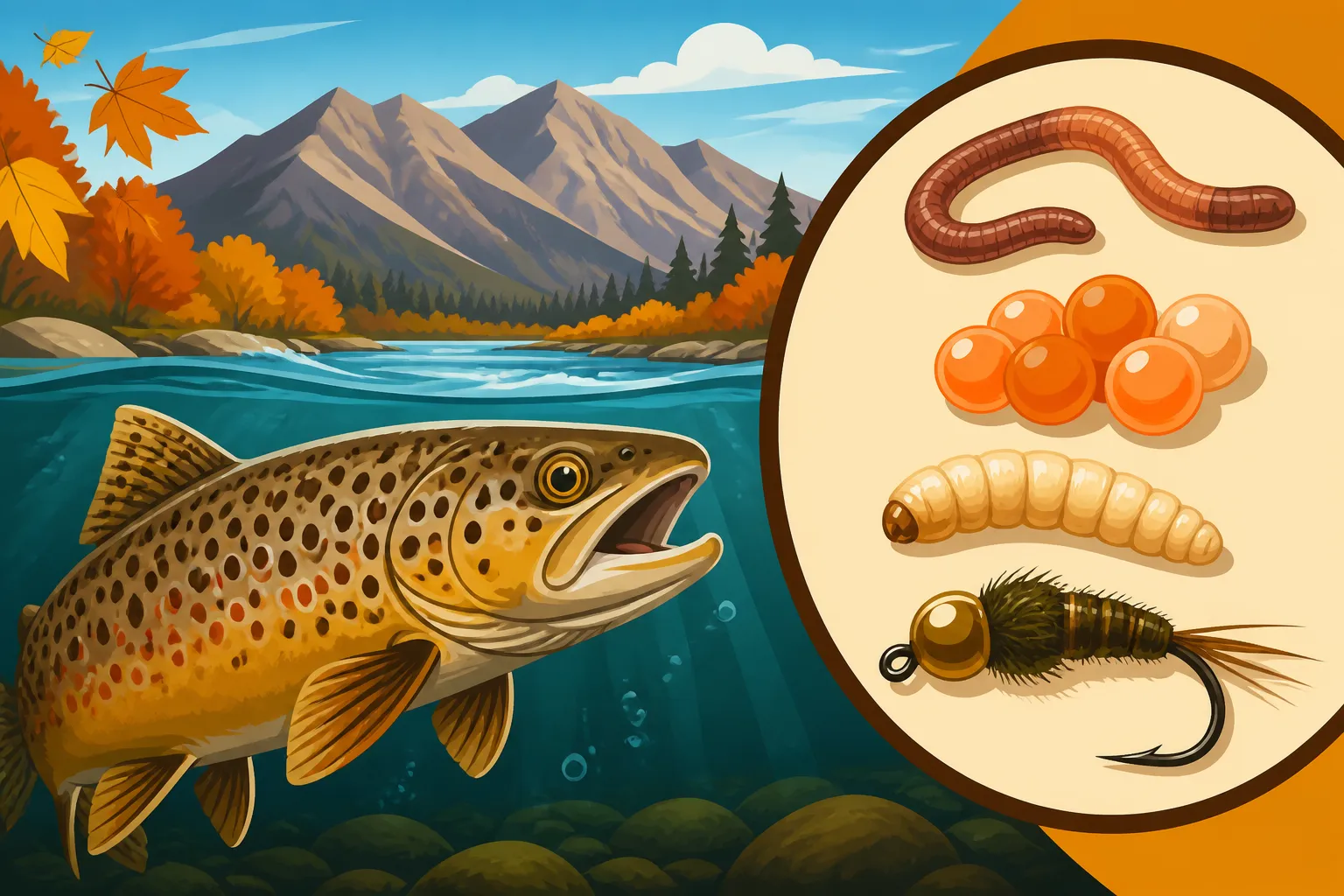
- Minnows and Small Baitfish: Live minnows are often considered the gold standard for large brown trout. They mimic the natural forage fish that browns aggressively hunt down to bulk up for spawning. A 3-4 inch minnow, hooked lightly through the lip or dorsal fin, presented with minimal weight, can be incredibly effective. Consider local bait restrictions – some waters in Wyoming may prohibit the use of live baitfish to prevent the spread of aquatic invasive species. If live bait is restricted, frozen or salted baitfish, or even realistic soft plastic imitations, can work well. Drifting them through deeper pools or along undercut banks where trophy browns like to ambush is a killer strategy. Many anglers find these effective when fishing the Yellowstone River Near Gardiner.
- Worms and Nightcrawlers: While perhaps more commonly associated with spring fishing, a juicy nightcrawler can still be a fantastic option in fall. The natural scent and squirming action can trigger a strike, especially if the water is slightly off-color or after a rain event. Browns won't pass up an easy meal, and a large nightcrawler fits that bill perfectly. Threading a full nightcrawler onto a hook, perhaps with a small piece of foam or an air injector to give it some buoyancy, can present a very enticing meal.
- Salmon Eggs and Spawn Sacks: If you're fishing rivers where salmon or other trout species are also spawning, their eggs are a natural food source for opportunistic brown trout. Commercial salmon eggs or homemade spawn sacks (using netting to bundle a cluster of trout or salmon eggs) can be incredibly effective. The scent and bright color can draw strikes from actively spawning or post-spawn browns that are still holding in the area. Remember to check local regulations on bait restrictions.
Artificial Lures: Aggression Triggers
When brown trout are aggressive, either pre-spawn or defensively during the spawn, artificial lures designed to provoke a reaction strike can be incredibly effective.
- Spinners and Spoons: Classic metal lures like spinners (e.g., Mepps, Rooster Tail, Panther Martin) and spoons (e.g., Kastmaster, Dardevle) are fantastic for covering water and eliciting an aggressive chase. The flash and vibration mimic fleeing baitfish. Opt for larger sizes (1/4 to 1/2 ounce) in patterns that imitate local forage, or go for bright, attention-grabbing colors like orange, chartreuse, or firetiger, especially in lower light or stained water. Cast these across currents and retrieve with varying speeds, adding pauses to trigger strikes. Many anglers find these productive when fishing the North Fork of the Shoshone River. You can often find a wide selection of these versatile lures on Amazon.
- Jerkbaits and Stickbaits: These lures are designed to imitate an injured baitfish, darting and twitching erratically with each retrieve. Brands like Rapala, Yo-Zuri, and Lucky Craft offer excellent options. Suspending jerkbaits are particularly effective in cold water, as they can be twitched and then paused, hanging tantalizingly in the strike zone. Browns often hit them on the pause. Focus on natural baitfish colors or bright, aggressive patterns. These are excellent for targeting larger, predatory browns holding in deeper pools or along current breaks.
- Soft Plastic Swimbaits and Grubs: Modern soft plastics, often rigged on a weighted jig head, offer incredible realism and versatility. Swimbaits with paddle tails create enticing thumping actions, while grubs and creature baits can imitate anything from crayfish to nymphs. Colors can range from natural browns and greens to vibrant white or chartreuse. Fish these with a slow, bottom-bouncing retrieve or by swimming them steadily through the water column. The scent-infused options available from brands like Berkley Gulp! can add an extra layer of attraction.
Fly Fishing in Fall: Matching the Hatch and More
For the fly angler, fall is a magical time, offering opportunities for both technical dry fly fishing and aggressive streamer presentations. The best time of year to fish the North Platte River often includes the fall months, specifically for fly anglers.
- Streamers: This is arguably the most effective fly fishing technique for fall brown trout. Large, aggressive patterns that imitate baitfish, sculpins, or even small leeches can provoke powerful strikes. Think Woolly Buggers, Sex Dungeons, Articulated Streamers, and Sculpzillas in sizes #2 to #8. Colors like olive, black, brown, white, and tan are excellent. Strip these flies aggressively through pools, along undercut banks, and across current seams. The idea is to make the fly look like a fleeing or injured meal that the brown trout can't resist chasing down. Learning how to fish streamers for trophy brown trout is a skill that truly shines in autumn.
- Nymphs: While brown trout might be focused on larger meals, they are still opportunistic. Traditional nymphing techniques remain highly effective, especially in early fall or during periods when browns aren't actively chasing streamers. Pat's Rubber Legs, Copper Johns, Prince Nymphs, and Pheasant Tails in larger sizes (#10-16) can imitate larger aquatic insects or even small leeches. Focus on drifting these deep through runs and riffles, often under an indicator. You can even run a smaller nymph as a dropper behind a large streamer.
- Dry Flies: Don't completely rule out dry fly fishing! Fall can still bring sporadic hatches of blue-winged olives (BWO's), midges, and even late-season caddis. On warmer, overcast days, or during consistent hatches, brown trout may rise to these smaller patterns. Keep an eye on the water for active feeding. Having a selection of these smaller dries (sizes #18-24) can save the day when larger presentations aren't getting attention. Knowing how to fish dry flies on slow-moving water is particularly important during these conditions.
Presentation is Everything: Techniques for Success
Having the best bait is only half the battle; knowing how to present it effectively is crucial. Fall brown trout can be incredibly discerning, even when they're aggressive. The subtle nuances of your retrieve, drift, and approach can make all the difference.
Drifting Natural Baits
When using live or natural baits like minnows, worms, or salmon eggs, the key is often to let the bait move as naturally as possible with the current. This is called a "dead drift" or "free drift."
- Weighting and Rigging: Use just enough weight (split shot or a small sliding sinker) to get your bait down to the fish's level without hindering its natural movement. For minnows, a single split shot a foot or two above the hook can be perfect. For worms or eggs, a small lead-free weight might be needed to get it rolling along the bottom. The goal is for the bait to tumble and drift as if it were unattached, rather than dragging unnaturally. This is particularly important when targeting brown trout in rivers and streams, such as the Grey Reef section of the North Platte River.
- Reading the Water: Identify the current seams, eddies, and deeper pockets where brown trout are likely to hold. Cast your bait upstream of these spots, allowing it to drift naturally into the strike zone. Keep your line relatively tight to feel subtle bites, but not so tight that it pulls the bait unnaturally. Watch your line for any hesitation, twitch, or sudden movement – these are often signs of a bite.
- Strategic Placement: Don't just cast anywhere. Focus on the edges of strong currents, behind large rocks, under undercut banks, and at the heads and tails of pools. These are prime ambush points where brown trout conserve energy while waiting for food to be delivered by the current. Remember that brown trout are incredibly sensitive to vibrations and shadows, so approach your chosen spot carefully and keep a low profile.
Casting and Retrieving Artificials
Artificial lures require an active presentation. You're not just letting the current do the work; you're imparting action to the lure to trigger a strike.
- Varying Your Retrieve: Don't fall into a monotonous retrieve pattern. Experiment with speed, pauses, and twitches. Sometimes a fast, erratic retrieve triggers a chase, while other times a slow, steady retrieve with occasional pauses is more effective, especially in colder water. For jerkbaits, a "twitch, twitch, pause" cadence is often deadly. For spinners and spoons, varying the retrieve speed and adding drops can mimic a struggling baitfish.
- Targeting Structure and Currents: Cast your lures to land precisely near structure – logs, boulders, weed beds, or rock walls. Retrieve them so they either skirt the edges of these structures or briefly bump into them. In rivers, cast across the current and retrieve, letting the current sweep the lure downstream while you slowly reel, maintaining tension. This allows the lure to swing through the strike zone in a natural, tempting arc.
- Fan Casting: To effectively cover a wider area, use a fan casting approach. Start by casting straight upstream, then gradually move your casts to the left and right, covering a broad fan-shaped area. This ensures you're presenting your lure to different fish holding in various positions within a pool or run. Pay attention to where strikes occur and concentrate your efforts there.
Stealth and Strategy in Clear Fall Waters
Fall waters in Wyoming can often be crystal clear, especially after runoff has subsided. This means brown trout have excellent visibility, making stealth more important than ever.
- Approach with Caution: Move slowly and deliberately along the bank. Avoid heavy footsteps or sudden movements that can send vibrations through the water. Keep a low profile, using natural cover like trees, bushes, or bank contours to break up your silhouette.
- Longer Leaders and Thinner Line: In clear water, fish can be line-shy. Consider using longer leaders (8-10 feet for fly fishing, or a fluorocarbon leader for spin fishing) and lighter test lines (4-6 lb mono or fluorocarbon for spin fishing) to make your presentation less visible. Fluorocarbon is an excellent choice as it has a refractive index close to water, making it virtually invisible underwater.
- Shadow Management: Be acutely aware of where your shadow falls on the water, especially on bright, sunny days. Your shadow passing over a fish can instantly spook it. Try to position yourself so your shadow falls behind you or parallel to the bank, away from your casting target. These small details can drastically improve your success rate on finicky fall brown trout.
Gear Essentials for Fall Brown Trout Fishing
Having the right equipment can make your fall brown trout pursuit more comfortable and effective. This isn't about buying the most expensive gear, but selecting tools that are well-suited for the conditions and the fish you're targeting. For a wider selection, many reliable options can be found on Amazon.
Rods, Reels, and Line Choices
Your primary setup needs to be balanced and responsive enough to handle both subtle bites and powerful runs from a large brown trout.
- Rods:
- Spin Fishing: A medium-light to medium power spinning rod, 6'6" to 7'6" in length, is ideal. This length provides good casting distance and control, while the medium-light action offers sensitivity for detecting light bites and enough backbone to fight larger fish. A fast action tip will help with quick hook sets.
- Fly Fishing: For general fall brown trout fishing, a 5-weight or 6-weight fly rod, 9 feet long, is a versatile choice. A 5-weight is excellent for nymphs and smaller streamers, while a 6-weight offers more power for casting larger streamers, fighting bigger fish, and handling windy conditions, common in Wyoming. For dedicated large streamer fishing, some anglers opt for a 7-weight rod. Knowing the best fly rod weight for Wyoming trout streams is essential for an enjoyable experience.
- Reels:
- Spin Fishing: A reliable spinning reel in the 2000-3000 size range, with a smooth drag system, is perfect. The drag is critical for preventing break-offs when a big brown makes a strong run.
- Fly Fishing: A matching reel with a smooth, adjustable disc drag system is key. You'll want a reel that can hold your fly line plus adequate backing (at least 100 yards) for those longer battles.
- Line:
- Spin Fishing: 4-8 lb test monofilament or fluorocarbon line. Monofilament offers good knot strength and shock absorption, while fluorocarbon is nearly invisible underwater and has less stretch, providing more sensitivity. A popular choice is to spool with braided line and then add a fluorocarbon leader for abrasion resistance and invisibility.
- Fly Fishing: A weight-forward floating fly line is standard for most dry fly and nymphing applications. For streamer fishing, a sink-tip or full sinking line can be highly effective for getting your flies down deep quickly.
Terminal Tackle and Accessories
These are the small but mighty components that connect you to the fish. Don't skimp on quality here!
- Hooks: Sharp, strong hooks are non-negotiable. For bait fishing, choose Aberdeen or Kahle hooks in sizes #6 to #2, appropriate for your bait size. For artificial lures, ensure your treble hooks are sharp and replace any dull or bent ones. Some waters, like certain stretches of the North Platte River, require Barbless Hook Requirements on the North Platte River to protect fish, so always check the regulations.
- Weights: A selection of lead-free split shot (removable styles are convenient) and small bullet weights will allow you to adjust your presentation depth.
- Swivels and Snaps: Small, high-quality barrel swivels can prevent line twist, especially when using spinners. Snaps allow for quick lure changes.
- Waders and Boots: Fall fishing can mean cold water and air temperatures. Breathable chest waders with sturdy wading boots (felt or rubber soles, depending on stream bed composition) are essential for comfort and safety, allowing you to access prime fishing spots. Consider Do You Need Waders to Fish Wyoming Rivers in Spring? for year-round comfort.
- Net: A good landing net with a rubberized mesh is crucial for safely landing and handling brown trout, especially if you plan to practice catch and release. The rubber mesh is gentler on the fish's slime coat and won't tangle hooks as easily.
- Pliers/Forceps: Essential for safely removing hooks from fish and for cutting line. Long-nosed pliers or hemostats are particularly useful.
- Layered Clothing: Wyoming fall weather can be unpredictable, with warm afternoons and freezing mornings. Dress in layers, including a moisture-wicking base layer, insulating mid-layers, and a waterproof/windproof outer shell. A warm hat and gloves are also highly recommended.
- Sun Protection: Even in fall, the Wyoming sun can be intense, especially at higher elevations. Don't forget sunscreen, a wide-brimmed hat, and polarized sunglasses to protect your eyes and help you spot fish or subsurface structure.
A well-organized tackle box or pack will keep your essentials readily accessible, allowing you to quickly adapt to changing conditions and fish preferences. Investing in quality gear for fall fishing will pay dividends in comfort and success.
| Bait Type | Pros | Cons | Ideal Scenario for Fall Brown Trout |
|---|---|---|---|
| Live Minnows | Extremely natural presentation; strong scent and movement. Appeals to large, predatory browns. | May be restricted in some waters; requires careful handling; can be difficult to keep alive. | Pre-spawn aggression in rivers/lakes; targeting trophy browns; moderate to stained water. |
| Nightcrawlers | Natural scent and action; readily available; easy to rig. | Can be picked apart by smaller fish; less targeted than minnows for specific large browns. | Early fall, after rain, slightly off-color water; general opportunistic feeding. |
| Salmon Eggs | Highly attractive during spawning season; natural food source. | May be restricted; can attract many small fish; less action than live bait. | Actively spawning areas; targeting post-spawn opportunistic feeders; clear water. |
| Spinners/Spoons | Excellent for covering water; highly visible flash and vibration; triggers reaction strikes. | Can be less effective on wary fish in very clear water; can snag easily in heavy cover. | Aggressive pre-spawn browns; covering large sections of river/lake; moderate to fast current. |
| Jerkbaits | Mimics injured baitfish; allows for suspended presentation; triggers territorial strikes. | Requires active retrieve to impart action; can be expensive; can snag. | Wary fish; cold water; targeting specific structure in deeper pools; clear to slightly stained water. |
| Streamers | Highly effective fly pattern for aggressive browns; versatile in size and color. | Requires fly casting skills; can be challenging in windy conditions or heavy cover. | Aggressive pre-spawn and spawning browns; targeting structure; low light conditions. |
| Nymphs | Mimics natural aquatic insects; consistent year-round producer. | Can be subtle takes; requires good drift and depth control. | Any time browns are feeding subsurface; technical fishing; clear water. |
Conclusion
Tackling fall brown trout in Wyoming is an experience unlike any other. It’s a game of wits, patience, and adapting your strategy to the fish’s powerful instinct to spawn and survive. By understanding their seasonal shifts—from aggressive pre-spawn gorging to territorial spawning behavior—you can choose the most effective baits, whether they’re natural offerings like plump nightcrawlers and lively minnows, or artificial triggers like flashy spinners and seductive jerkbaits. For the fly angler, mastering streamers during the fall brown trout run is a truly rewarding endeavor. Remember, it's not just about the bait, but the presentation, stealth, and gear that bring it all together for a truly memorable autumn day on the water.
Disclaimer
Fishing conditions, regulations, and access can change rapidly in Wyoming. Always consult the most current Wyoming Game and Fish Department regulations before heading out. This guide is for informational purposes only and does not supersede official government regulations.