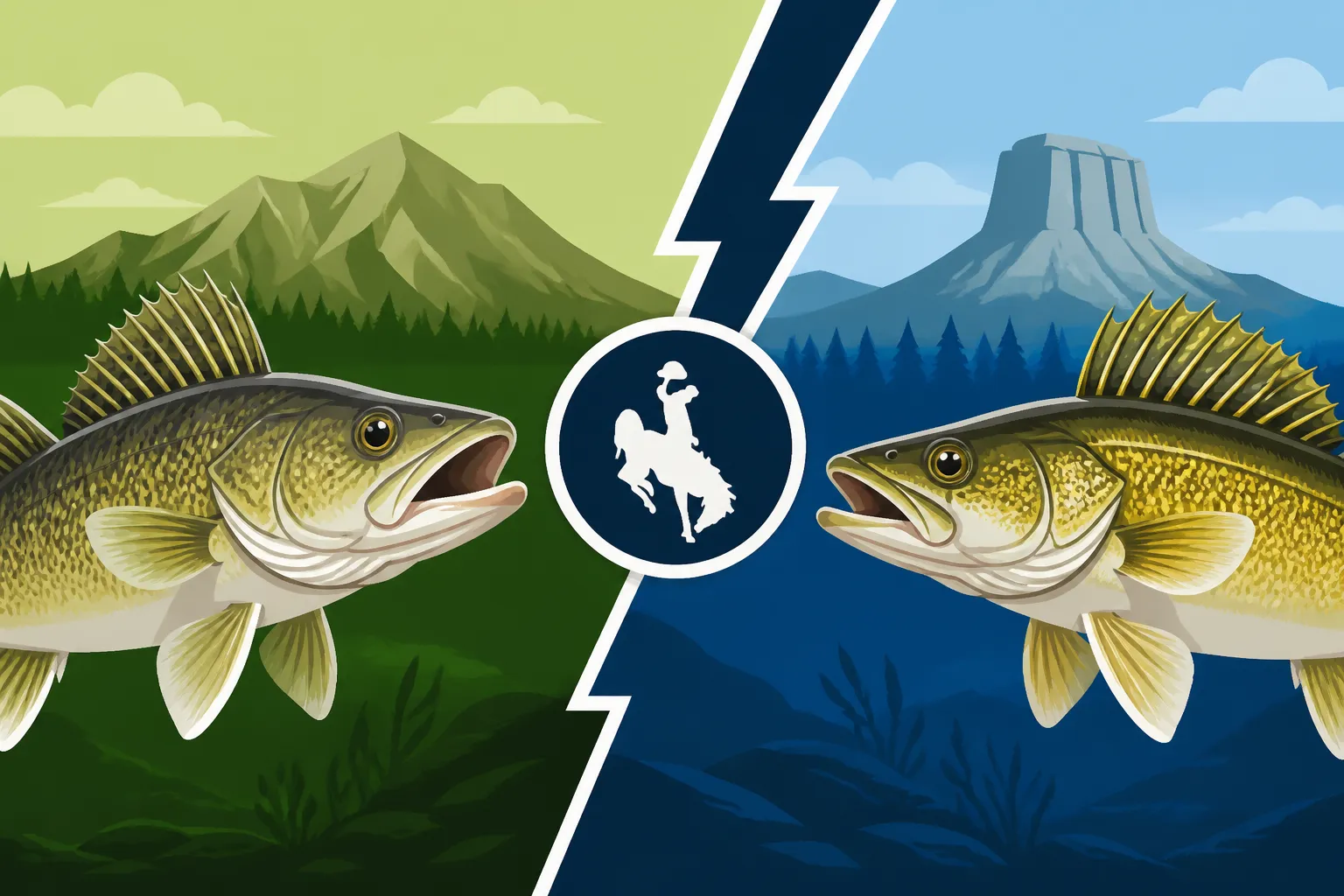
Sauger vs Walleye Identification Guide
There's nothing quite as frustrating as reeling in a beautiful fish in Wyoming, only to pause, scratching your head, wondering if it's a walleye or a sauger. These two popular game fish, both members of the perch family, can look incredibly similar, especially to the untrained eye. However, confidently telling them apart isn't just about boosting your angling expertise; it's often crucial for staying compliant with Wyoming's fishing regulations. This comprehensive guide will walk you through the distinct characteristics of sauger and walleye, helping you confidently identify your catch every time you're out on the water.
Why Distinguishing Sauger and Walleye Matters in Wyoming
Anglers often assume that if it looks like a walleye, it's a walleye, and that's usually good enough. But in Wyoming, where conservation and specific species management are taken very seriously, this casual approach can sometimes lead to unintended issues. The Wyoming Game and Fish Department meticulously manages fish populations, and this often means different regulations for closely related species.
Regulation Differences and Bag Limits
Imagine you're out on a beautiful reservoir, and you've had an incredible day, catching several fish that you think are walleye. You've kept a few, adhering to what you believe is the walleye bag limit for that particular water. However, if some of those fish were actually sauger, and the sauger limit is different or perhaps even entirely closed in that area, you could inadvertently be in violation. It's not about malice; it's about a lack of precise identification, which can still carry consequences. How Bag and Possession Limits Work in Wyoming explains the complexities.
For instance, certain waters might have a more restrictive limit on sauger due to smaller populations or specific management goals. Conversely, in some systems, sauger might be more prevalent and have a slightly more generous limit. Without knowing which fish you truly have in your livewell, you're essentially fishing blind when it comes to legal harvest. This is why a clear understanding of Wyoming Fishing Regulations Every Angler Should Know is paramount, and it starts with accurate fish identification.
Habitat and Behavior Clues
Beyond the legalities, knowing the difference between sauger and walleye offers valuable insights into their behavior and preferred habitats. These insights can make you a more effective angler. While they are both predatory fish, their ecological niches often have subtle differences.
Walleye tend to prefer clearer, deeper waters, often associated with rockier structures, submerged timber, or distinct drop-offs in large reservoirs and lakes. They are known for their light-sensitive eyes, which is why they are often most active during low-light conditions like dawn, dusk, or on cloudy days, or found in deeper water during bright daylight.
Sauger, on the other hand, frequently inhabit murkier, turbid waters, often in river systems or the upper, muddier arms of reservoirs. They seem to be more tolerant of turbid conditions, perhaps due to their somewhat smaller, less light-sensitive eyes compared to walleye. This preference for cloudier water means they might be active in shallower areas or throughout the day in places where walleye would typically retreat to deeper cover. If you're consistently catching fish in a muddy river bend, you might have a sauger on your line, even before you examine its fins. Understanding these habitat preferences helps you choose your fishing spots and techniques more strategically.
Key Physical Characteristics: Spotting the Differences Up Close
When you pull a fish from the water, it's those immediate visual cues that will help you make a positive identification. While they share the torpedo-shaped body and prominent dorsal fins, a close look reveals crucial distinctions.
Dorsal Fin Markings: The Easiest Tell-Tale Sign
This is, hands down, the most reliable and immediate way to differentiate between a sauger and a walleye. Focus on the spiny first dorsal fin—the one closer to the head.
- Walleye: A true walleye will have a distinct, opaque, dark blotch at the very rear base of its first dorsal fin. Think of it like a thumbprint. The rest of this fin is typically clear or lightly speckled. This blotch is almost always present and is a fantastic indicator.
- Sauger: Sauger, by contrast, lack this single dark blotch. Instead, their entire first dorsal fin is usually covered in several distinct, round, dark spots, often arranged in rows or irregular patterns across the fin membrane. These spots make the fin look speckled or banded. There won't be one large, solid blotch at the base.
Imagine you're holding a fish. Tilt its dorsal fin up and spread it slightly. If you see a prominent, singular dark area at the very back, it's likely a walleye. If the fin is covered in smaller, scattered dark spots, you've probably got a sauger. It's a subtle difference, but once you've seen it a few times, it becomes second nature. Many anglers keep a small, waterproof fish identification card in their tackle box, which can be found on Amazon, to quickly reference these kinds of details.
Body Shape and Coloration
While the dorsal fin is the primary identifier, secondary characteristics in body shape and coloration can also provide supporting evidence, especially if you're still unsure or the fin markings are ambiguous.
Walleye:
Walleye typically have a more uniform, often olive green to golden-brown body color on their backs, fading to a lighter, creamy white belly. They usually have faint, saddle-like bars or mottling along their sides, but these are generally less distinct than a sauger's. Their bodies tend to be a bit more robust and deeper-bodied than sauger of comparable length. The lower lobe of their caudal (tail) fin often has a milky-white or opaque tip, though this can sometimes be faint.
Sauger:
Sauger tend to have a more slender, elongated body profile, giving them a slightly "snakier" appearance than walleye. Their coloration is often a darker, brassy olive-brown or gray, and they exhibit much more pronounced, distinct dark blotches or saddle markings along their sides and back. These markings are typically very clear and almost leopard-like. Unlike walleye, their caudal fin will not have a white tip on the lower lobe; it will be spotted or banded like their dorsal fin. The lateral line, a sensory organ running along the side of the fish, is also usually quite distinct on a sauger.
Keep in mind that coloration can vary widely based on the specific water body, diet, and even the clarity of the water. A walleye from a clear, rocky lake might appear lighter than one from a stained river, for example. However, the general patterns hold true.
Caudal Fin and Pyloric Caeca
For those who really want to get into the weeds, there are two more identifying features, though one is far more practical for the average angler.
Caudal Fin (Tail Fin): As mentioned, the lower lobe of a walleye's tail fin often has a distinct white or milky tip. This is a fairly consistent feature and can be a good secondary confirmation if you're debating between the two species. Sauger lack this white tip; their tail fins are usually mottled or spotted, reflecting the general pattern of their dorsal fins.
Pyloric Caeca: This is where things get a bit more technical and definitely not something you'd use for field identification if you intend to release the fish. Pyloric caeca are finger-like projections near the stomach of the fish. Walleye have three long pyloric caeca, usually longer than two-thirds the length of the stomach. Sauger, on the other hand, have 7 to 10 shorter caeca, typically less than one-half the length of the stomach. This requires dissection and is really only for scientific study or for positive identification of filleted fish, not for a quick check on the water. Stick to the fins and body markings for your angling adventures!
Geographical Distribution and Habitat in Wyoming
Understanding where these fish typically live in Wyoming can give you a strong hint about what you've just caught, even before you get a close look. While there's some overlap, their preferences often lead them to different corners of our state's diverse waters.
Where Walleye Thrive in Wyoming
Walleye are one of Wyoming's most popular game fish, and for good reason—they're delicious and challenging to catch. They thrive in large, open reservoirs and lakes, particularly those with good forage bases and a mix of rocky and sandy bottoms. These are often the places where you'll find serious walleye anglers targeting them.
You'll find robust walleye populations in well-known Wyoming waters such as:
- Boysen Reservoir: Often considered a walleye hotspot, especially in its deeper, clearer sections. Boysen Reservoir's Best Walleye Water is a prime example.
- Glendo Reservoir: Another excellent walleye fishery known for its consistent production.
- Keyhole Reservoir: In northeastern Wyoming, it provides good walleye opportunities.
- Seminoe Reservoir: While known for its trout, Seminoe also holds a strong walleye population.
- Alcova Reservoir: Often produces quality walleye, especially around its various structures.
These reservoirs offer the sprawling, somewhat turbid, but generally expansive environments that walleye prefer, allowing them to grow to impressive sizes. They appreciate areas with submerged timber, old creek channels, and significant depth changes where they can ambush prey.
Where Sauger Are Found in Wyoming
Sauger, while also popular, are generally less widespread and tend to favor different types of environments compared to their walleye cousins. They are more commonly found in river systems or the riverine sections of reservoirs, particularly those with a higher degree of natural turbidity (cloudy water from suspended sediment).
Notable sauger strongholds in Wyoming include:
- The North Platte River: Especially in sections below major dams like Gray Reef and the Miracle Mile, where the water might be clearer, but sauger still coexist. However, Are Sauger Common in the North Platte River? often highlights that while present, they are less dominant than the prolific trout. They are more frequently found in the slower, deeper holes and runs.
- The Big Horn River: Downstream from Boysen Reservoir, this river system provides ideal sauger habitat with its slower flows and often stained water.
- The Wind River: Parts of the Wind River and its associated reservoirs can hold sauger, particularly where river conditions persist.
- Reservoir Embayments: In some larger walleye reservoirs, sauger might congregate in the shallower, muddier river-fed arms or embayments, rather than the main lake body.
Sauger seem to tolerate, and even prefer, environments that might be a bit too silty or turbid for walleye, allowing them to carve out their own niche. If you're fishing a relatively murky river in Wyoming, your chances of encountering a sauger increase significantly.
Overlapping Habitats and Hybrid "Saugeye"
To add another layer of complexity to identification, walleye and sauger can and do coexist in some of Wyoming's waters. When this happens, there's always the possibility of hybridization, resulting in what anglers commonly call a "saugeye."
Saugeye are a cross between a female walleye and a male sauger, and they often exhibit a mix of characteristics from both parent species. This can make field identification even more challenging, as they might have faint dorsal fin spots and a hint of a dark blotch, or a body shape that's somewhere in between. How to Identify a Saugeye goes into much greater detail on these hybrids.
These hybrids can sometimes be stocked by state fisheries agencies because they often grow faster and are more tolerant of a wider range of environmental conditions than pure walleye, while still providing excellent angling opportunities. When you catch a fish that just doesn't quite fit the typical description of either a walleye or a sauger, especially in waters where both are present, you might be looking at a saugeye. In such cases, it's always best to consult the local regulations or err on the side of caution regarding bag limits, as rules for hybrids can vary.
Practical Tips for Anglers in the Field
Being able to quickly and accurately identify your catch on the water is a skill that comes with practice, but some simple strategies can make it much easier. You don't want to be guessing when a game warden pulls up.
Quick Check Guide on the Water
When you land a fish that looks like either a walleye or a sauger, follow this quick mental checklist:
- Observe the Dorsal Fin First: This is your primary indicator. Gently spread the spiny dorsal fin. Are there clear, distinct spots all over it, like freckles? That's a strong sign of a sauger. Or is there one single, prominent dark blotch at the very back of the fin, with the rest being relatively clear? That points to a walleye.
- Check the Body Pattern: Look at the sides of the fish. Are there several very distinct, dark saddle-like blotches running down its sides? More sauger-like. If the body is more uniformly colored with fainter, less distinct bars, it's probably a walleye.
- Examine the Tail Fin: Does the very bottom tip of the tail fin have a milky-white or opaque patch? That's a classic walleye feature. If the tail is mottled or spotted without that clear white tip, it leans towards a sauger.
- Consider the Habitat: Where did you catch it? Was it a clear, deep main lake body? More likely walleye. Was it a turbid, flowing river section or a muddy bay? Increased chance of sauger. This is a supportive clue, not a definitive one.
Always handle your fish with care, especially if you plan to release it. Wet your hands before touching the fish, support its body, and minimize its time out of the water. This also allows for a good, calm identification.
Essential Gear for Identification
Having the right tools on hand can make a big difference, especially when you're dealing with subtle distinctions.
- Waterproof Fish Identification Chart: These compact charts often have clear illustrations or photos highlighting the key differences between common species. They're lightweight, fit in a tackle box, and can be easily found for purchase on Amazon or at local sporting goods stores. Having one specifically for Wyoming fish species is a major asset.
- Camera Phone: A quick, clear photo of the fish, especially its dorsal fin, can be invaluable. If you're truly stumped, you can refer to the photo later, or even send it to a more experienced angler or the Wyoming Game and Fish Department for an opinion (though they often prefer to inspect in person for enforcement purposes). A reliable measuring tape, easily found on Amazon, is also crucial for verifying legal lengths, regardless of species.
- Measuring Tape: Beyond identification, accurate measurement is critical for complying with size limits. Always carry a flexible measuring tape.
- Gloves (optional): Some anglers prefer to use lightweight fishing gloves to protect their hands from sharp fins and to minimize human oils transferring to the fish, which can protect its slime coat. This also helps with a firmer grip for a clearer look.
When in Doubt, Release or Consult
The golden rule of fishing, especially when regulations are involved, is "when in doubt, let it out." If, after all your checks, you're still not 100% certain whether your fish is a walleye, sauger, or saugeye, the safest course of action is to carefully release it back into the water. This ensures you avoid any potential violations related to bag limits, size restrictions, or closed seasons. Fines and Penalties for Common Fishing Violations are no fun for anyone.
Alternatively, if you're with an experienced local guide or a fellow angler who is highly knowledgeable about Wyoming's fish species, don't hesitate to ask for their opinion. Many bait shops and local tackle stores also have staff who are well-versed in local fish identification and regulations. Always consult the official Wyoming Game and Fish Department regulations booklet, which you can typically find online or at license vendors. Reading the Wyoming Fishing Regulations Booklet is a skill every angler should master.
Sauger vs. Walleye Comparison Chart
To help visualize the key differences, here's a quick comparison table:
| Feature | Walleye (Sander vitreus) | Sauger (Sander canadensis) |
|---|---|---|
| Dorsal Fin | Single, prominent dark blotch at the rear base. Rest clear/lightly speckled. | Covered in several distinct dark spots, often in rows or bands. No single blotch. |
| Body Pattern | More uniform olive/golden-brown, faint saddle bars. | Darker brassy/gray-brown, distinct dark blotches/saddle markings. |
| Body Shape | Generally more robust, deeper-bodied. | More slender, elongated, "snakier" appearance. |
| Caudal Fin | Lower lobe often has a milky-white or opaque tip. | No white tip. Spotted/mottled like dorsal fin. |
| Cheek Scales | Large cheek scales, few or no small scales. | More scales on cheeks, often small and numerous. |
| Habitat Pref. | Clearer, deeper lakes/reservoirs, rocky structure. | Murkier, turbid river systems and riverine sections of reservoirs. |
| Eyes | Larger, more opaque (light-sensitive). | Slightly smaller, less opaque. |
| Average Size | Can grow larger, especially in reservoirs. | Generally smaller than walleye. |
This table should serve as a handy reference point when you're trying to quickly assess your catch. Remember, practice and observation are key to becoming proficient in identifying these magnificent fish. Happy fishing out there!
Disclaimer
This article is for general informational purposes only and does not constitute professional advice. Laws, prices and regulations vary by location and change over time. Consult a qualified professional for guidance on your specific situation.