How Wyoming’s Fishing Regulations Differ From Colorado’s
It's a common misconception among anglers that if you understand the fishing regulations in one Rocky Mountain state, you're set for its neighbor. But believe me, trying to apply Colorado's fishing rules to Wyoming's waters, or vice-versa, is a recipe for frustration and potential penalties. Each state manages its unique fisheries with distinct philosophies, leading to significant differences in everything from licensing to bag limits and tackle restrictions. This comprehensive guide will illuminate the crucial distinctions between Wyoming and Colorado fishing regulations, ensuring you're well-prepared for a legal and enjoyable angling experience, no matter which side of the state line you cast your line.
The Philosophical Divide: Conservation Goals and Management
At first glance, it might seem like all states have the same goal: protecting fish. And while that's fundamentally true, the way Wyoming and Colorado pursue that goal, and the specific challenges they face, lead to vastly different regulatory frameworks. Understanding this underlying philosophical difference is crucial to appreciating why the rulebooks aren't interchangeable. It's about more than just fish; it's about landscape, population, and historical management approaches.
Different Priorities, Different Rules
Wyoming, often celebrated for its expansive, wild landscapes and lower human population density, tends to prioritize the preservation of wild and native trout populations. The Wyoming Game and Fish Department (WGFD) often manages its diverse fisheries with a strong focus on maintaining pristine ecosystems and providing unparalleled wilderness angling experiences. For instance, many of its high-alpine lakes and remote river stretches are managed for native cutthroat trout, with regulations designed to protect their genetic integrity and natural reproduction cycles. This often translates into stricter rules regarding bait, barbless hooks, and catch-and-release practices in sensitive areas. The emphasis is frequently on quality over quantity, especially for wild trout.
Colorado, conversely, grapples with a much higher population density and immense recreational pressure on its waters. Colorado Parks and Wildlife (CPW) must balance rigorous conservation efforts for native species with providing diverse and accessible angling opportunities for a far larger number of residents and tourists. This often results in a more varied approach: you'll find numerous "put-and-take" fisheries, where stocked rainbow trout are regularly introduced to meet demand, existing alongside meticulously managed wild trout waters. Colorado's regulations can appear more complex and localized, precisely because they're designed to cater to a wider spectrum of angling desires while simultaneously protecting vulnerable ecosystems. The sheer volume of anglers means that adherence to even seemingly minor rules is heavily enforced to prevent overharvesting or habitat degradation.
Public Access and Land Management
The way land is owned and managed for public access also fundamentally shapes fishing regulations and angler experience in both states. Wyoming is renowned for its vast stretches of public land, particularly Bureau of Land Management (BLM) and National Forest lands. This widespread public access often simplifies reaching remote fishing spots. While specific waters will always have their unique nuances, the abundance of public domain allows the WGFD to implement broader regulations across wider geographic areas, fostering a sense of wild, open-country fishing. The state actively works with federal agencies to ensure these expansive public lands offer ample angling opportunities.
Colorado also features significant public lands, especially in its mountainous regions, but with more urban centers and private properties interspersed, accessing rivers and lakes can sometimes be more intricate. Anglers must be acutely aware of rights-of-way, stream access laws, and private land boundaries, as these can drastically impact where and how they can legally fish. These access considerations influence not only where specific regulations are applied but also how they're enforced, sometimes even dictating whether wading or floating is permitted in certain river sections. For example, a river flowing through private land might limit access to the streambed only, while public land offers full bank access. It's always a good practice to consult detailed maps and official access points before embarking on a fishing trip in either state.
Key Regulatory Differences: Licenses, Stamps, and Species Specifics
When planning a fishing trip across state lines, the first, and arguably most important, difference you'll encounter is in the basic requirements for legal angling. This isn't just about buying a license; it's about understanding which license, what additional stamps might be necessary, and how long they're valid. Overlooking these fundamental details can quickly turn a potential trophy catch into an unwelcome citation.
Licensing and Conservation Stamps
Let's begin with the legal framework for casting a line. In Wyoming, if you are 14 years or older, you must possess a valid fishing license. For nonresidents, options include an annual license, a daily license, or a popular five-consecutive-day license. However, a critical difference in Wyoming is the requirement for a separate Wyoming Conservation Stamp. This stamp, vital for funding conservation efforts, must be purchased in addition to most adult fishing licenses. Exceptions typically apply to anglers under 14, those holding certain daily licenses, or when fishing on specific private waters. This additional stamp is a key detail many visitors accidentally overlook. You can dive deeper into these requirements in articles like Wyoming Resident vs Nonresident License Rules.
Colorado operates with a similar, yet distinct, system. Anglers between the ages of 18 and 64 are generally required to purchase an annual Habitat Stamp in conjunction with their fishing license. This stamp, akin to Wyoming's Conservation Stamp, supports vital wildlife habitat and conservation projects across the state. The main procedural difference is that Colorado's Habitat Stamp is often automatically integrated into the online purchase process or added when you buy your first license for the year. Colorado also offers annual, daily, and five-day licenses, with various price tiers for residents and nonresidents. For younger anglers, Colorado requires anyone 16 years or older to have a license. Both states provide convenient online purchasing through their respective state agency websites (WGFD and CPW), and licenses are also available at authorized vendors, including many sporting goods stores, outdoor outfitters, and even larger retailers that stock outdoor gear you might find on Amazon.
Bag and Possession Limits
This is where regulations can become particularly intricate, as limits frequently vary not just between states, but also between specific waters within each state. This demands careful attention to detail for every angling destination.
In Wyoming, while there is a general statewide daily limit for trout, it’s far more common to encounter special restrictions on individual waters. For example, some blue-ribbon trout streams might enforce a "one over 16 inches" rule, meaning you can only keep one trout per day that exceeds 16 inches, with all others released. Other stretches might be designated as catch-and-release only. Conversely, certain reservoirs might have higher daily limits, sometimes even encouraging the harvest of specific species (like lake trout or burbot) to manage the fishery. It is absolutely essential to consult the current Wyoming Fishing Regulations Booklet for the exact body of water you intend to fish. Additionally, you’ll need to grasp the difference between daily bag limits and Possession Limits vs Daily Limits in Wyoming, especially if your trip spans multiple days.
Colorado's bag and possession limits are equally, if not more, complex, owing to its vast array of diverse waters and the aforementioned angling pressure. While a general statewide trout limit exists, countless rivers, lakes, and reservoirs are governed by highly specific regulations. You'll frequently encounter "Gold Medal Waters" that often mandate catch-and-release or strict slot limits (e.g., all fish between 12-16 inches must be released). Colorado also features extensive warmwater fisheries (for species like bass, walleye, and northern pike) with their own distinct limits, which might be more liberal than trout limits, often as part of a management strategy for invasive or overpopulated species. For instance, specific waters might allow for generous walleye harvests to protect native fish populations, whereas a nearby trophy trout stream demands stringent catch-and-release. Always, without exception, consult the official CPW fishing regulations brochure, readily available online and at most tackle shops and sporting goods retailers.
Tackle and Bait Restrictions
The type of gear you can use and what you can affix to your hook are significant areas of divergence between the two states, often reflecting their different management philosophies.
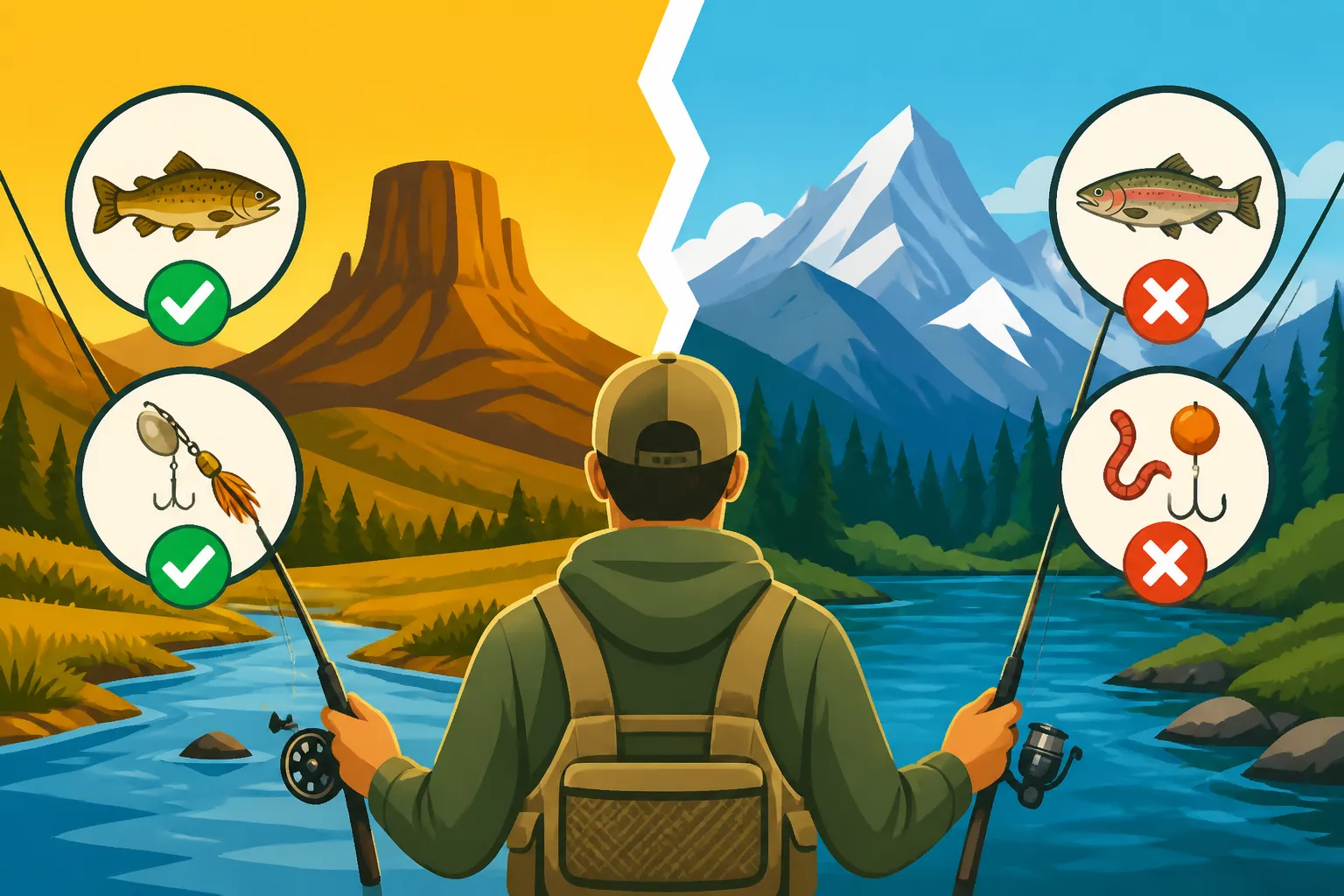
Wyoming tends to be more restrictive in specific areas, particularly on its world-renowned trout streams. Many blue-ribbon sections will explicitly require the use of artificial flies or lures only, often coupled with barbless hooks. The famous North Platte River, for example, has designated stretches where Barbless Hook Requirements on the North Platte River are rigorously enforced to minimize harm to wild trout. Live bait, especially live minnows, is highly regulated and frequently prohibited in many trout waters to prevent the introduction and spread of aquatic invasive species and diseases. It’s common to find areas where only artificial flies and single-point hooks are permitted.
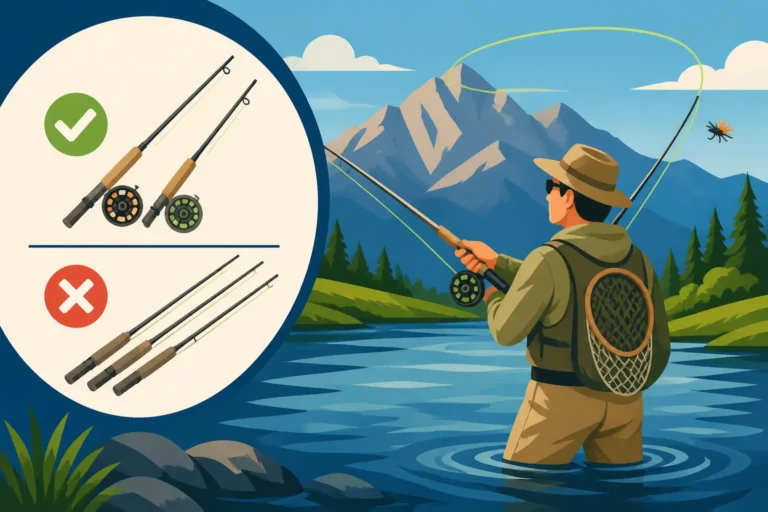
Colorado also has its share of artificial-only and barbless hook regulations, especially on its numerous Gold Medal Waters and sensitive native trout streams. However, live bait is generally more widely permitted in Colorado, particularly in warmwater fisheries and many general regulation waters, though specific restrictions always apply to prevent ecological harm. For instance, using live minnows might be permissible in certain large lakes for walleye, but strictly forbidden in a sensitive nearby trout stream. The use of multiple rods presents another key difference: in Wyoming, you typically need to purchase a separate "Two-Pole Permit" to fish with more than one rod, and even then, there's usually a cap on the total number of rods (often two). Conversely, Colorado generally allows anglers to use up to three lines without an additional permit, although, as always, water-specific regulations can override this. For clarity on multi-rod use, you can easily refer to guides such as Two-Pole and Multiple-Rod Rules in Wyoming.
Navigating Specific Waterbody Rules and Enforcement
Understanding the general statewide rules is a good start, but both Wyoming and Colorado offer an incredible diversity of fishing experiences—from remote high mountain lakes to expansive reservoirs and world-class river systems. This diversity inevitably leads to hyper-specific regulations for individual bodies of water, which can be challenging to navigate if you're not thoroughly prepared.
Water-Specific Regulations
In Wyoming, many of its most famous fishing destinations—like the North Platte River, the Snake River, or Flaming Gorge Reservoir—come with their own distinct sets of rules. These localized regulations are often implemented to protect unique fish populations (such as the Snake River Fine-Spotted Cutthroat Trout) or to manage particular angling opportunities. For instance, while much of the state might allow certain types of bait, a specific stretch of the Snake River could be designated "fly-fishing only," or a particular lake might have unique slot limits for lake trout. You might discover that New Snake River Trout Limits Near Jackson Lake Dam are different from regulations just a few miles downstream. These precise rules are usually highlighted within the annual regulation booklet but are most reliably found on the WGFD website, which serves as the most up-to-date source for Where to Find Current Wyoming Fishing Regulations.
Colorado takes this concept of water-specific regulations to an even more granular level. With its extensive network of Gold Medal Waters, Wild Trout Waters, and community urban fishing ponds, the regulations can be incredibly detailed. It's not uncommon for a single river to have one set of rules above a certain bridge and an entirely different set below it. Reservoirs frequently have special limits for species like walleye, pike, or bass, all designed to achieve specific fishery management goals. For instance, a Gold Medal stretch of the Arkansas River might be strictly catch-and-release with artificial flies and lures only, while a nearby community pond might permit bait and have generous limits for stocked trout. This means that simply knowing you're fishing in Colorado isn't sufficient; you must know the specific regulations for the exact stretch of river or lake you plan to fish. This level of detail makes it absolutely critical to obtain a copy of the Colorado Fishing Regulations brochure or to diligently use the CPW's comprehensive online resources before every trip.
Enforcement and Penalties
Neither state takes fishing violations lightly. Fishing without a proper license, exceeding bag limits, or using prohibited tackle can lead to significant fines, court appearances, and even the suspension of fishing privileges. In Wyoming, a violation can result in substantial Fines and Penalties for Common Fishing Violations, sometimes including restitution fees for any fish illegally taken. Game wardens in both states are highly dedicated and visible, committed to protecting their valuable natural resources, so an excuse of "I didn't know" typically won't waive the penalties. For instance, possessing an undersized or oversized trout contrary to regulations is a common violation that carries a hefty fine.
Colorado's enforcement is similarly stringent. Given the state's higher population density and the resulting pressure on its fisheries, CPW officers are diligent in checking licenses, limits, and tackle. Penalties can include fines, mandatory court appearances, and the potential suspension of hunting and fishing privileges, not just in Colorado but, through interstate compacts, in other states as well. Both states want you to enjoy their incredible outdoor resources, but they demand responsible and compliant behavior in return. It’s always better to err on the side of caution and ensure you’ve meticulously checked all the applicable rules. For example, before even considering transporting your catch, you should be fully aware of state-specific guidelines like Transporting Your Catch Across State Lines Legally.
Staying Informed
The most effective way to avoid any unwelcome surprises or penalties is to stay thoroughly informed. Always download or pick up the latest regulation booklets from both the Wyoming Game and Fish Department (WGFD) and Colorado Parks and Wildlife (CPW). These are updated annually, and sometimes even have in-season emergency closures or regulation changes that are primarily posted online. The official websites and mobile applications from these agencies are invaluable tools. Many experienced anglers go a step further, carrying a small, waterproof printout of the specific rules for their target water, or saving a PDF version to their smartphone. Never rely on hearsay or outdated information, as regulations can and do change. Even browsing fishing guides on Amazon or similar platforms might offer general insights, but they are never a substitute for the official, current state regulations.
Here's a quick comparison of some general regulations between the two states:
| Feature | Wyoming (General Regulations) | Colorado (General Regulations) |
|---|---|---|
| Fishing License Age | 14 years and older | 16 years and older |
| Conservation/Habitat Stamp | Wyoming Conservation Stamp required for most licenses (separate purchase) | Colorado Habitat Stamp required (often integrated into first license purchase) |
| Daily Trout Limit (General) | Varies widely by water, often 3-6 total (check specific waters) | Varies widely by water, often 4 total (check specific waters) |
| Multiple Rods | Requires "Two-Pole Permit" for more than one rod (max typically 2) | Up to 3 lines generally allowed without extra permit (check specific waters) |
| Live Minnows as Bait | Highly restricted, often prohibited in trout waters | More widely permitted in warmwater and some general waters, but restrictions apply |
| Barbless Hooks | Required on many blue-ribbon trout streams and special waters | Required on many Gold Medal/Wild Trout waters |
| Annual Regulations Update | Annually, typically March 1st effective date | Annually, typically April 1st effective date |
| Online Purchase | Yes (WGFD website) | Yes (CPW website) |
| Physical License Required | Yes, or digital version on mobile device | Yes, or digital version on mobile device |
Remember, this table provides a general overview. The true complexities and specific requirements lie within the detailed water-specific regulations published by each state's wildlife agency. Your diligence in checking these specifics will make all the difference for a successful and legal fishing trip.
Disclaimer
Please note that fishing regulations are subject to change. Always consult the official Wyoming Game and Fish Department (WGFD) and Colorado Parks and Wildlife (CPW) websites or current regulation booklets for the most up-to-date and specific information before planning your fishing trip. This guide is for informational purposes only and should not be considered a substitute for official sources.