Best Trolling Speed for Kokanee Salmon
One of the biggest head-scratchers for any angler chasing those elusive Kokanee Salmon in Wyoming is figuring out just how fast to troll. It can feel like you're playing a guessing game, constantly adjusting and wondering if you're hitting that perfect sweet spot where they just can't resist. This guide is here to take the mystery out of finding the best trolling speed for Kokanee, helping you put more of these vibrant silver bullets in your cooler.
Understanding Kokanee Salmon Behavior and Trolling Speed
Kokanee Salmon are truly unique fish, especially when it comes to how they feed and react to your presentation. They aren't aggressive predators like a huge lake trout or a brown trout. Instead, they're typically filter feeders, relying on zooplankton as their primary food source. This fundamental aspect of their diet dictates why trolling speed is absolutely critical for success.
Why Speed Matters for Kokanee
Think about it: if Kokanee are eating tiny, almost microscopic organisms, they're not exactly chasing down huge, fast-moving baitfish. Your trolling speed needs to mimic something that looks natural or, at the very least, enticing without being overtly threatening or too fast to catch. When you hit the right speed, your lures come alive in a way that triggers their curiosity or even their predatory instincts, especially for the larger, more mature Kokanee.
Too slow, and your lure might just sit there, looking lifeless and uninteresting. Too fast, and it could appear unnatural, spinning wildly or zooming past them before they even have a chance to react. The goal is to present your offering in a way that suggests an easy meal, a shimmering, fluttering anomaly, or a school of something interesting that they feel compelled to investigate. Getting the speed just right makes your dodgers flash and your hoochies dance in that irresistible, subtle manner that Kokanee can't ignore.
Factors Influencing Optimal Trolling Speed
While there are general guidelines, a rigid "one-speed-fits-all" approach simply doesn't work for Kokanee. Their behavior is incredibly sensitive to a host of environmental factors. For instance, the water temperature plays a massive role; Kokanee are cold-water fish, and their activity levels will vary dramatically between early season cool water and mid-summer warmth. You might find them more lethargic and requiring a slower, more deliberate presentation in colder water, while warmer water can sometimes make them more active and willing to chase a slightly faster lure. You can dive deeper into this topic by reading up on How Water Temperature Changes Wyoming Trout Behavior.
The time of day also influences their activity. Early morning or late evening often finds them closer to the surface and more actively feeding, sometimes allowing for slightly faster speeds. Mid-day sun can push them deeper, making them less aggressive. Furthermore, the specific type of lure and how it's designed to perform at different speeds is paramount. A dodger needs enough speed to create its characteristic "kick" and flash, while a wedding ring might shine at a slightly different pace. Even the depth you're fishing at can affect the perceived speed of your lure due to water resistance and current, especially in a vast body of water like the Flaming Gorge Reservoir. Mastering these variables is a continuous learning process on the water.
The Sweet Spot: Recommended Trolling Speeds for Kokanee
Let's cut to the chase and talk numbers. While no two days are exactly alike, there's a commonly accepted range that Kokanee anglers tend to start with and often find success within. This isn't just arbitrary; it's based on years of collective experience and understanding how lures react in the water.
General Speed Guidelines and Starting Points
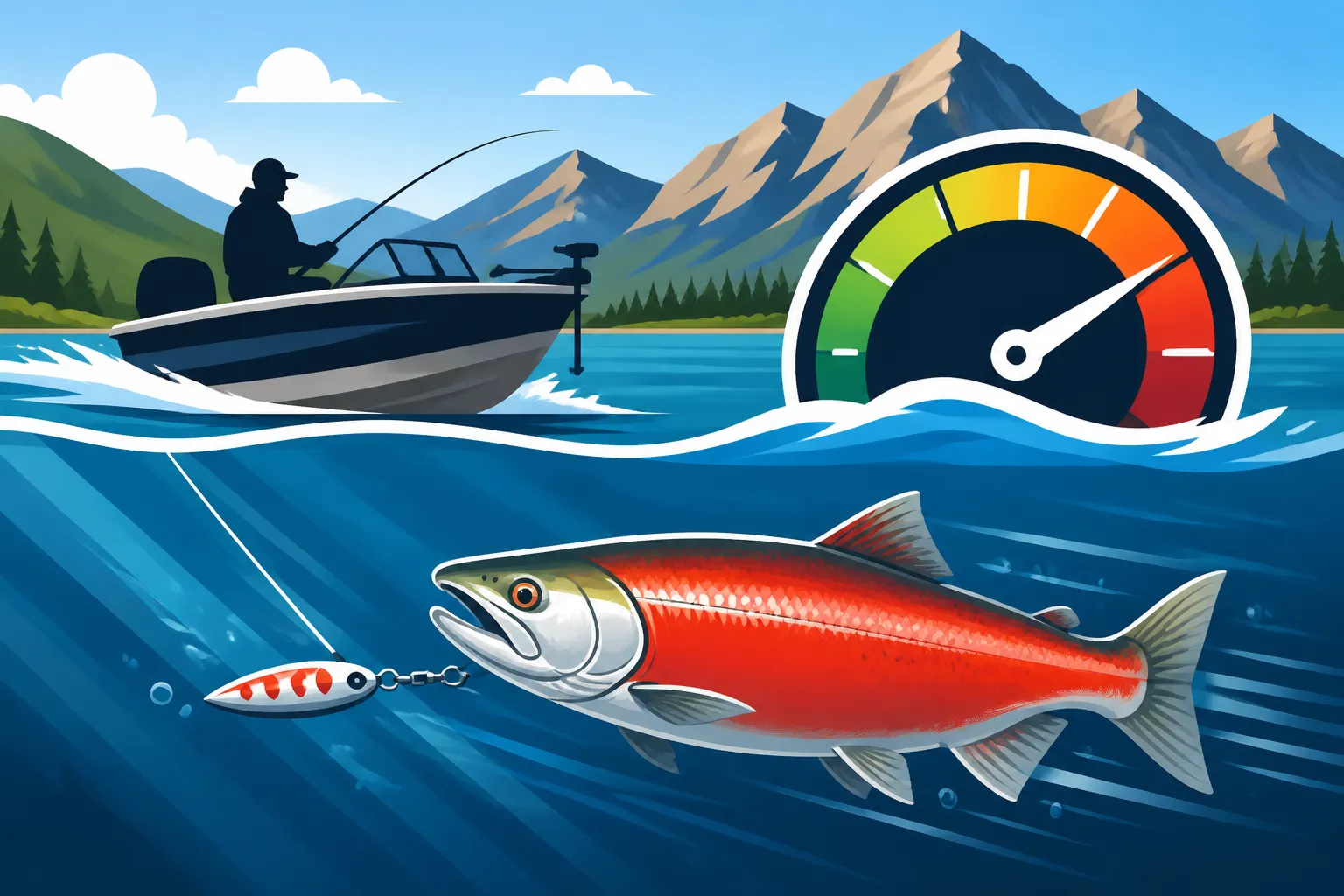
For most Kokanee trolling scenarios, especially in Wyoming's larger reservoirs, you'll want to aim for a trolling speed somewhere between 1.0 to 1.8 miles per hour (MPH). This might seem like a narrow window, but those subtle tenths of an MPH can make a huge difference. Many successful anglers often find their "sweet spot" at around 1.2 to 1.5 MPH. This range typically allows dodgers, flashers, and the various lures trailing behind them to perform optimally, creating that enticing wobble and flash that Kokanee can't resist.
It's crucial to have a reliable GPS unit or a speed-over-ground indicator on your fish finder to monitor your exact speed. Relying solely on your boat's speedometer (RPMs) can be misleading due to wind, current, and prop wash. Remember, your boat's speed directly dictates how your lure moves, so precision here is key. Start within this range, pay close attention to your electronics for any signs of fish, and be ready to adjust.
Adjusting Speed for Lure Type and Depth
The type of lure you're pulling is intricately linked to your optimal trolling speed. A small, lightweight Kokanee hoochie or squirt, often paired with a dodger, needs a certain speed to achieve its characteristic darting action. Too slow, and it might just drag. Too fast, and it could spin unnaturally, becoming a tangled mess or just looking "off" to a wary Kokanee. Larger dodgers, for instance, often require a bit more speed to get their full range of motion and flash, while smaller ones might be effective at slightly slower speeds.
Before you deploy your line, it's always a great idea to watch your lure's action right next to the boat. Does it wobble, kick, or dart as intended at your chosen speed? If not, adjust your speed until it looks perfect. This simple check can save you a lot of wasted time and effort. Also, consider the depth you're targeting. When you're trying to reach those deeper fish using downriggers, a slight increase in speed can sometimes help your lure maintain its action against the water pressure, although significant speed increases can also cause your downrigger ball to "blow back" or rise in the water column. Understanding Downrigger Basics for Wyoming Reservoir Trout is invaluable here.
Practical Tips for Maintaining Consistent Speed
Maintaining a consistent trolling speed, especially in changing wind and current conditions, is a skill in itself. A good GPS speed indicator is non-negotiable. Many modern fish finders have this built-in, but a dedicated unit can offer even more precision. For boats without a dedicated kicker motor, a bow-mounted electric trolling motor can be a game-changer. Brands like Minn Kota and Motorguide offer models with GPS anchoring and precise speed control that make holding a specific speed almost effortless, even in choppy water. You can often find great deals on these on Amazon.
If you're using your main outboard, investing in a trolling plate or a "happy troller" can help slow your boat down sufficiently without lugging the engine. These devices fit onto your cavitation plate and effectively "brake" the boat, allowing your engine to run at higher, smoother RPMs while maintaining a slower trolling speed. Another technique is to use drift socks or sea anchors, especially if you're battling strong winds. Deploying one or two of these off the sides of your boat can dramatically reduce your speed and help you stay on course.
Fine-Tuning Your Trolling Speed on Wyoming Waters
Once you've got a handle on the basic speed ranges, the real artistry comes in fine-tuning. Kokanee, like most fish, can be incredibly particular from day to day, and even hour to hour. What worked yesterday might not work today, making on-the-water adjustments crucial.
Reading the Water and Reacting to Bites
Always be observing. If you're getting short strikes, or fish are just nipping at your lure without truly committing, it's a sign that something isn't quite right. Sometimes, slowing down a few tenths of an MPH can turn those tentative taps into solid hookups. Conversely, if you're not getting any action at all, try speeding up. A sudden burst of speed might trigger a chase instinct, especially if a school of Kokanee is near.
A classic technique for varying speed and depth without constantly messing with your throttle is the "S-turn." As you troll, make wide, sweeping S-turns with your boat. On the inside of the turn, your lures will slow down and sink slightly. On the outside, they'll speed up and rise. Often, a fish will strike precisely as the lure changes speed or depth during these turns. Pay attention to which part of the turn produces bites – that tells you whether they prefer faster or slower presentations that day. Your fish finder is also an invaluable tool here; watch for how fish react as your lure passes through a school. Are they scattering, ignoring, or rising to investigate? Their reaction can inform your speed adjustments.
Gear Considerations for Speed Control
The gear you use also plays a significant role in how effectively you can control and present your lure at optimal speeds. Downriggers are practically indispensable for Kokanee fishing, allowing you to present your lures at precise depths. Combining a downrigger with a line counter reel (which you can easily find on Amazon) ensures that you can consistently replicate your depth and successful presentations. Planer boards can help you spread out your lines, especially useful if you're running multiple rods, creating a wider presentation and covering more water without tangling. This setup allows you to test different speeds and lure combinations simultaneously across a wider swath.
Lead core line is another option for reaching deeper fish without the bulk of a downrigger ball. The amount of lead core deployed and the speed of your boat directly determine the depth of your lure. Understanding this relationship is vital. For example, if you're targeting Kokanee at 30 feet, and your lead core sinks roughly 5 feet per color (often 10 yards), you'd need about 6 colors out at a certain speed. Adjusting your speed will change that depth, so knowing your gear and how it performs is essential for consistent results. Many anglers refine their Trolling Techniques for Wyoming Reservoirs by precisely managing these variables.
When you're out on the water in a place like Flaming Gorge, conditions can change rapidly. One minute it's calm, the next, a stiff breeze picks up. Having a trolling motor with a remote control is a game-changer, allowing you to make micro-adjustments to your speed without ever taking your hands off the rod. For a comprehensive overview of fishing in one of Wyoming's prime Kokanee fisheries, check out our Fishing Wyoming's Flaming Gorge Reservoir Fishing Guide. Anglers exploring Pathfinder Reservoir Fishing Access Points in Wyoming for Kokanee will also find these speed principles directly applicable.
Wyoming Specific Examples and Seasons
Wyoming's Kokanee fisheries, particularly Flaming Gorge and Pathfinder Reservoir, offer fantastic opportunities, but they also demand attention to detail. In the spring, after ice-out, Kokanee might be shallower and more active, sometimes preferring a slightly slower troll as they awaken from winter. As summer progresses and they move into deeper, cooler water, a consistent, methodical troll within that 1.0-1.8 MPH range often proves most effective.
Later in the season, as Kokanee approach their spawning cycle in the fall, their behavior changes again. They might become more aggressive, reacting to faster, more erratic movements. Knowing your Wyoming Fishing Seasons Month by Month and how that impacts Kokanee behavior is crucial for adjusting your trolling speed. Specifically, for those targeting Kokanee in the region, diving into Kokanee Salmon at Flaming Gorge Reservoir and Kokanee Salmon in Pathfinder Reservoir will provide even more tailored insights, as these bodies of water have their own nuances influenced by their unique environments and fish populations. These large, expansive reservoirs demand precise navigation and speed control to effectively cover water and locate schools. Knowing How Kokanee Salmon Got Into Wyoming Reservoirs can also offer interesting insights into their behavior in these specific environments.
Common Trolling Speed Mistakes and How to Avoid Them
Even experienced anglers can fall into common traps when it comes to trolling speed. Avoiding these pitfalls can significantly increase your success rate and reduce frustration.
Ignoring Your Electronics
One of the biggest mistakes is not utilizing the tools at your disposal, primarily your fish finder and GPS. Many anglers get so focused on their lines that they forget to glance at their screens. Your fish finder isn't just for locating fish; it can show you how fish are reacting to your presentation. Are they staying deep as your lure passes over them? Are they rising to meet your lure but not biting? These visual cues are invaluable. If you see fish on your screen but aren't getting bites, it's a strong indicator that your speed, depth, or lure choice needs adjustment. Similarly, if your GPS shows you're constantly drifting off your target speed due to wind or current, you need to correct it. Don't just set your engine RPMs and assume your speed is constant; verify it with your electronics.
Not Experimenting Enough
It's easy to get into a rut and stick with what worked on your last trip or what someone else told you. However, Kokanee can be incredibly finicky. If you're not getting bites, don't be afraid to experiment. Try slowing down by 0.2 MPH for 15 minutes. If no bites, speed up by 0.2 MPH. Make S-turns, try zigzagging. Even slight adjustments can sometimes be the magic bullet. The fish will tell you what they want, but you have to give them options to choose from. Keep a log if you need to, noting conditions, speeds, and successful patterns. Sometimes, varying your speed by a tiny margin, like from 1.3 to 1.5 MPH, is enough to trigger a bite.
Overlooking Lure Action
Your lure is the primary attractant, and its action is paramount. It doesn't matter how perfect your speed is if your lure isn't swimming correctly. Before you send your lure down, always check its action right at the surface. Does it look natural? Is it spinning correctly? Is your dodger kicking as it should? Sometimes, a tiny piece of debris, a fouled hook, or even a twisted line can completely ruin a lure's presentation.
Even after you've deployed it, a subtle twitch in your rod tip or a slight vibration can indicate that your lure has fouled or collected weeds. If a line goes quiet, reel it in and check it. A tangled leader or a piece of plant matter can make your perfectly trolled lure completely ineffective. Don't be afraid to spend a few seconds verifying your lure's performance; it's time well spent. The best speed in the world won't catch fish if your lure isn't doing its job.
Here's a quick reference for common Kokanee lure types and suggested starting speeds:
| Lure Type | Description | Suggested Trolling Speed Range (MPH) | Key Action |
|---|---|---|---|
| Dodger & Hoochie | Flashing attractor with soft plastic squid/worm | 1.0 – 1.8 | Dodging, darting motion of hoochie |
| Dodger & Wedding Ring | Flashing attractor with spinning blade & beads | 1.2 – 1.6 | Spinning blade, erratic wobble |
| Small Spoon (e.g., Croc) | Metal spoon, often with a slight curve | 1.4 – 2.0 | Wobbling, fluttering, mimicking baitfish |
| Flasher & Squirt | Larger attractor for more thump and flash | 1.0 – 1.5 | Aggressive thumping, squirt wiggles |
| Rigged Pop Gear | String of blades/flashers with a bait hook | 0.8 – 1.2 | Continuous flash, subtle bait movement |
Remember, these are starting points. Always observe your lure's action and adjust your speed based on fish response and changing conditions.
Important Disclaimer
Fishing conditions and regulations can change rapidly. Always consult the most current Wyoming Game and Fish Department regulations before heading out. This guide is for informational purposes only and does not constitute legal advice.