How to Identify a Golden Trout
Imagine the thrill of a lifetime: you've hiked into a remote, high-alpine lake in the Wyoming wilderness, cast your line, and reeled in a truly stunning fish. Its scales shimmer with an unbelievable, almost ethereal gold. Could it be? Is this the legendary Golden Trout you've heard whispers about? Or is it a vibrant cutthroat, a particularly colorful rainbow, or even a brook trout showing off its finery? The truth is, identifying a Golden Trout can be a real head-scratcher, especially with so many other beautiful salmonids swimming in our pristine waters. This guide is going to walk you through the distinct features that will help you confidently identify a genuine Golden Trout, ensuring you know exactly what kind of treasure you've just landed.
The Elusive Golden Trout: Why Accurate Identification Matters
Catching a Golden Trout is, for many anglers, a bucket-list achievement. These fish are renowned not only for their breathtaking beauty but also for the challenging, often strenuous, high-country adventures required to reach their remote habitats. Because of their rarity and specific habitat, knowing exactly what you've caught isn't just about bragging rights – it's crucial for conservation and for truly appreciating the unique wildlife that calls Wyoming home. It's easy to mistake a brilliantly colored cutthroat or a vividly marked rainbow for a Golden, especially when your heart is pounding with excitement and the high-altitude light plays tricks on your eyes.
Think about it: you've probably seen pictures of the vibrant, almost neon-orange bellies and dazzling golden flanks, but in real life, under varying light conditions or after the fish has been out of the water for a moment, those colors can soften. Furthermore, some of our native cutthroat subspecies, like the Snake River Fine-Spotted Cutthroat, can display incredibly rich coloration, leading to honest confusion. Without a keen eye and a solid understanding of the key distinguishing features, that once-in-a-lifetime catch might remain a mystery, or worse, be misidentified. This guide aims to clear up that confusion once and for all.
Moreover, if you're pursuing a state record or simply want to document your catch accurately for a personal log, precise identification is paramount. You can find excellent portable cameras and even waterproof notebooks on Amazon to help document your catch clearly, capturing those vibrant colors before they fade. When you've put in the effort to hike miles into the backcountry, often gaining thousands of feet in elevation, you want to be sure you know what you're holding. How to Fish Wyoming's High-Alpine Lakes will give you an idea of the effort required for these pursuits.
Key Physical Characteristics of a Golden Trout
Golden Trout are arguably one of the most stunning freshwater fish in North America, and their appearance is truly distinctive once you know what to look for. While their name gives a big hint, it's not just about the gold; there are several other key markers that set them apart from their trout cousins. Let's break down these unique features so you can confidently spot one in the wild.
Vibrant Gold and Yellow Coloration
The most obvious and striking characteristic of a Golden Trout is its incredibly vivid coloration. This isn't just a hint of yellow; it's typically a brilliant, almost iridescent golden-yellow hue that covers their flanks, often transitioning into a darker olive-green or bronze along their back. Their sides often sparkle with an almost metallic sheen, truly living up to their name.
However, it's important to note that the intensity of this gold can vary. Factors like diet, water clarity, and even the individual fish's age and health can influence how vibrant their colors appear. A fish caught in clear, nutrient-rich high-alpine waters will often display a more pronounced gold than one from a murkier or less productive environment. This golden hue also tends to be most brilliant when the fish is first pulled from the water; like many fish, their colors can dull slightly over time, even just minutes, after being caught.
Persistent Vertical Parr Marks and Distinct Lateral Band
One of the most reliable identifiers for a Golden Trout, particularly as an adult, is the presence of distinct, often elongated, vertical parr marks along its sides. Unlike many other trout species where these juvenile marks fade and disappear as the fish matures, Golden Trout often retain these dark, oval-shaped marks well into adulthood. They're usually centered on the lateral line and can be quite prominent.
Running horizontally along the length of the fish, often overlaying these parr marks, is a vibrant, unbroken reddish-orange lateral band. This band is typically a rich, almost fiery color, and it contrasts beautifully with the golden flanks. It's not just a subtle blush; it's a bold stripe that makes them truly stand out. This combination of persistent parr marks and a prominent lateral band is a critical clue.
Reddish-Orange Belly and Fin Tips
Beyond the golden flanks and lateral band, the underside of a Golden Trout is another tell-tale sign. Their belly is usually a brilliant, almost flame-orange or crimson red, often extending up into the lower flanks. This bright coloration is significantly more intense than what you'd typically see on a rainbow or cutthroat trout. It gives them a truly fiery appearance.
Adding to this vibrant display, many Golden Trout will also exhibit reddish-orange tips on their pectoral, pelvic, and anal fins. These aren't always super bright, but they contribute to the overall warm color palette of the fish. When you combine the intense gold, the bold lateral band, the deep orange belly, and the subtle red fin tips, you start to see a very consistent and unmistakable pattern. It's a fish that looks like it's been painted with a sunset.
Small Scales and Absence of Cutthroat Slash
If you get a chance to gently handle a Golden Trout, you'll notice their scales are remarkably small and fine compared to other trout species. This makes their skin feel quite smooth to the touch, almost silky. This subtle characteristic might require a closer look, but it's another piece of the identification puzzle.
Perhaps most importantly, unlike the various cutthroat trout found throughout Wyoming, Golden Trout do not possess the characteristic red or orange "slash" mark under their jawline. This slash is the definitive feature of a cutthroat and its absence on a fish with otherwise golden hues immediately rules out most cutthroat species. Comparing a golden trout to a Yellowstone Cutthroat Trout Fishing in Wyoming will immediately highlight this difference.
| Feature | Golden Trout | Cutthroat Trout | Rainbow Trout | Brook Trout (technically a char) |
|---|---|---|---|---|
| Primary Color | Brilliant golden-yellow to orange | Olive, bronze, or silvery with various spots | Silvery, greenish, or brassy with dark spots | Dark green/brown with worm-like markings |
| Belly Color | Deep reddish-orange to crimson | White, cream, or pale yellow | White, cream, or light yellow | White, cream, or orange/red with blue halos |
| Lateral Band | Prominent, unbroken reddish-orange | Usually faint or absent, sometimes pinkish | Broad, iridescent pink/red stripe | Absent (no distinct lateral band) |
| Parr Marks | Persistent and often elongated into adulthood | Present in juveniles, usually fade in adults | Present in juveniles, usually fade in adults | Present in juveniles, often fade in adults |
| Spots | Typically small, distinct black spots on back/tail | Various spots, often concentrated towards tail | Numerous, evenly distributed small black spots | Light spots (red with blue halos) on dark body |
| Jaw Slash | Absent | Always Present (red or orange) | Absent | Absent |
| Scale Size | Very small, fine | Medium to large | Medium | Very small (looks scaleless) |
| Fin Tips | Often reddish-orange | Typically pale or white | Typically pale or white | White leading edges with black trailing edge (distinct) |
Distinguishing Golden Trout from Similar Species in Wyoming
The high-alpine lakes and streams of Wyoming are home to a stunning array of trout, and it's easy to get them mixed up, especially when they're all sporting their most vibrant spawning colors or simply glowing in clear water. Let's tackle the common culprits that get confused with the illustrious Golden Trout.
Golden Trout vs. Cutthroat Trout
This is perhaps the most frequent point of confusion, and for good reason. Wyoming is home to several subspecies of cutthroat trout, and many of them can display incredibly rich, even yellowish or orange hues, especially around their bellies and lower flanks. A vibrant Bonneville Cutthroat or a feisty Yellowstone Cutthroat, particularly those thriving in pristine waters, can look remarkably "golden" at first glance.
However, the absolute, non-negotiable identifier for a cutthroat trout is that distinct red or orange "slash" mark under its jaw, right in the crease where the two gill plates meet. Think of it like a painted cheek mark. If the fish has this slash, it's a cutthroat – no matter how golden its body appears. Golden Trout absolutely do not have this slash. Additionally, while some cutthroat can have sparse spots, a Golden Trout will typically have finer, more concentrated spotting on its back and tail, whereas cutthroat spots are often larger and more scattered, sometimes heavily concentrated towards the tail. For a deeper dive, check out Identifying a Yellowstone Cutthroat Trout and Cutthroat vs Rainbow Trout: Telling Them Apart.
Golden Trout vs. Rainbow Trout
Rainbow trout are another common species in Wyoming, both wild and stocked, and they too can sometimes throw anglers for a loop. Rainbows are known for their iridescent, often silvery or greenish bodies, punctuated by a lateral pinkish-red stripe that can be quite striking. This stripe can sometimes be mistaken for the Golden Trout's lateral band.
However, the key differences lie in the overall body color and the parr marks. A true Golden Trout will have that unmistakable, radiant gold or yellow body, whereas a rainbow trout, even a colorful one, will maintain more of a silvery, olive, or brassy base color. Furthermore, while juvenile rainbow trout have parr marks, these almost always fade completely as the fish matures. Golden Trout, as we discussed, often retain their parr marks into adulthood. Also, rainbow trout have small, numerous black spots distributed fairly evenly across their body, fins, and tail, which are usually more numerous and consistent than the spotting pattern on a Golden Trout. Rainbow Trout Fishing in Wyoming is a good resource for learning more about them.
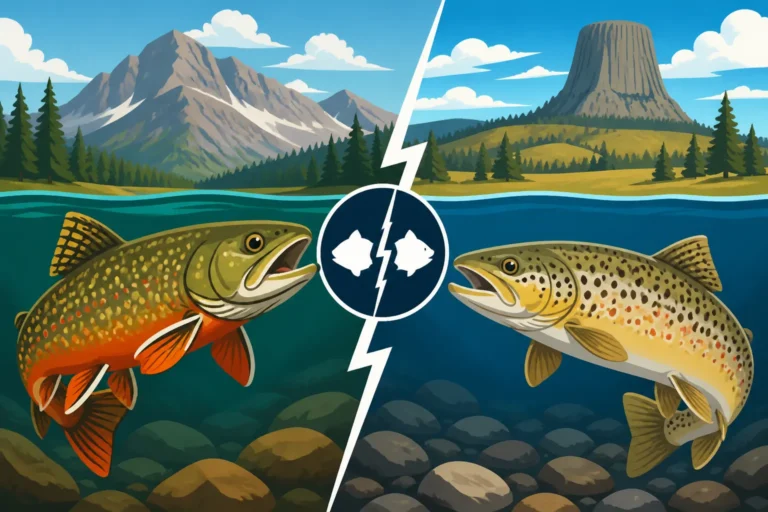
Golden Trout vs. Brook Trout
Brook trout, while technically a char, are often lumped in with trout by anglers and are widespread in Wyoming's cooler, higher-elevation waters. They are beautiful fish in their own right, with a dark, mottled back that often has distinctive worm-like markings (vermiculations) and vibrant red spots with blue halos along their sides. They also have a cream-colored belly that can turn a deep, rich orange or red during spawning, especially in males, sometimes leading to confusion with the Golden Trout's similarly colored belly.
However, the differences are stark. Brook trout lack the Golden Trout's overall bright golden body coloration. Instead, their base color is much darker – typically dark green, brown, or even black. They have no distinct lateral band like the Golden Trout, and their red spots with blue halos are unique to brook trout. Perhaps the most obvious difference, besides the overall body pattern, is the brook trout's characteristic white leading edges on its pectoral, pelvic, and anal fins, often bordered by a black line, which is absent in Golden Trout. You can read more about them in Brook Trout Fishing in Wyoming.
Where Golden Trout Live in Wyoming and Habitat Clues
Knowing where a fish is typically found can often be the first clue to its identity. Golden Trout are not found just anywhere in Wyoming; they are primarily residents of the state's most pristine, high-elevation alpine lakes and streams. We're talking about those crystal-clear, glacier-fed waters nestled among the peaks of ranges like the Wind River Mountains. These fish thrive in cold, oxygen-rich environments that often require a significant hike, sometimes even an overnight pack trip, to access. This isn't your average roadside fishing hole.
Historically, Golden Trout were native to specific drainages in California, but they have been widely transplanted into suitable high-alpine habitats across the western United States, including Wyoming. The Wyoming Game and Fish Department has carefully stocked many of these remote lakes, often using helicopters, to create these unique fisheries. So, if you're pulling a "golden" looking fish from a low-elevation reservoir or a major river like the North Platte, it's highly unlikely to be a true Golden Trout; it's almost certainly a very vibrant cutthroat or rainbow. Understanding their habitat is a powerful identification tool in itself. For specific locations, you'll want to dive into resources like Golden Trout Fishing in Wyoming. You can also find some helpful topographical maps and wilderness navigation tools on Amazon for planning these remote excursions.
When fishing these high-alpine waters, pay attention to the environment. Are you in a pristine, cold, clear lake at 9,000+ feet? That increases the probability of encountering a Golden Trout. Are you fishing in a larger, more accessible river system? The odds shift dramatically. This combination of visual cues on the fish and environmental cues from the habitat will give you the best chance of making a correct identification.
Disclaimer
This article is for general informational purposes only and does not constitute professional advice. Laws, prices and regulations vary by location and change over time. Consult a qualified professional for guidance on your specific situation.