Trolling Tube Jigs for Lake Trout at Flaming Gorge
Anglers often dream of landing those legendary, massive lake trout, but the reality of fishing for them, especially in a vast, deep reservoir like Flaming Gorge, can be incredibly daunting. It's easy to feel overwhelmed by the sheer size of the water, the depths these fish inhabit, and the complex gear seemingly required. This comprehensive guide is here to demystify one of the most effective and exciting ways to target these magnificent fish: trolling tube jigs for lake trout at Flaming Gorge.
Understanding Lake Trout Behavior at Flaming Gorge
To successfully troll for lake trout, or "mackinaw" as they're often called, you first need to understand their world. These fish are creatures of habit, yet their habits can shift dramatically with the seasons and even the time of day. Flaming Gorge Reservoir is a prime example of a fishery where lake trout thrive, growing to impressive sizes, thanks to an abundant food supply and deep, cold waters.
Seasonal Movements and Depths
Lake trout in Flaming Gorge are constantly on the move, primarily chasing baitfish like kokanee salmon and cisco. In the spring, shortly after ice-out, you'll often find them cruising relatively shallower waters, sometimes in the 30-60 foot range, as they follow their prey which are seeking warmer surface temperatures. This can be a fantastic time for shore anglers or those who prefer less complex trolling setups. As summer progresses and surface waters warm, these trout retreat to the cooler, oxygen-rich depths. You might find them anywhere from 80 to over 200 feet deep, often suspended over structure or hugging the bottom in the deepest parts of the reservoir.
Come fall, as the water cools again, you might see them beginning to move back shallower, though not always as pronounced as the spring movement. They're often fattening up for winter, and this can be a great time to target trophy fish. Understanding these general seasonal patterns is crucial, as it dictates the depth you need to present your tube jigs. For more insights into these fascinating fish, check out our guide on How Big Wyoming Lake Trout Get.
Preferred Forage and Habitat
The diet of lake trout at Flaming Gorge is primarily small fish. Kokanee salmon are a significant part of their diet, especially in areas where kokanee are abundant. Cisco, whitefish, and even smaller rainbow trout can also be on the menu. This diet heavily influences the presentation of your tube jig – you want it to mimic the natural prey. These predatory fish will often ambush their meals, so understanding their preferred ambush points is key. They love to relate to structure: submerged islands, deep points, ledges, and channels. If you can locate these underwater features, you're halfway to finding the fish.
The habitat they choose offers both cover and feeding opportunities. Deep humps and long, tapering points that extend into the main channel are classic lake trout haunts. They'll use the contours of the bottom to conserve energy, waiting for an unsuspecting baitfish school to swim by. Understanding What Lake Trout Eat in Wyoming Reservoirs can give you an edge in choosing the right jig.
Reading Sonar and Structure
Modern fish finders and chartplotters are your best friends when targeting deep-dwelling lake trout. Before you even think about dropping a line, spend time idling around potential fishing grounds, carefully scanning your electronics. Look for bait balls, which appear as clouds on your screen, and the tell-tale arches of large fish hovering nearby or underneath. Pay close attention to changes in bottom contour – sudden drops, submerged rock piles, and old creek beds can be magnets for lake trout.
Many anglers who consistently catch big lake trout don't just look for fish; they look for the structure that holds fish. Mapping software like Navionics or Garmin's Quickdraw can show you detailed contours, helping you identify prime ambush points. Mark waypoints when you see promising activity or structure. These aren't just random spots; they're the underwater neighborhoods where the big mackinaw hang out. Don't be afraid to circle back over productive areas multiple times.
The Tube Jig: Why It's a Lake Trout Powerhouse
Among the myriad of lures available, the tube jig stands out as an exceptionally effective tool for enticing large lake trout, particularly when trolled. Its unique design allows for a versatile presentation that mimics a variety of natural prey, making it irresistible to hungry mackinaw.
Anatomy of a Tube Jig and Its Appeal
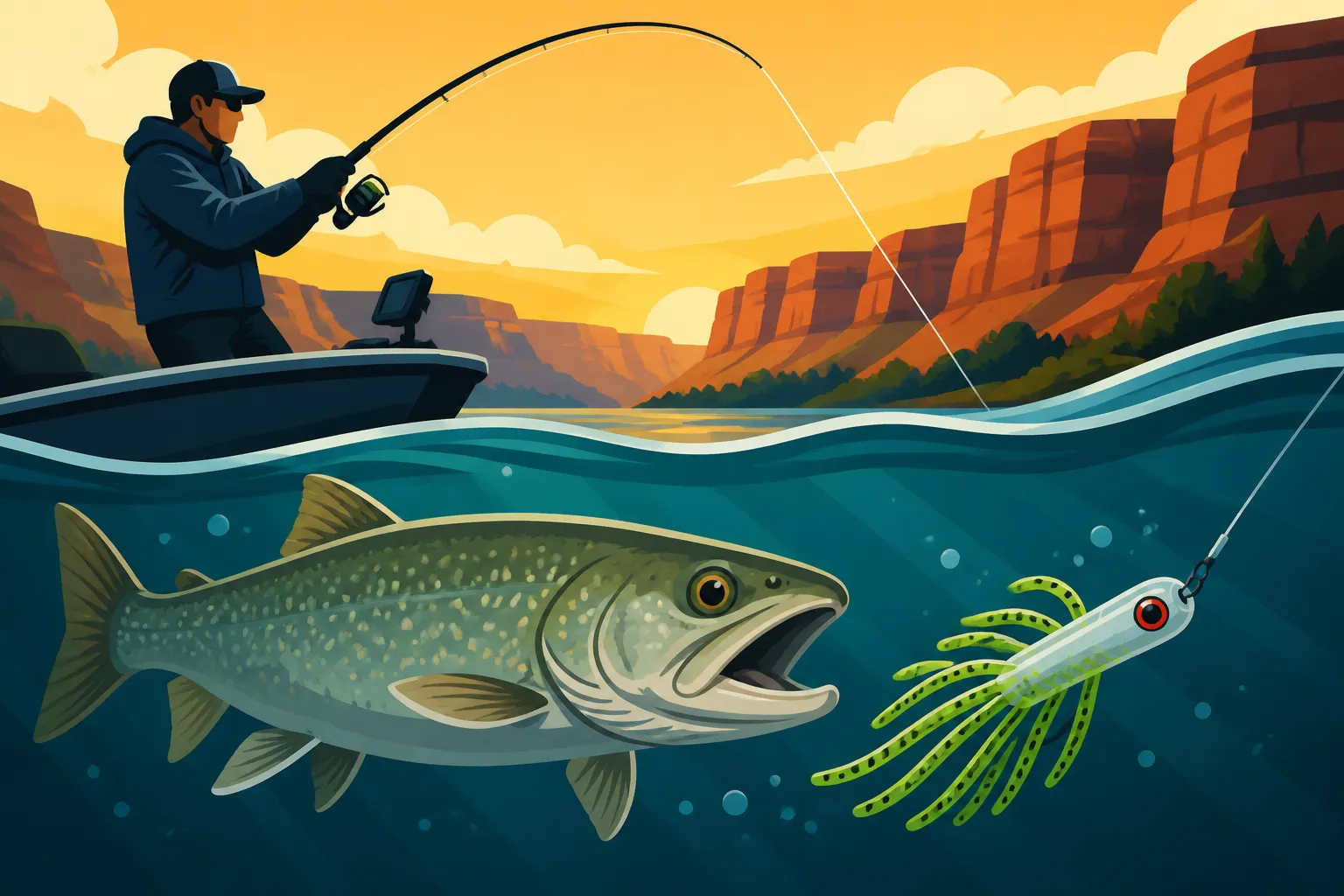
A tube jig, at its core, is a cylindrical soft plastic body with tentacles, or "skirts," at one end. It's usually hollow, allowing for a specialized lead-head jig to be inserted, often with the hook eye exiting through the top of the tube. What makes it so appealing to lake trout is its uncanny ability to imitate a dying baitfish or even a crayfish. When trolled, the skirts pulsate and flare, creating a lifelike action that triggers aggressive strikes. The soft body feels natural to a biting fish, encouraging it to hold on longer, giving you more time to set the hook.
Unlike hard baits, a tube jig's flexibility allows for a more subtle and natural movement, especially at slower trolling speeds. The tube jig’s profile, color, and action are highly customizable, giving anglers endless options to match the hatch or experiment when fish are finicky. Whether you buy them individually or in bulk on platforms like Amazon, make sure you're stocking up on a variety of colors and sizes.
Color Selection and Size Considerations
Choosing the right color and size is paramount. For Flaming Gorge lake trout, natural colors that mimic cisco, kokanee, or other baitfish are often top producers. Think shades of white, pearl, silver, chartreuse, and sometimes even darker greens or blues. In clear water, more natural, translucent colors tend to work well. On overcast days or in deeper, darker water, brighter colors like chartreuse or glow-in-the-dark tubes can be incredibly effective at attracting attention. It's a good idea to have a range of options, as trout preferences can change from day to day, or even hour to hour.
Size also matters. While smaller tubes (3-4 inches) can attract bites from smaller fish, if you're targeting those trophy mackinaw, don't be shy about going big. Tubes ranging from 6 to 10 inches are not uncommon for larger lake trout. The general rule is: larger bait, larger fish. However, if the bite is slow, scaling down slightly can sometimes trigger more strikes. Many anglers find success by checking the stomach contents of any fish they keep to see what prey they were actively feeding on, then adjusting their tube jigs accordingly.
Scent and Enhancements for Tube Jigs
Adding scent to your tube jigs can make a significant difference, especially on those days when the fish are less aggressive. Lake trout have a keen sense of smell, and a natural scent can mask any human odors from your hands, making the lure even more enticing. Popular choices include scents formulated with real baitfish oils, garlic, or even Berkley Gulp! products that impregnate the soft plastic with scent. You can apply these directly to the outside of the tube or, even better, inject them into the hollow body of the tube for a longer-lasting release.
Beyond scent, some anglers enhance their tube jigs with rattles inserted into the body, which create subtle vibrations that can attract fish from a distance. Others might add a small spinner blade on a swivel just above the jig head, providing extra flash and movement. Experimentation is key; what works one day might not work the next, so be prepared to change up your presentation. A bit of creative enhancement can often turn a slow day into a successful one.
Essential Gear for Trolling Tube Jigs
Trolling for lake trout at depth requires a specialized setup, far beyond your average bass or panfish gear. Investing in the right equipment will not only increase your chances of success but also make the entire experience more enjoyable and less frustrating.
Rod, Reel, and Line Selection
For trolling heavy tube jigs at deep depths, you need robust gear. A medium-heavy to heavy power trolling rod, typically 7 to 9 feet long, with a moderate action is ideal. The moderate action allows the rod to absorb the shock of a big fish strike without tearing the hook out, and it provides enough backbone to fight powerful mackinaw. Many anglers prefer fiberglass or composite rods for their durability and forgiving flex. Look for rods designed for downriggers or lead core.
Pair your rod with a sturdy level-wind conventional reel, like a Penn Squall or an Okuma Coldwater line counter reel. Line counter reels are almost a necessity for precise depth control, allowing you to replicate successful presentations. Spool your reel with a strong main line. Braided line in the 30-50 lb test range is a popular choice for its no-stretch properties, which provide excellent sensitivity and solid hooksets at extreme depths. However, you'll need a monofilament or fluorocarbon leader (15-30 lb test, 6-10 feet long) to connect your tube jig, as braid can be visible to fish and doesn't offer much abrasion resistance against rocks. Make sure your knots are impeccable; a double uni knot or a FG knot are excellent choices for connecting braid to leader.
Downriggers, Dipsy Divers, and Lead Core
To get your tube jigs down to where the lake trout live, you'll need one of several depth control methods:
- Downriggers: These are perhaps the most precise method. A heavy weight (cannonball) on a cable is lowered, and your fishing line is attached to the cable via a release clip. When a fish strikes, the line pops free, and you fight the fish directly without the weight. Downriggers allow you to troll at very specific depths and are ideal for pinpointing fish in a narrow depth range. Brands like Cannon and Scotty are reliable choices.
- Dipsy Divers (or similar planers): These disc-shaped devices use water pressure to dive to a predetermined depth, carrying your lure with them. They're attached directly to your main line and release pressure when a fish hits, allowing you to reel in the fish and the diver. Dipsy Divers can be set to track out to the side of the boat, creating a wider trolling spread. This is particularly useful for covering more water when the fish are scattered.
- Lead Core Line: This specialized line has a lead core wrapped in a braided sheath. Each "color" (usually 10 yards) of line gets your lure down approximately 5 feet at a typical trolling speed. By letting out a certain number of colors, you can estimate your depth. Lead core is less precise than downriggers but offers a simpler, less expensive setup, and it can be highly effective, especially when lake trout are suspended at moderate depths, such as when targeting Best Depth for Trolling Lake Trout at Flaming Gorge. You'll need a long leader of mono or fluoro with lead core.
Each method has its pros and cons, and often, anglers will use a combination of these on the same boat to cover various depths and water columns. For example, you might run downriggers deep, a Dipsy Diver out to the side at a shallower depth, and a lead core line right off the stern.
Specialized Electronics and Mapping
Beyond a basic fish finder, specialized electronics can elevate your lake trout trolling game. A good GPS-enabled chartplotter with detailed mapping is essential for navigating Flaming Gorge's vast waters and identifying key structures. High-definition mapping, showing contours down to one-foot increments, allows you to pick apart subtle changes in the bottom that hold fish. Look for historical track lines functionality, which allows you to precisely repeat successful trolling passes.
For many serious lake trout anglers, side-imaging or Mega Imaging (from brands like Humminbird) and LiveScope or Panoptix (from Garmin) are game-changers. These technologies provide incredibly detailed views of the underwater world to the sides and front of your boat, helping you spot bait schools, individual fish, and structure that you might otherwise miss directly below your transducer. Being able to see fish off to the side before you troll over them allows you to adjust your path and present your tube jig directly to them. This level of detail makes a huge difference in finding active fish, especially on Amazon, where many reputable brands for these units can be found.
Mastering Trolling Techniques with Tube Jigs
Once you have your gear dialed in, it's time to put it to work. Trolling tube jigs for lake trout isn't just about dragging a lure; it's a dynamic dance of boat speed, depth control, and strategic presentation.
Setting Up Your Trolling Spread
A well-organized trolling spread is crucial for covering maximum water and preventing tangles. If you're running multiple lines, consider varying your depths, lead lengths, and even colors to see what the fish are responding to. For example, if you're running two downriggers, set one 10-15 feet deeper than the other. If you're incorporating Dipsy Divers, set them to run out to different side angles or with different lead lengths to your tube jigs.
Using rod holders is non-negotiable for trolling. Secure your rods firmly, ensuring they are pointed correctly for the type of trolling device you're using (e.g., rods for Dipsy Divers should angle out to the sides). When deploying your lines, always start by clearing your prop and ensuring no lines are fouled. Drop your deepest lines first, then your shallower ones. This helps avoid crossing lines. Pay attention to how your lines are separating from the boat; you want a clean, wide spread that covers as much water column horizontally and vertically as possible. Some anglers even utilize planer boards for an even wider spread, particularly in open water.
Speed, Depth, and Direction Strategies
Trolling speed is a critical variable for tube jigs. Generally, slower speeds (1.0 to 2.5 mph) are effective, allowing the tube jig to pulsate and undulate naturally. However, don't be afraid to experiment. Sometimes, a slight increase in speed can trigger a chase reflex in dormant fish, while other times, an ultra-slow creep is what they want. Use your GPS to maintain consistent speeds. Watch your rod tips closely; you want to see a gentle pulse from the tube jig's action, not a frantic vibration which might indicate you're going too fast.
Depth control, as discussed earlier, is paramount. Knowing the specific depth the lake trout are holding at is half the battle. If your electronics show fish at 100 feet, make sure your tube jigs are getting there. Consider the "blowback" of your downrigger cables and the angle of your Dipsy Divers; these factors mean your lure might not be at the exact depth shown on your counter. Small adjustments can make a big difference. Trolling in an S-pattern or making gentle turns can also be very effective. The outside turn will cause your lure to speed up and rise slightly, while the inside turn will slow it down and drop it, often triggering a strike as the lure changes its action.
Strikes, Hooksets, and Landing Lake Trout
When a lake trout hits a trolled tube jig, it's often a firm, decisive strike. If you're using a downrigger, your line will pop out of the release clip, and your rod tip will spring back, then immediately load up as the fish pulls. With Dipsy Divers or lead core, you'll feel the rod tip abruptly double over. Resist the urge to yank the rod immediately. Instead, sweep the rod back firmly to ensure a solid hookset. Lake trout have tough mouths, so a good, hard hookset is essential.
Once hooked, be prepared for a powerful fight. Lake trout are known for their deep, bulldogging runs. Keep constant pressure on the fish, and let your rod and reel's drag do the work. Pump the rod to gain line, then reel down. Be patient, especially with larger fish, as they can make multiple runs before coming to the boat. As the fish gets closer to the boat, have a large net ready. Lake trout can be heavy and awkward, so a wide-mouthed, rubberized landing net is ideal to avoid tangles and minimize harm to the fish if you plan on releasing it. For specific guidance on how to land and handle these fish, our guide on Catch-and-Release Rules on Wyoming Waters has excellent tips.
Navigating Flaming Gorge: Hotspots and Conditions
Flaming Gorge is immense, stretching across both Wyoming and Utah. Understanding its key features and how environmental conditions influence lake trout behavior will vastly improve your success rate. For more detailed exploration of the reservoir, a look at Wyoming's Flaming Gorge Reservoir Fishing Guide is highly recommended.
Key Structures and Submerged Features
Flaming Gorge is renowned for its dramatic underwater topography, a product of the Green River canyon being flooded. This means there are numerous deep channels, submerged cliffs, humps, and points that act as magnets for lake trout. Popular areas known for good lake trout fishing include the Buckboard Crossing area, which offers excellent access and diverse structure, and the deeper areas near the dam. The Antelope Flat area is another well-known hotspot.
Don't neglect the numerous submerged islands and rock piles that litter the main channel. These areas often concentrate baitfish, which in turn attract hungry lake trout. Mark these structures on your GPS and systematically troll over and around them. Remember that lake trout don't just sit on top of structure; they'll often be found along the edges, in the adjacent deep water, or suspended above it. Exploring these specific spots, like Fishing the Buckboard Area of Flaming Gorge, Wyoming or Fishing the Antelope Flat Area of Flaming Gorge, can lead to fantastic results.
Wind, Weather, and Water Temperature Effects
Wind is a major factor on Flaming Gorge. A moderate breeze can be your friend, creating a current that moves baitfish and positions your boat for a natural drift while trolling. However, strong winds can make boat control difficult and create dangerous choppy conditions, especially on such a large body of water. Always check the weather forecast before heading out. Overcast days can sometimes be more productive for lake trout, as the reduced light encourages them to feed higher in the water column.
Water temperature is the master key to locating lake trout. They prefer cold water, typically in the 40s and 50s Fahrenheit. Your electronics will often show the thermocline – the boundary between warmer surface water and cooler deep water. Lake trout will often be found just above, below, or within this thermocline, especially during the summer months. Paying attention to these subtle changes will help you understand where the fish are most comfortable and actively feeding.
Best Times of Day and Year for Trolling
While lake trout can be caught year-round, certain times offer better opportunities. Spring, just after ice-out (typically April to early June), can be fantastic as fish move shallower. Early mornings and late evenings during the summer months often see fish moving up slightly to feed, though they generally remain deep. During the middle of the day in summer, expect to target them in their deepest haunts.
Fall (September and October) can be another prime time as water temperatures cool, and fish become more active, feeding heavily in preparation for winter. Ice fishing is also popular on Flaming Gorge, with anglers using similar tube jigs but in a jigging presentation. For a comprehensive overview of how these fish behave throughout the year, our detailed article on the Best Month for Lake Trout at Flaming Gorge can provide crucial insights. Remember, while there are general patterns, flexibility and constant adaptation to conditions are what truly make a successful angler on Flaming Gorge.
Common Challenges and Troubleshooting
Even with the best gear and knowledge, fishing can throw curveballs. Trolling for lake trout on a massive reservoir like Flaming Gorge comes with its own set of unique challenges that every angler will inevitably face. Being prepared to troubleshoot on the fly is a hallmark of an experienced angler.
Dealing with Snags and Break-Offs
Trolling deep means you're often putting your line, and expensive lures, right into the strike zone—which also happens to be where the rocks, submerged trees, and other snags reside. Snags are an unfortunate reality of deep-water trolling. To minimize break-offs, always use a leader that is lighter than your main line. This way, if you do snag, you're more likely to break off just your leader and lure, saving your main line and expensive downrigger cable or Dipsy Diver. When you feel a snag, immediately stop the boat, reverse direction, and try to pull the lure free from a different angle. Sometimes this works.
Another strategy is to use "breakaway" release clips on your downriggers that are set to release at a lower tension, allowing the lead ball to remain on the cable even if your lure snags. Consider carrying extra tube jigs and jig heads, as well as a selection of spare terminal tackle like swivels and snaps. Losing a favorite lure can be frustrating, especially if you're out on the water for a multi-day trip, so having backups on hand, perhaps ordered through Amazon for convenience, is always a smart move.
Adjusting to Finicky Bites
There will be days when the lake trout seem to have lockjaw, despite your best efforts. This is where experimentation becomes key. If fish are showing on your electronics but not biting, start by changing your trolling speed. A slight increase or decrease can often make all the difference. Next, try different tube jig colors. Sometimes, a subtle shift from white to pearl, or from chartreuse to a darker green, can trigger strikes. Experiment with the size of your tube jig; if the bigger baits aren't working, try scaling down.
Don't forget scent. Applying fresh scent to your tube jigs can sometimes be the magic bullet for finicky fish. Also, consider the action of your lure. If you're using downriggers, try lengthening or shortening your leader from the downrigger release clip to the lure (the "lead length"). Varying this distance can present the lure in a slightly different way. Sometimes, even the subtle movement from a slight turn of the boat is enough to provoke a strike from a hesitant fish. These minor adjustments can turn a frustrating day into a productive one, especially when you consider that How Deep Flaming Gorge Guides Fish for Lake Trout often involves constant adjustments.
Safety Considerations on Large Water
Flaming Gorge is a beautiful but formidable body of water. Its vastness means that weather conditions can change rapidly, and even moderate winds can quickly whip up dangerous waves. Always check the marine forecast before heading out, and be prepared to cut your trip short if conditions deteriorate. Carry all required safety gear, including properly fitting life jackets for everyone on board, a first-aid kit, a fire extinguisher, distress signals (flares), and an anchor with sufficient rode.
Inform someone on shore of your float plan, including where you're going and when you expect to return. Consider carrying a marine radio or a satellite communication device, as cell service can be spotty in many areas of the reservoir. Maintaining your boat's engine and ensuring you have enough fuel for your trip, plus a reserve, are also crucial. Being safe on the water ensures you can focus on the fishing and enjoy the stunning scenery Flaming Gorge has to offer.
Disclaimer
Please note that fishing regulations, including bag limits, season dates, and specific rules for certain waters, can change. Always consult the most current Wyoming Game and Fish Department regulations booklet before heading out on any fishing trip. This guide is for informational purposes only and does not supersede official regulations.