What a Clipped Adipose Fin Means
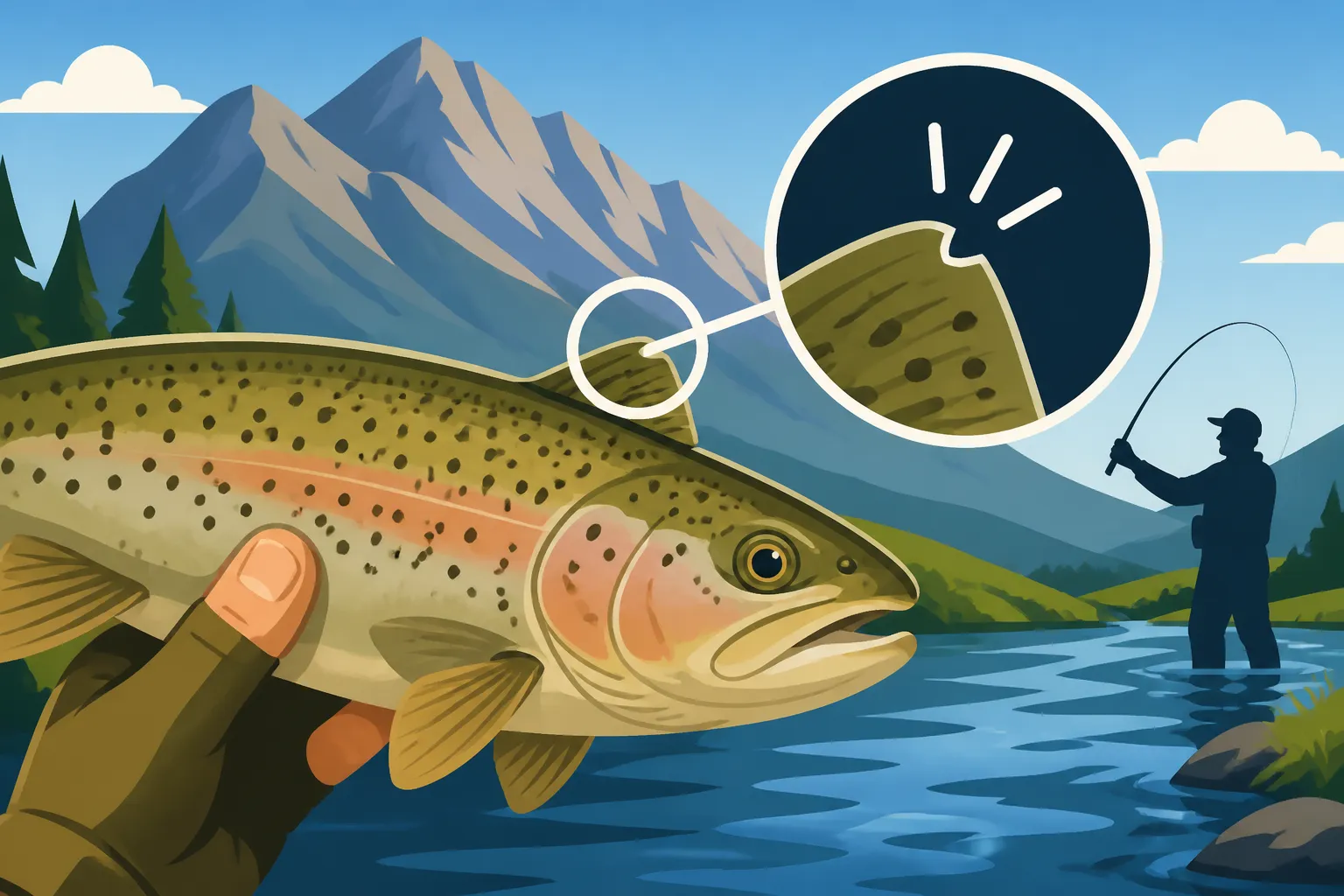
You've just landed a gorgeous trout from one of Wyoming's pristine rivers or serene high-country lakes, and as you carefully handle your catch, you notice something a little peculiar: a small, almost surgical-looking snip where a tiny, fleshy fin should be near its tail. Is the fish injured? Is it a rare species? You might be scratching your head, wondering "What a clipped adipose fin means." Trust me, you're not the first, and it's a very common question out here in the Cowboy State. This isn't some random injury; it's a deliberate mark with a vital purpose in Wyoming's fisheries management, and understanding it will give you a deeper appreciation for the fish you're catching and the efforts to keep our waters healthy.
What is the Adipose Fin and Why is it Clipped?
Let's start with the basics, because if you're like me, you probably didn't spend much time in biology class identifying every single fin on a fish. It turns out, that little fleshy nub on a trout's back holds a big secret!
Anatomy of the Adipose Fin
The adipose fin is truly a peculiar little thing in the fish world. It's a small, soft, fleshy fin located on the dorsal (back) side of the fish, specifically between the main dorsal fin and the caudal (tail) fin. Unlike other fins, it doesn't contain any bony rays or spines; it's just a flap of fatty tissue. Not all fish species have an adipose fin, but it's a characteristic feature of salmonids – the family that includes trout, salmon, and char, which are, of course, the superstars of Wyoming's fishing scene. If you're holding a cutthroat, rainbow, brown, or lake trout, you'll find that little fin there, unless it's been purposely removed. It doesn't seem to have a major functional role in swimming or stability, which makes it an ideal candidate for marking without harming the fish's ability to thrive.
The Purpose of Clipping
So, why would anyone intentionally clip off a part of a fish? It's all about identification, and it's a widely used, effective, and humane method. When a fish has a clipped adipose fin, it's a clear, permanent, and easily recognizable sign that this particular fish originated from a hatchery, rather than being born in the wild. Think of it like a subtle tag that tells a big story. The Wyoming Game and Fish Department (WGFD), and similar agencies across the country, use this method primarily for research and management purposes. It’s a low-cost, high-volume way to mark fish before they’re released into lakes and rivers, ensuring that when anglers or biologists encounter them later, they know instantly where that fish began its life. Without this simple clip, distinguishing between a fish that grew up in a hatchery and one that spawned naturally in a stream would be incredibly difficult, if not impossible, especially as they grow.
How Clipping is Done
The actual clipping process is typically carried out on very young fish, often called fingerlings or sub-catchables, when they are still in the controlled environment of a fish hatchery. These small fish are carefully handled, and the adipose fin is snipped off using a small, sharp instrument. Because the fin is soft and cartilaginous, the procedure is quick and generally doesn't cause significant stress or long-term harm to the fish. Hatchery staff are trained to perform this task efficiently and hygienically to minimize any negative impact. The fin will not grow back, providing a lifelong marker for the fish. This early tagging allows millions of fish to be marked each year before they are stocked into various waters, providing invaluable data for future studies and management decisions. It’s a testament to the dedication of folks working behind the scenes to maintain our cherished fishing resources. You might even find some basic fishing and fish identification guides on Amazon that show diagrams of fish fins, which can be really helpful for new anglers trying to learn these details.
The Importance of Adipose Fin Clips in Wyoming Fisheries Management
This small clip plays a monumental role in how the WGFD makes decisions about our fisheries. It's not just a random tag; it's a key piece of a much larger puzzle that helps biologists understand fish populations, evaluate stocking programs, and ultimately, ensure sustainable fishing for generations to come.
Distinguishing Wild vs. Stocked Fish
This is perhaps the most critical function of the adipose fin clip. In many of Wyoming's rivers and lakes, you'll find a mix of fish that hatched and grew naturally in the wild, and fish that were raised in a hatchery and then released. For fisheries managers, understanding the proportion of wild versus stocked fish in a given water body is incredibly important. A clipped fin immediately tells them (and you!) that the fish is of hatchery origin. This distinction allows WGFD to assess how well wild populations are reproducing and surviving on their own. If a stream is teeming with clipped fish but very few unclipped ones, it might indicate that the wild population isn't thriving, prompting a review of habitat conditions or fishing regulations. Conversely, if there are plenty of wild fish, stocking efforts might be redirected to other waters that need more support. It’s a real-time report card on the health of a fishery. Understanding this helps you appreciate the incredible natural resources we have, and why sometimes Wyoming's Stocked Rainbow Trout Program is necessary to supplement wild populations.
Tracking Fish Movement and Survival
Beyond just origin, adipose fin clips help biologists track individual fish or groups of fish. When WGFD stocks a batch of clipped fish into a particular lake or river, they can later survey that water body (or rely on angler reports) to see where those fish ended up. Did they stay in the section they were stocked? Did they migrate upstream or downstream? How many survived over a year or two? This data is crucial for understanding fish behavior, habitat use, and overall survival rates. For instance, if hatchery fish are being stocked to relieve pressure on a sensitive wild population in one area, tracking their movement can confirm if they are staying in the intended zones or dispersing widely. This helps fine-tune stocking locations and timing for maximum effectiveness. It's a bit like a covert surveillance mission, but for fish!
Evaluating Stocking Programs
Wyoming has a robust fish stocking program, placing millions of fish into public waters annually. But how do they know if these programs are actually working? That’s where the clipped fins come in handy. By stocking a certain number of clipped fish and then monitoring angler catch rates or conducting follow-up surveys, WGFD can calculate the return rate of those stocked fish. Are anglers catching a significant percentage of the fish that were stocked? Are the fish growing to a desirable size? This feedback loop is essential for optimizing stocking strategies. It helps determine which hatcheries are most effective, which fish strains are best suited for certain environments, and whether the investment in stocking is yielding the desired recreational benefits for anglers. It's a data-driven approach that ensures your license dollars are put to good use. If you're curious about this, you can learn more about Why Some Wyoming Trout Are Fin-Clipped in other resources.
What Anglers Should Do When Catching a Clipped Fish
So, you've reeled in a fish, and sure enough, that tell-tale clipped adipose fin is staring back at you. What's your next move? Do you need to do anything special? The good news is, for the most part, it doesn't change your basic responsibilities as an angler, but there are a few things to keep in mind.
Observing and Identifying
First and foremost, take a moment to confirm that it is indeed an adipose fin clip and not just some natural damage or a birth defect. A proper clip will look clean and deliberate, often quite small. Other fins will be intact. Once you've identified it, you don't typically need to do anything extraordinary. For many anglers, seeing that clip is simply an interesting piece of information, a little insight into the fish's journey. It's a signal that this particular fish has contributed to the WGFD's research efforts, and you're now a small part of that data collection just by observing it. Keep in mind that How to Tell a Stocked Trout From a Wild Trout isn't always just about the fin clip; stocked fish sometimes show other subtle differences in fin condition, coloration, or overall body shape, though these can be subjective.
Reporting (or Not Reporting)
In most cases, you do not need to report catching a fish with a clipped adipose fin to the WGFD. These clips are so common that individual reports aren't usually necessary for their large-scale data collection. They already know these fish are out there! However, there can be exceptions. Sometimes, WGFD might be conducting a very specific study in a particular water body and may request anglers to report clipped fish, perhaps even offering rewards. If such a program is active, you'll see signage at boat ramps, access points, or notices in the annual fishing regulations booklet. Always check the current regulations for the specific body of water you're fishing. If you're ever in doubt, or if you catch a fish with a different kind of tag (like a small plastic tag near the dorsal fin, or a visible wire tag), it's always best to err on the side of caution and report it as instructed. These other tags are often part of more intensive, localized studies, and your report could be very valuable. Having a waterproof notebook or a fishing app on your phone (which you might have purchased accessories for on Amazon) can be handy for jotting down details if you need to report something.
Following Regulations
This is the most important part: catching a fish with a clipped adipose fin does not exempt it from any existing fishing regulations for that specific water, species, or size. You still need to adhere to all bag limits, possession limits, size restrictions, and any other special rules. For example, if you're fishing a stream with a slot limit where all trout between 12 and 16 inches must be released, that rule applies to both wild and hatchery-clipped fish. A clipped adipose fin simply tells you its origin; it doesn't grant it special status regarding what you can or cannot keep. Always consult the Wyoming Fishing Regulations Every Angler Should Know before heading out. Ignorance of the rules is never a valid excuse for a violation, and fines can be significant. It's your responsibility as a respectful angler to know and follow these guidelines.
Here's a quick comparison of some general characteristics between wild and stocked fish in Wyoming, which the adipose fin clip helps confirm:
| Feature | Wild (Native/Naturalized) Fish | Hatchery (Stocked) Fish |
|---|---|---|
| Adipose Fin | Typically present and intact | Often clipped (removed) as a marker |
| Fins (other) | Often more perfect, well-formed, less frayed | Can sometimes be worn or frayed from hatchery life |
| Coloration | Usually more vibrant, natural, adapts to environment | Can be paler, less distinct, sometimes "washed out" |
| Body Shape | Streamlined, often lean and muscular | Can sometimes appear thicker or more "chunky" for its length |
| Fight | Often stronger, more energetic, accustomed to current | Varies, can be less spirited initially |
| Diet | Natural insects, smaller fish, aquatic organisms | Hatchery pellets initially, then adapts to natural forage |
Common Misconceptions and Additional Fin Markings
It's natural to have questions, especially when something like a fin clip seems a bit unusual at first. Let's clear up a few common misunderstandings and touch on other ways biologists might mark fish.
Not All Stocked Fish are Clipped
While the adipose fin clip is a powerful tool for distinguishing wild from stocked fish, it's important to understand that not every fish stocked in Wyoming waters will have a clipped adipose fin. WGFD employs specific strategies for which fish to clip and when. Sometimes, fish are stocked for immediate "put-and-take" fisheries where the expectation is they'll be caught quickly, and the added effort of clipping isn't deemed necessary. Other times, specific research projects might call for clipping only a certain percentage of stocked fish, or only particular species. So, if you catch an unclipped fish, it doesn't automatically mean it's wild; it simply means it wasn't marked with an adipose clip by a hatchery. This is why looking at other characteristics, as discussed in our table, can sometimes provide additional clues, though the adipose clip is the definitive marker of hatchery origin when present. This also ties into how many Wyoming's Stocked Rainbow Trout Program fish might be released annually.
Other Marking Methods
The adipose fin clip is perhaps the most common and recognizable marking technique, but it's not the only one used by fisheries biologists. For more detailed research, especially on individual fish or smaller populations, other methods are employed:
- Coded Wire Tags (CWTs): These are tiny, unnoticeable bits of wire, usually stainless steel or nickel, often less than 1 mm long. They're injected into the snout or cheek of the fish. Each tag has a unique code that can be read only with a specialized detector. Fish with CWTs often also have an adipose fin clip, serving as an external indicator that there's an internal tag, so anglers know to report the fish or turn in the head (if requested) for tag retrieval.
- Floy Tags (External Anchor Tags): These are small, brightly colored plastic tags, often with a unique number, that are anchored into the musculature of the fish, usually near the dorsal fin. These are highly visible and often come with instructions to report the tag number, date, and location of catch. Rewards are sometimes offered for reporting these, as they provide very specific data on individual fish.
- PIT Tags (Passive Integrated Transponder Tags): Similar in concept to the microchips implanted in pets, these small electronic tags are injected under the skin. They don't have batteries but are activated by an external scanner, providing a unique ID number. These are great for tracking fish movement through specialized antennae placed in rivers or fish ladders.
- Fin Clipping (other fins): While the adipose fin is preferred because it's non-essential, sometimes other fins (like a pectoral or ventral fin) might be partially clipped or punched for specific studies, particularly if the adipose fin is already being used for a different marking program.
Each of these methods provides different types of data, and the choice depends on the research objectives and the scale of the study. If you encounter any of these other tags, always try to follow the instructions provided, as that fish is part of a very specific scientific effort.
Natural Fin Damage vs. Clips
It's easy to confuse a naturally damaged fin with a deliberate clip, especially if you're new to fishing or aren't sure what to look for. Fish can sustain all sorts of injuries in the wild: predators might take a nip, they might scrape against rocks, or aggressive spawning behavior can cause torn fins. Here’s how to usually tell the difference:
- Adipose Fin Clip: This will almost always be a very clean, complete removal of the adipose fin. It looks like a precise surgical snip, leaving a smooth, flat edge where the fin should be. There won't be ragged edges or signs of regrowth.
- Natural Damage: This tends to be more irregular. You might see tears, frayed edges, or partial loss of a fin. Sometimes, a naturally lost fin might have scar tissue or an uneven appearance, rather than the clean cut of an adipose clip.
If you're ever uncertain, just remember that the adipose fin is the one between the main dorsal fin and the tail. If that specific fin is completely and cleanly gone, it's almost certainly a hatchery clip. If another fin looks damaged, it’s most likely a natural occurrence. The more you fish and handle trout, the better you'll get at noticing these subtle differences. Maybe get yourself a good pair of polarized sunglasses (check out options on Amazon) to spot these details even before you land the fish!
The adipose fin clip is more than just a mark; it's a testament to the science and dedication behind managing Wyoming's incredible fisheries. It allows the WGFD to make informed decisions about stocking, habitat preservation, and regulation, ensuring that these waters remain vibrant and productive for all of us. So, the next time you catch a fish with that tiny, tell-tale clip, you'll know you're holding a piece of a larger story – a story of conservation, research, and the ongoing effort to keep Wyoming the fishing paradise it is. Keep those lines wet, and happy fishing!
Disclaimer
This article is for general informational purposes only and does not constitute professional advice. Laws, prices and regulations vary by location and change over time. Consult a qualified professional for guidance on your specific situation.