How to Identify Every Trout Species Found in Wyoming
Standing on the bank of a swift Wyoming river with a splashing fish in your net can be as confusing as it is thrilling. Between wild natives, stocked fish, and naturally occurring hybrids, telling one trout species from another isn’t always straightforward. Misidentifying your catch can quickly lead to accidentally keeping a protected native fish or violating water-specific harvest rules. This complete guide breaks down every trout species swimming in Wyoming so you can identify your catch with absolute confidence before slipping it back into the water or into your cooler.
Native Wyoming Trout: Spotting the Cutthroat Subspecies
Wyoming is world-famous for its native cutthroat trout. While all cutthroat species share a few common characteristics—most notably the red or orange slash beneath the lower jaw—their spot patterns, coloration, and native ranges vary significantly across the state’s major watersheds.
Yellowstone Cutthroat Trout
The Yellowstone cutthroat trout is the quintessential native fish of northern and northwestern Wyoming. When Identifying a Yellowstone Cutthroat Trout, the most distinctive feature to look for is the distribution of spots across its body. Unlike rainbow trout, which are covered in small spots from head to tail, the Yellowstone cutthroat has larger, rounded spots concentrated mainly toward the tail and above the lateral line. The front half of the fish’s body, particularly near the head and shoulders, is usually relatively clean and spot-free.
Coloration ranges from an olive-green back to a pale yellow or golden-brown belly. During the spring spawning season, males develop a brilliant crimson blush along their lower sides and gill covers. Underneath the jaw, you will clearly see two bright red or orange slashes tucked into the folds of the lower jaw. You will find these fish thriving in the Yellowstone River drainage, the Clark’s Fork, and the upper Wind River systems.
Snake River Fine-Spotted Cutthroat Trout
If you are fishing around Jackson Hole, the Snake River, or the Greys and Salt River drainages, you are likely catching the Snake River Fine-Spotted Cutthroat Trout. As the name suggests, this subspecies is instantly distinguishable by its unique spot pattern. Instead of large, sparse spots, this fish is covered in thousands of tiny, pepper-like specks that run from its tail all the way up to its head, even dusting the fins.
The overall body tone of a fine-spotted cutthroat is yellow-brown to amber, with a darker olive-brown back. The characteristic red cutthroat slashes under the lower jaw are present, though they can sometimes appear slightly more muted or orange compared to their Yellowstone cousins. These fish are renowned for their willingness to rise to dry flies and their incredible stamina in heavy river currents.
Colorado River and Bonneville Cutthroat Trout
In the southern and southwestern corners of Wyoming, two other native cutthroats occupy high-mountain streams and river basins: the Colorado River cutthroat and the Bonneville cutthroat.
The Colorado River cutthroat trout is often considered the most striking of the group. In non-spawning months, it displays a dark brassy or copper-brown body with medium-sized spots clustered mostly on the back third of the body. During spawning season, both males and females turn a vivid crimson or burnt orange along their entire belly. They are native to the Green River and Little Snake River drainages.
The Bonneville cutthroat trout, found in the Bear River drainage along the western border, tends to have a more subdued silver or dull bronze body with larger, evenly spaced spots. Both of these native subspecies are heavily managed, and keeping them often involves strict length or gear restrictions depending on the specific creek you are fishing.
Introduced Non-Char Trout and Hybrids
Over the past century, non-native trout species were introduced into Wyoming’s rivers and lakes to diversify angling opportunities. Today, these species thrive alongside native fish, sometimes creating natural hybrid offspring that challenge even experienced anglers.
Rainbow Trout and the Hybrid Cutbow
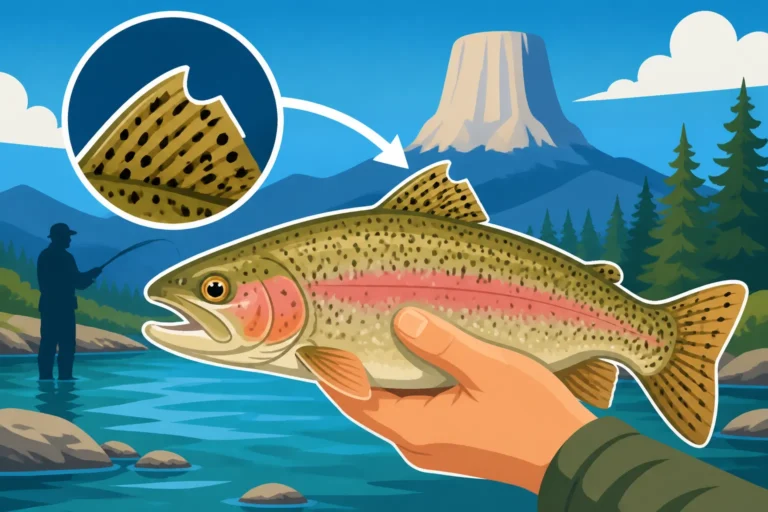
Rainbow trout are perhaps the most common trout encountered in stocked lakes and major river tailwaters like the North Platte. Identification begins with the body shape and pattern. Rainbows feature a silver-to-olive body coated in small, uniform dark spots that cover the head, body, dorsal fin, and tail. Their hallmark feature is a broad, pink-to-magenta lateral stripe running down the middle of the body from the gill cover to the tail base. Crucially, a pure rainbow trout lacks any red slashes under the jaw.
However, when rainbow trout and cutthroat trout share the same spawning gravels, they interbreed to create a hybrid known as a cutbow. Knowing What Are Cutbow Trout? is essential because their features are a blend of both parents. A cutbow typically displays the overall spotting pattern and bright pink lateral stripe of a rainbow, but retains a pale yellow or orange slash underneath the jaw. If you land a fish that looks like a rainbow trout but features faint jaw marks, you are holding a cutbow. When sorting out confusing catches, using a pair of polarized sunglasses ordered on Amazon can help you spot the pink hue and jaw marks while the fish is still resting in your net in shallow water.
Brown Trout
Native to Europe, brown trout are now firmly established in Wyoming’s medium and large rivers, as well as many mid-elevation reservoirs. Unlike rainbows and cutthroats, brown trout do not have dark spots on a light background alone; they feature a distinct combination of black and bright orange or red spots surrounded by pale blue halos.
The body color of a brown trout ranges from buttery yellow on the lower flanks to a dark brownish-olive along the back. Their belly is usually pale white or creamy yellow without any pink stripes or jaw slashes. During the autumn spawning run, male brown trout develop long, hooked lower jaws known as kypes and turn a deep mahogany shade. You will frequently encounter brown trout on famous tailwaters like Gray Reef or the Miracle Mile.
The Char Family: Lake Trout, Brook Trout, and Splake
Technically speaking, several popular game fish that anglers call trout are actually members of the char family. From an identification standpoint, char are easy to distinguish from true trout: true trout have dark spots on a lighter background, whereas char have light spots on a dark background.
Brook Trout
Brook trout were introduced to Wyoming’s high-country streams and alpine lakes from eastern North America. They are easily one of the most colorful fish in the state. When evaluating a fish for Identifying Brook Trout vs Brown Trout, look closely at the body background and the edges of the lower fins.
A brook trout has a dark olive or slate-colored back covered in a squiggly, worm-like pattern called vermiculation. Its sides are dotted with bright red or pink spots surrounded by bright blue halos, set against a dark body. The definitive identification mark for a brook trout is the leading edge of its lower fins: the pectoral, pelvic, and anal fins feature a sharp, snow-white front edge backed immediately by a black stripe. During fall spawning, the bellies of male brook trout turn a brilliant, fiery orange-red.
Lake Trout (Mackinaw)
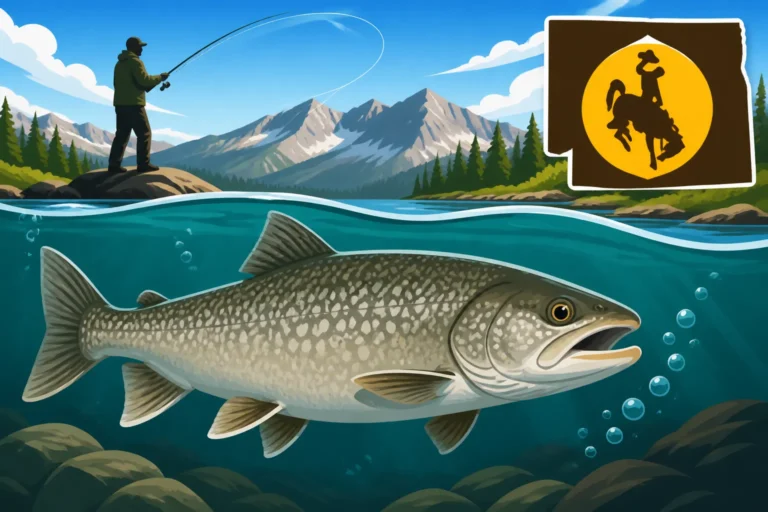
Lake trout, often called Mackinaw, are the apex predators of deep lakes like Flaming Gorge, Jackson Lake, and Fremont Lake. If you are researching Where to Find Mackinaw (Lake Trout) in Wyoming, you will likely target deep structure using heavy trolling gear.
Identifying a lake trout is straightforward:
1. Look for a deeply blue-gray, silver, or olive-green body completely covered in pale, cream-colored spots.
2. Examine the tail fin; lake trout possess a deeply fork-shaped tail, unlike the square or slightly notched tails of brook trout, rainbows, or browns.
3. Check the body shape. Lake trout have sleek, elongated bodies and large, broad heads designed for swallowing large prey fish like kokanee salmon or whitefish.
Splake Hybrids
Splake are a hatchery-produced hybrid resulting from a cross between a female lake trout and a male brook trout. They are stocked in select Wyoming lakes to help control overpopulated prey fish while offering a hard-fighting game fish.
Physically, splake exhibit a mixture of both parent species. They feature the vermiculated worm-like pattern on their backs similar to a brook trout, but their tails are moderately forked—deeper than a brook trout’s square tail, but not as deeply notched as a lake trout’s. They often possess light-colored spots on a dark body and light leading edges on their fins, though the black stripe behind the white fin edge is usually less pronounced than on a pure brook trout.
High-Alpine Specialties: Golden Trout and Tiger Trout
For anglers willing to hike deep into Wyoming’s wilderness areas, a few specialized trout species provide incredible reward and unique identification characteristics.
Golden Trout
Golden trout are native to California’s Sierra Nevada mountains but were introduced to the high-elevation lakes of Wyoming’s Wind River Range and Beartooth Mountains decades ago. Today, targeting Golden Trout in Wyoming’s High Lakes is a bucket-list experience for high-country anglers.
A golden trout is unmistakable due to its intense coloration:
* The belly and gill covers are a brilliant, shimmering orange-red.
* The sides are bright yellow-gold, split by a faint lavender or olive lateral band.
* Dark, oval vertical marks known as parr marks usually remain visible along the sides of adult fish.
* Small, distinct black spots are confined strictly to the tail fin and dorsal fin, leaving the main body virtually spot-free.
* The tip of the dorsal, anal, and pelvic fins end in stark white points.
Tiger Trout
Tiger trout are a sterile hybrid created by crossing a female brown trout with a male brook trout. Because they cannot reproduce, fish managers stock them in specific waters to manage stunted forage fish populations and create unique angling opportunities.
The tiger trout gets its name from its wild visual appearance. The squiggly vermiculation pattern normally found only on the back of a brook trout covers the entire body of a tiger trout, creating a maze-like, tiger-stripe effect of dark olive brown swirling over a yellow or brassy background. The belly is often warm orange, and the fins carry an orange tint with light leading edges. Because of their aggressive nature, they strike lures hard and put up an exceptional fight.
Quick-Reference Trout Identification Table and Field Tips
To help you distinguish between these species while on the water, use the comparative identification matrix below before handling your catch.
| Trout Species | Background Body Color | Spot Patterns & Colors | Key Distinguishing Feature |
|---|---|---|---|
| Yellowstone Cutthroat | Yellow-brown to olive | Large dark spots clustered toward the tail | Red slashes under jaw; head is mostly spot-free |
| Snake River Cutthroat | Amber to golden-brown | Thousands of tiny, pepper-like dark spots | Tiny spots cover entire body from head to tail |
| Rainbow Trout | Silver to greenish-olive | Small dark spots across entire body and fins | Broad pink/red lateral stripe; no jaw slashes |
| Cutbow Hybrid | Silver to golden-pink | Small dark spots across body and dorsal fin | Pink lateral stripe combined with pale red jaw slashes |
| Brown Trout | Buttery yellow to dark olive | Black and red/orange spots with pale blue halos | Yellow belly; dark and orange spots; no red jaw slash |
| Brook Trout | Dark slate to olive | Pale cream spots plus red spots with blue halos | White front edges backed by black on lower fins |
| Lake Trout | Blue-gray to silver-green | Numerous pale, light-colored spots across body | Deeply forked tail; light spots on dark background |
| Golden Trout | Brilliant yellow and orange | Small black spots restricted to tail and dorsal fin | Intense golden sides, red belly, persistent parr marks |
| Tiger Trout | Brassy yellow to light olive | Dark, swirling maze patterns (tiger stripes) | Labyrinthine stripe pattern across entire body |
Stream-Side Identification and Handling Steps
When catching fish in Wyoming rivers, following a quick, systematic check ensures you identify the fish correctly without causing unnecessary stress to the animal. Keeping a compact pocket waterproof field guide or a quick-reference card stored in your vest—both easy to pick up on Amazon—makes field checks seamless.
- Keep the fish submerged: Keep the trout in your net submerged in water while you examine its features. Avoid laying the fish on dry rocks or grass, which removes their protective slime coat.
- Check under the jaw: Look closely at the folds beneath the lower jaw. Bright red or orange slashes indicate a pure cutthroat or a hybrid cutbow.
- Analyze the spot type: Determine whether the spots are dark on a light background (true trout like rainbows, cutthroats, and browns) or light on a dark background (char like brook trout and lake trout).
- Examine the fins: Look at the lower fins for white leading edges, which signal brook trout or splake, and check whether the tail is square, slightly notched, or deeply forked.
- Review local regulations: Match your confirmed species identification against the water-specific regulations booklet. Rules regarding Understanding Wyoming’s Daily Bag Limits by Species vary widely between body of water types, so knowing exact species details keeps you legal.
Knowing how Cutthroat vs Rainbow Trout: Telling Them Apart works in practice protects fragile native populations and helps state biologists manage fisheries effectively. Before heading out, double-check your target water’s rules on How Bag and Possession Limits Work in Wyoming and verify the local Wyoming Trout Stream Daily Limit so you can enjoy your day on the water with complete peace of mind.
Disclaimer
This article is for general informational purposes only and does not constitute professional advice. Laws, prices and regulations vary by location and change over time. Consult a qualified professional for guidance on your specific situation.