How to Read a Wyoming River From a Drift Boat
There's a special kind of freedom that comes with drifting down a Wyoming river in a boat, the current guiding you through breathtaking landscapes. But that serene float can quickly turn into a frustrating quest if you don't know how to "read" the water effectively. This comprehensive guide is all about equipping you with the skills and observational techniques needed to identify those prime fish-holding lies from your moving vantage point, ensuring your next float trip is filled with more hook-ups and less head-scratching.
The Unique Challenge of River Reading from a Drift Boat
When you're standing on the bank, reading a river feels straightforward enough. You can see the eddies, the current seams, the submerged rocks. But once you step into a drift boat and that current takes hold, everything changes. The river seems to fly by, and those subtle cues can become a blur. It's a completely different perspective, and it takes practice to adjust your eyes and your strategy.
Why Drifting Changes Your Perspective
From a drift boat, you're constantly in motion, which means the river's features are also in constant motion relative to you. What might be a clear, deep slot directly ahead one moment becomes a fleeting glimpse as you pass it. This dynamic viewpoint demands quick decision-making and an ability to anticipate what's coming next. It's not just about seeing a good spot; it's about seeing it in time to get a cast off, execute a proper drift, and be ready for a strike before you've floated past the opportunity. This is where many anglers, even experienced ones, struggle initially. The steady pace of the current dictates your timing, unlike wading where you can linger and explore.
The angle at which you approach a piece of water also dramatically shifts. What looks like a gentle current from the bank might reveal a powerful subsurface boil or a tricky cross-current seam once you're on top of it. Your ability to cast accurately and control your line from a moving boat, often while facing upstream or across, is paramount. You're not just reading the water; you're reading the water as it moves under and around your boat, which requires a kind of spatial awareness that only comes with experience.
Overcoming the Current's Influence
The current isn't just a force that moves your boat; it's a fundamental element that shapes the river and dictates where fish will hold. Fish are inherently lazy, or rather, incredibly efficient. They seek out spots where they can expend minimal energy while having easy access to food. This almost always means current breaks – places where the fast-moving main channel meets slower water, or where an obstruction creates a calm pocket. Understanding these dynamics is the first step to successful river reading from a boat.
Your oarsman (or you, if you're pulling the sticks) plays a crucial role in overcoming the current's influence. A good oarsman can slow the boat, hold it in a productive seam, or adjust the angle to give you the best shot at a holding lie. This collaboration transforms the boat from a passive floatation device into an active fishing platform. Without someone skillfully managing the boat, even the best river reader will struggle to make effective presentations. It’s a dance between the angler and the oarsman, where precise boat control allows you to capitalize on the fish-holding features you've identified. It's often said that a good guide is 80% oarsman and 20% fishing expert, and that's largely because of the importance of boat control in enabling effective fishing.
Key Features to Spot and Understand
To truly read a Wyoming river from a drift boat, you need to know what you're looking for. It's not just about spotting water that looks fishy; it's about understanding why fish are there. Wyoming's rivers offer a rich tapestry of features, each holding its own secrets for the observant angler.
Decoding Riffles, Runs, and Pools
These are the fundamental building blocks of any trout stream, and from a drift boat, recognizing them quickly is crucial.
- Riffles: These are the shallow, fast-moving sections of the river, often characterized by choppy, disturbed water over a rocky bottom. While they might seem too fast, the broken surface provides cover from overhead predators, and the turbulent water oxygenates the stream and dislodges insects, making them feeding zones. You'll often find smaller, aggressive fish here, or larger fish moving in and out to feed. As you drift into a riffle, look for slightly deeper channels or larger rocks that create subtle current breaks where fish might hold out of the main flow. Don't be fooled into thinking riffles are just for small fish; sometimes a big brown will lurk just behind a large boulder, darting out to grab a meal.
- Runs: Longer, deeper, and often smoother sections of water, runs typically follow riffles. They have a consistent current and are often prime feeding and holding water for a variety of trout species. Look for uniform depth and current, but pay close attention to the edges, any visible structure, or subtle changes in depth that might indicate a fish lie. The "tongue" of a run, where the faster water from the riffle smooths out, is often a hot spot. Fish will often spread out in runs, making them excellent places for covering a lot of water with various presentations. For more on this, check out Reading Riffles and Runs on Wyoming Trout Streams.
- Pools: Pools are the deepest, slowest-moving sections of the river. They provide refuge from strong currents and offer cool, stable water during hot weather or low flows. Pools are often where larger, more wary fish will reside, especially during non-feeding times. From a drift boat, you’ll want to target the entry and exit points of pools, as well as any significant structure within them like submerged logs, large boulders, or deep depressions. While the middle of a large, featureless pool might seem barren, the deeper sections near the banks or around structure can be goldmines. You might even find some productive water by focusing on How to Fish a Deep Pool for Big Trout.
Identifying Seams and Current Breaks
If there's one thing you should be constantly scanning for from your drift boat, it's seams and current breaks. These are the lifeblood of a trout river.
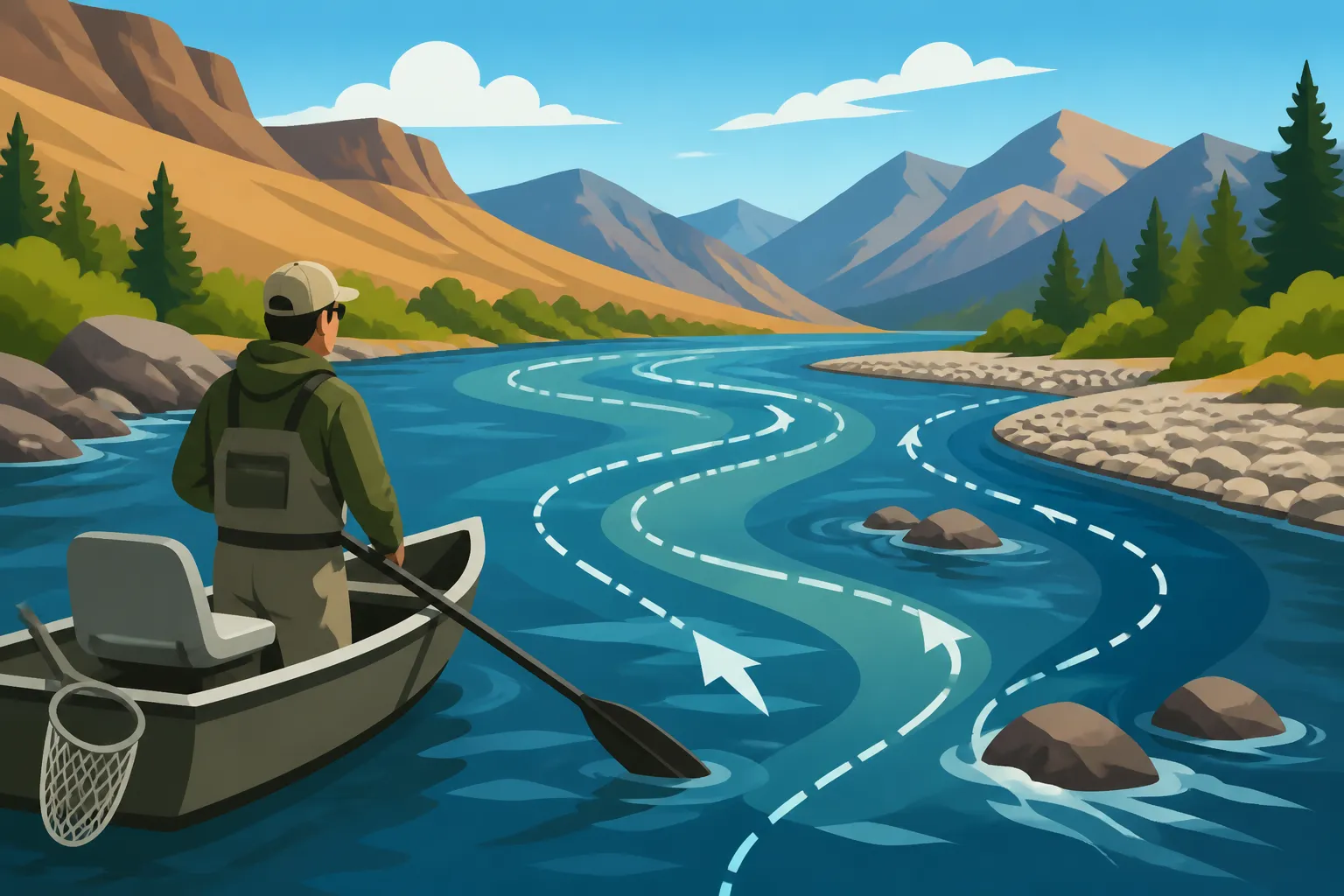
- Seams: A seam is essentially the boundary where two different currents meet, or where fast water transitions to slow water. Think of the distinct line where the main current brushes past an eddy, or where the turbulent water from a riffle smooths out into a run. Fish love seams because they deliver a conveyor belt of food on the faster side, while providing a low-energy resting spot on the slower side. From a boat, you want to position yourself to cast into the faster water and let your fly or lure drift naturally along the seam into the slower water where fish are likely holding. The challenge is often getting your boat into the right position without spooking the fish in the seam itself.
- Current Breaks: These are created by any obstruction that slows or diverts the flow of water. Rocks, logs, submerged boulders, even changes in the river bottom can create a current break. Behind or alongside these breaks, fish can hold comfortably out of the main current, waiting for food to drift by. Identifying these from a moving boat requires a keen eye for subtle disturbances on the water's surface, or even a slight color change indicating deeper water or submerged structure. Don't underestimate even small current breaks; a single baseball-sized rock can create enough of a calm spot for a respectable trout to lie in wait. A good pair of polarized sunglasses, available on platforms like Amazon, can dramatically improve your ability to spot these crucial subsurface features.
Undercut Banks and Overhanging Vegetation
These natural features are absolute magnets for fish, offering both shelter and food.
- Undercut Banks: These are formed when the river current erodes the bank beneath the surface, creating a hollowed-out space. They offer prime protection from predators, strong currents, and often provide cooler water. Fish, especially larger brown trout, absolutely love to hide in undercut banks. From a drift boat, you need to cast your offering right up against or even under the bank itself. This is often a difficult cast, requiring accuracy and a delicate touch to avoid snagging. Look for darker water against the bank, or swirling eddies that suggest a hollowed-out area. Knowing How to Fish an Undercut Bank effectively from a boat will significantly increase your success.
- Overhanging Vegetation: Trees, bushes, and tall grasses that hang over the water's edge provide shade, which keeps the water cooler, and also drop terrestrial insects (grasshoppers, ants, beetles) into the river. This makes them natural feeding stations. Again, the key is to get your fly or lure as close as possible to, or even slightly under, this vegetation. The deeper the shade, and the more abundant the insects you see, the more likely you are to find fish tucked in there. A well-placed cast under an overhanging branch, often requiring a roll cast or a side-arm presentation, can often yield an immediate strike from a hungry trout.
Structure on the River Bottom
While harder to see from a moving boat, understanding bottom structure is key to reading the river effectively.
- Rocks and Boulders: These create current breaks and eddies, as discussed. Larger rocks provide more substantial holding lies. From a drift boat, you'll often infer their presence by observing disturbances on the water's surface – boils, seams, or sudden changes in current direction. In shallower, clearer water, you might actually see them, but in deeper or slightly off-color water, you have to interpret the surface clues.
- Ledges and Drop-offs: Changes in depth are almost always productive. A sharp drop-off from a shallow flat into a deeper channel creates a natural current break and a distinct holding zone. Fish will often sit right on the edge of these ledges, darting into the shallower water to feed. You can often identify these by looking for a darker band of water or a sudden smoothing of the surface. Pay close attention to your depth finder if you have one, or simply note where the water visibly deepens.
- Submerged Logs and Root Wads: These provide incredible cover and current breaks. They can be tricky to fish because of snags, but they are absolutely worth the risk. Look for branches poking out of the water, or for foam lines and eddies that seem to form out of nowhere. If you suspect a submerged log, approach cautiously, and try to get a fly or lure to drift alongside it. Sometimes, a quick tug from a small jig or worm, easily available on Amazon, can reveal whether it's just a snag or a potential fish haven.
Mastering Boat Position and Presentation
Reading the river from a drift boat isn't just about spotting features; it's about translating that knowledge into effective fishing. Your boat position and how you present your offering are inextricably linked to your ability to interpret the water.
The Art of the Angle and Drift
This is perhaps the most critical skill when fishing from a drift boat. It's not enough to simply float down the river; you need to manage your boat's angle and speed to optimize every cast. The goal is often to maintain a boat speed that allows your fly or lure to drift naturally, at the same speed as the current, for as long as possible through a productive zone.
Your oarsman will use the oars to slow the boat down, often moving slower than the current itself, which is known as "back-rowing" or "checking" the boat. This gives you more time to target specific lies and achieve longer, drag-free drifts. As an angler, you'll need to communicate clearly with your oarsman: "Hold us here for a bit," or "Let's slide further left on this seam." The angle of the boat also matters. Sometimes you want to be perpendicular to the bank to cast across; other times, you want to be slightly angled downstream to allow for a longer, more direct presentation into a particular pocket. Practicing your casting from various angles will make a huge difference, especially when trying Fly Fishing Techniques for Wyoming Trout Streams.
Anticipating the Next Productive Spot
The river is constantly moving, and so are you. This means you can't just react to what's right in front of the boat. A successful drift boat angler is always looking ahead, anticipating the next riffle, the upcoming bend, the deep slot behind a boulder. This foresight allows your oarsman to position the boat optimally for the next cast, and it allows you to mentally prepare your presentation.
For example, if you see a beautiful eddy forming downstream, you might tell your oarsman to angle the boat to allow for a perfect cross-current cast that will let your fly swing into that eddy. Or if you see a series of undercut banks coming up, you'll want to ensure you have enough line out and are ready for those tricky, close-quarter casts. This constant forward-thinking is a hallmark of an experienced drift boat angler and significantly reduces missed opportunities. It's like playing chess with the river, always planning several moves ahead.
Communication with Your Oarsman
This cannot be stressed enough. A great fishing day from a drift boat is almost always a result of excellent communication between the angler and the oarsman. You need to be vocal about what you're seeing, what you want to target, and how you want the boat positioned. Don't assume your oarsman knows what you're thinking; they're busy navigating the boat safely while also trying to put you on fish.
Here’s a small table illustrating effective communication cues:
| Situation | Angler's Call to Oarsman | Oarsman's Action |
|---|---|---|
| Approaching a promising run or seam | "Let's slow down and hold on this seam." | Back-rows gently, maintaining position. |
| Spotting an undercut bank or log ahead | "Can you get us closer to that bank, just a bit?" | Adjusts boat angle and proximity to the bank. |
| Missing a fish or getting a snag | "Hold up for a second, I need to re-rig/untangle." | Holds boat in current, allowing angler to fix issues. |
| Wanting to cover a wide section of water | "Let's swing wide here and cover the whole flat." | Adjusts drift path to maximize coverage. |
| Needing to fish slower, deeper water | "Can we pause on this deep pool for a few casts?" | Holds boat or gently sweeps back and forth over the area. |
This collaborative approach ensures that you're both working in harmony with the river, maximizing your chances of success. Good communication is just as important as reading the water itself, and a comfortable rapport will make the whole experience more enjoyable.
Environmental Cues and Conditions
The river isn't a static environment; it's constantly changing with the weather, time of day, and season. Being able to factor these external conditions into your river reading will give you a significant advantage.
How Light and Water Clarity Influence Your Read
Light and water clarity are two of the most significant environmental factors affecting how you read a river and how fish behave.
- Light: On bright, sunny days, fish often seek deeper water or the shade of undercut banks and overhanging vegetation. The glare on the water's surface can also make it incredibly difficult for you to see subtle features. This is where those polarized sunglasses, perhaps a high-quality pair ordered from Amazon, become absolutely indispensable. In low light conditions, like early morning, late evening, or overcast days, fish tend to be more active and less wary, often moving into shallower feeding lies. The absence of harsh glare also makes it easier to spot underwater structure. Pay attention to shadows cast by the sun; fish often position themselves in these shaded areas for comfort and concealment.
- Water Clarity: Crystal clear water means you can see everything – and the fish can see you! This calls for longer leaders, smaller flies, and a stealthier approach. You'll be able to spot fish more easily, but they'll also be quicker to spook. On the other hand, slightly off-color or "stained" water, often found during Fishing Wyoming During Spring Runoff, can be fantastic for fishing. The reduced visibility makes fish feel more secure and less wary, and it allows you to use heavier tippet and larger presentations. However, it also makes it much harder to visually pick out those key holding lies, forcing you to rely more on reading the current and anticipating structure. Knowing How Water Temperature Changes Wyoming Trout Behavior will also help you understand how fish react to different water conditions.
Wind, Weather, and Water Levels
These elements all play a dynamic role in river fishing and reading.
- Wind: Wind can be a blessing or a curse. A light breeze can create a chop on the water's surface, breaking up the reflection and making fish feel more secure. It can also blow terrestrial insects into the water, triggering a feeding frenzy. However, strong winds can make casting incredibly difficult, create boat control challenges for your oarsman, and generate confusing surface currents that obscure fish-holding lies. On windy days, focus on protected banks or deeper, calmer sections where fish are less affected by the surface disturbance. A wind-resistant jacket is a must-have for comfort, and you can find a wide selection of fishing apparel on Amazon.
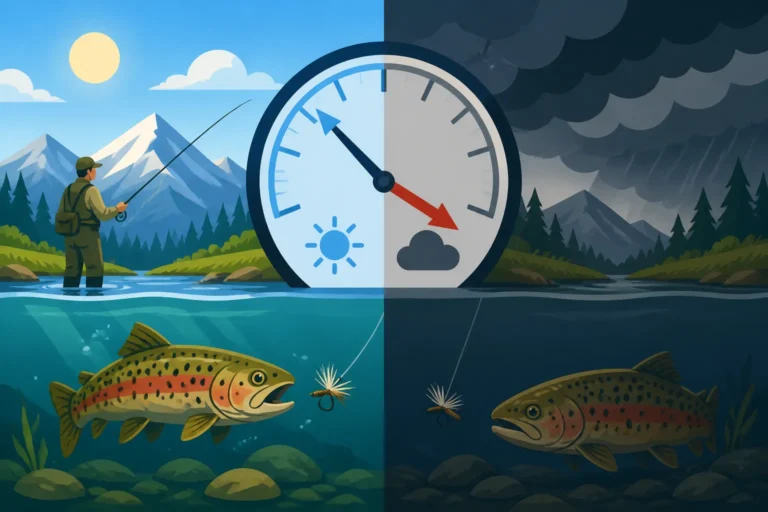
- Weather: Beyond light conditions, broader weather patterns influence everything. A cold front moving in can shut fish down, making them less active and harder to tempt. Conversely, a warm front or a steady drizzle can invigorate fishing, especially for trout. Thunderstorms can quickly raise water levels and decrease clarity, necessitating a change in tactics and river reading. Always check the forecast before your trip and adjust your expectations and techniques accordingly.
- Water Levels: High water, often associated with spring runoff or heavy rains, means faster currents and expanded habitat. Fish might move into slower-moving eddies, flooded vegetation, or side channels. Low water, common in late summer or during drought years, concentrates fish in deeper pools and runs, but can also make them more stressed and wary. Learning to adapt your river reading to current water levels is crucial. High water might obscure familiar features, while low water might expose new ones. Always consult local reports from the Wyoming Game and Fish Department to understand current conditions, which can be critical for safety and success.
Reading a Wyoming river from a drift boat is a skill that blends observation, anticipation, and communication. It's an ongoing learning process, constantly refined with every bend of the river and every cast. Embrace the challenge, stay observant, and enjoy the incredible experience of connecting with nature and its wild inhabitants.
Disclaimer
This article is for general informational purposes only and does not constitute professional advice. Laws, prices and regulations vary by location and change over time. Consult a qualified professional for guidance on your specific situation.