How Old a Wyoming Lake Trout Can Get
There's a special kind of wonder that comes with pulling a truly massive lake trout out of Wyoming's deep, cold waters. Beyond the thrill of the fight, many anglers find themselves gazing at these magnificent fish and asking: just how old is this creature? It's a question that speaks to the incredible journey these fish undertake, surviving years, even decades, in some of the West's most pristine and challenging environments. This guide is dedicated to exploring the fascinating longevity of Wyoming's lake trout, diving into what makes them tick, how we figure out their age, and where these grand old fish call home.
The Astonishing Lifespan of Wyoming's Lake Trout
When you think about fish, you might not imagine them living for a very long time, but Wyoming's lake trout, often called Mackinaw, can be truly ancient. While not every lake trout will reach extreme old age, these fish are built for endurance in the deep, cold waters they inhabit. Their ability to survive for many years is a testament to their adaptability and the robust ecosystems they thrive in.
It’s not uncommon for anglers and researchers to encounter lake trout that have seen many, many seasons. These fish aren't just big; they're living history, carrying the stories of countless winters and summers in their very being. The sheer longevity is one of the most remarkable characteristics of the species, allowing them to grow to truly impressive sizes and become the apex predators of their aquatic homes. If you've ever landed one of these giants, you know it feels like you've connected with something ancient, and in many cases, you have!
Factors Influencing Lake Trout Longevity
Just like us, a lake trout's lifespan isn't predetermined by genetics alone. A whole host of environmental and external factors play a huge role in how long these fish will grace Wyoming's waters. Understanding these elements can help you appreciate the journey each fish has taken and why certain lakes produce older, larger specimens.
First and foremost is the water temperature. Lake trout are cold-water fish, through and through. They thrive in the deep, frigid parts of lakes and reservoirs. Waters that stay consistently cold, even during the peak of summer, are crucial for their long-term health and survival. Warmer waters stress these fish, can lead to faster metabolisms, and ultimately, shorter lifespans. Think of it like a natural refrigerator: the colder it is, the slower things metabolize and age. Lakes like Flaming Gorge Reservoir and Jackson Lake offer vast expanses of deep, cold water that are ideal for these temperature-sensitive fish. You can learn more about how crucial this is in How Water Temperature Changes Wyoming Trout Behavior.
Next up is food availability. A thriving lake trout needs a consistent and abundant food supply. In many Wyoming reservoirs, their diet consists of smaller fish like kokanee salmon, cisco, or even other trout species. A healthy forage base means the lake trout can grow steadily and maintain their health without expending excessive energy seeking food. When food is scarce, fish grow slower, are more prone to disease, and might not have the energy reserves to survive harsh winters or spawning cycles.
Habitat quality is another non-negotiable factor. Lake trout need clean, well-oxygenated water, plenty of deep structure for hiding and ambush points, and suitable spawning grounds. A lake with diverse bottom contours, rocky ledges, and deep basins provides ample protection from predators and opportunities to feed. Pollution or habitat degradation can quickly diminish a lake's ability to support a robust population of long-lived lake trout.
Finally, fishing pressure plays a significant role, especially when we talk about trophy-sized, older fish. In waters with high fishing pressure and liberal harvest limits, fewer fish will survive to old age. Conversely, lakes with strict slot limits, reduced bag limits, or strong catch-and-release ethics tend to produce more older, larger fish. It's a balance between enjoying the resource and ensuring its long-term health. Knowing Wyoming Fishing Regulations Every Angler Should Know is crucial for all of us.
Age vs. Size: Not Always What You'd Expect
It's a common misconception that the biggest fish is always the oldest fish. While there's certainly a correlation – you don't get massive without some years under your belt – it's not a direct, one-to-one relationship. Just like people, fish grow at different rates depending on their individual genetics, the quality of their diet, and the specific conditions of their environment.
Imagine two lake trout born in the same year. One lives in a section of a reservoir with an incredibly rich food supply and ideal temperatures, perhaps near a consistent source of forage fish. This fish might grow rapidly, becoming quite large in a relatively short amount of time. The other fish might live in a slightly less abundant area, perhaps needing to work harder for its meals or enduring slightly less optimal conditions. This second fish might be the same age but considerably smaller. So, while both are venerable members of their ecosystem, one might simply be a "fast grower."
This phenomenon is why scientists can't just weigh and measure a fish to tell its age. A 20-pound lake trout from one lake might be 15 years old, while a 20-pounder from another lake could be 20 or even 25 years old. This variability makes the scientific methods of aging fish even more fascinating and necessary. Understanding that size isn't the sole indicator of age helps us appreciate that every big fish is a survivor, regardless of its exact number of years. If you're wondering How Big Wyoming Lake Trout Get, remember that age is just one piece of that puzzle.
How Scientists Determine Lake Trout Age
So, if you can't just guess a lake trout's age by its size, how do biologists figure it out? The process is a lot like dating a tree, but instead of rings in the trunk, they look for rings in specific bony structures of the fish. It's a blend of careful collection and precise laboratory analysis, revealing incredible insights into a fish's life story.
This scientific detective work is vital for managing fish populations. By understanding the age structure of a lake trout population, wildlife agencies can make informed decisions about harvest limits, stocking programs, and habitat protection. Knowing how many old, mature fish are in a system helps them ensure the future health and sustainability of these valuable fisheries.
The Science of Otoliths (Ear Bones)
The primary and most accurate method for determining the age of lake trout, especially older ones, involves examining their otoliths. What are otoliths? They are small, calcium carbonate structures found in the inner ear of bony fish. Often called "ear stones," these structures are essential for a fish's balance and hearing. But for biologists, they are like nature's tiny hard drives, recording the fish's entire life history.
Otoliths grow continuously throughout a fish's life, adding layers of material much like a tree adds growth rings. During periods of rapid growth (typically in warmer seasons when food is abundant), the layers are wider and less dense. During periods of slower growth (like cold winters when food is scarce), the layers are narrower and denser. When an otolith is cut in cross-section, polished, and viewed under a microscope, these alternating bands of dense and less dense material appear as distinct rings, called annuli. Each annulus represents approximately one year of the fish's life.
The process of analyzing otoliths is meticulous. First, the fish needs to be harvested (which is why this method is usually done on fish collected for research or those legally harvested by anglers). The otoliths are then carefully removed from the fish's head. In the lab, they are embedded in epoxy resin, sectioned using a precision saw to expose the core, and then painstakingly polished. Finally, a trained technician or scientist examines the polished section under a microscope, counting the annuli to determine the fish's age. It's a labor-intensive but highly reliable method, especially for those truly ancient lake trout where scales might be less accurate.
Other Methods and Their Limitations
While otoliths are the gold standard for aging lake trout, especially the big ones, other methods have been used, though with varying degrees of accuracy.
One common method involves examining scales. Like otoliths, fish scales also grow throughout the fish's life, adding rings (called circuli) that can form annuli. Scales are much easier to collect than otoliths – you can simply scrape a few off the fish without harming it. For younger, faster-growing fish, scale readings can be quite accurate. However, as fish age, their scales can become worn, regenerated, or the growth rings can become compressed and difficult to distinguish. For very old lake trout, scale readings often underestimate the fish's true age, making them less reliable for determining maximum lifespan.
Another method involves fin rays. Similar to otoliths, the rays of certain fins (like the pectoral or dorsal fin) can also exhibit growth rings. A small section of a fin ray can be removed without critically harming the fish, making it a less invasive method than otolith removal. The fin ray is then sectioned, polished, and examined under a microscope, much like an otolith. This method is often more accurate than scales for older fish, but still generally considered less precise than otolith analysis, particularly for the oldest specimens.
Each method has its trade-offs between invasiveness, ease of collection, and accuracy. For understanding the true maximum age and longevity of a species like the lake trout, the otolith method remains the most trusted tool in a biologist's toolkit.
Key Wyoming Lakes Known for Older, Larger Lake Trout
Wyoming is blessed with some incredible waters that provide the perfect habitat for lake trout to grow to impressive sizes and live for many, many years. These aren't just any old lakes; they are often deep, cold, and harbor abundant forage, creating ideal conditions for these long-lived predators. If you're looking for a chance to encounter a true leviathan, knowing which waters historically produce these ancient fish is key. For more on where these fish hide, check out Where to Find Mackinaw (Lake Trout) in Wyoming).
Flaming Gorge: A Haven for Ancient Mackinaw
When it comes to grand old lake trout in Wyoming, Flaming Gorge Reservoir often comes to mind first. This massive reservoir, straddling the Wyoming-Utah border, is a true Mecca for Mackinaw anglers, and for good reason. Its unique characteristics make it an almost perfect incubator for lake trout to reach truly astounding ages and sizes.
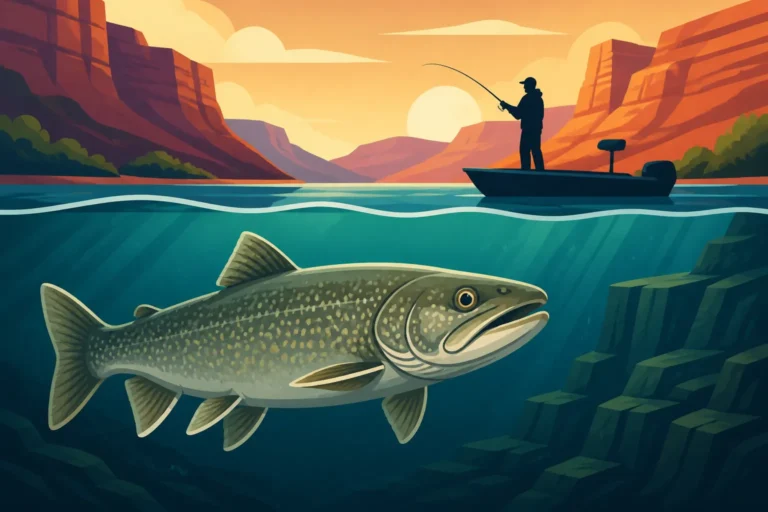
First off, Flaming Gorge is incredibly deep. We're talking hundreds of feet in many areas. This depth provides a huge volume of consistently cold water, even during the hottest summer months. As we discussed earlier, cold water is paramount for lake trout longevity. It allows them to maintain a slower metabolism, reduces stress, and provides comfortable habitat year-round. You can explore this further in How Deep Lake Trout Live in Flaming Gorge.
Secondly, Flaming Gorge boasts an incredibly rich and diverse forage base. Kokanee salmon, cisco, and even some chub species provide an abundant food source for the lake trout. A never-ending buffet means the lake trout don't have to work as hard to find food, allowing them to conserve energy and put more resources into growth and survival. These prolific forage fish are a primary reason why Flaming Gorge lake trout can grow so large and live so long. Many anglers target these larger lake trout using specialized Trolling Techniques for Wyoming Reservoirs.
Finally, the sheer size and complex underwater structure of Flaming Gorge offer countless hiding spots, ambush points, and safe havens for lake trout throughout their long lives. From submerged canyon walls to deep humps and ledges, there's ample protection from predators and plenty of prime real estate for these territorial fish. This combination of deep, cold water, abundant food, and complex habitat truly makes Flaming Gorge a premier destination for those hoping to encounter an ancient Mackinaw. For a deeper dive into this incredible fishery, consider reading Flaming Gorge Reservoir Fishing Guide.
Jackson Lake and Other Prime Habitats
While Flaming Gorge often steals the spotlight, other Wyoming waters also hold populations of impressive, long-lived lake trout. Jackson Lake in Grand Teton National Park is another iconic fishery known for its large and often ancient Mackinaw. Nestled within the stunning Teton Range, Jackson Lake offers deep, glacially carved waters that remain frigid year-round.
Jackson Lake's depths provide that essential cold-water habitat, allowing lake trout to mature slowly and reach considerable ages. The lake has its own unique forage base, contributing to the growth of these majestic fish. While fishing regulations and historical management approaches have varied, the inherent qualities of Jackson Lake's environment continue to support a population of long-lived lake trout. It's a truly special place to pursue these fish, surrounded by some of the most breathtaking scenery on Earth. You can discover more about fishing here in our Jackson Lake Fishing Guide.
Beyond these major reservoirs, Wyoming's high-country wilderness lakes can also harbor incredibly old lake trout. These remote, often glacier-fed lakes, while perhaps not producing the sheer size of fish found in Flaming Gorge, can yield fish that are surprisingly old for their dimensions. Their extreme cold, isolation, and often limited food sources mean growth is slow, but longevity can be exceptional dueishing to the slow metabolism induced by the cold. Think of fish in these lakes as slow-and-steady winners in the race of life. They might not pack on pounds quickly, but they persist for many, many years in their pristine, challenging environments. These secluded spots often require significant effort to reach, but the reward of connecting with a truly wild, ancient lake trout in a pristine mountain setting is unparalleled.
Here's a quick look at why certain lakes foster such old lake trout:
| Lake Feature | Impact on Lake Trout Longevity | Examples in Wyoming |
|---|---|---|
| Deep, Cold Water | Slower metabolism, reduced stress, year-round comfort | Flaming Gorge, Jackson Lake, Alpine Lakes |
| Abundant Forage | Consistent growth, strong health, energy reserves | Flaming Gorge (Kokanee, Cisco) |
| Complex Structure | Hiding spots, ambush points, protection from elements | Flaming Gorge (Canyons), Jackson Lake (Ledges) |
| Stable Ecosystems | Consistent food web, less environmental fluctuation | Remote high-country lakes |
| Managed Pressure | Allows more fish to reach older age classes | Waters with specific slot limits |
Protecting Wyoming's Grand Old Lake Trout
The magnificent lake trout that live for decades in Wyoming's waters are a precious resource, both ecologically and for the angling community. Encountering a fish that has survived for 20, 30, or even 40+ years is a profound experience. Protecting these grand old fish isn't just about ensuring future fishing opportunities; it's about respecting the incredible resilience of these creatures and preserving the integrity of their ecosystems.
Conservation and Management Efforts
Wyoming's Game and Fish Department plays a crucial role in managing lake trout populations, balancing fishing opportunities with conservation goals. Their efforts are designed to ensure that healthy populations of lake trout continue to thrive, including those that grow to impressive sizes and ages.
One key aspect of management is setting appropriate bag and possession limits. These limits control the number of fish an angler can keep, directly influencing how many fish survive to older age classes. In some areas, there might be lower limits for larger lake trout to protect potential trophy breeders, or even specific slot limits that require anglers to release fish within a certain size range while allowing harvest of smaller fish. These regulations are not arbitrary; they are carefully crafted based on scientific data about the specific lake trout population, its growth rates, and reproductive cycles.
Size restrictions, often in the form of slot limits or maximum size limits, are another tool. For example, a regulation might state that all lake trout between 24 and 30 inches must be released, while smaller or larger fish can be kept. This strategy aims to protect the prime spawning-size fish, allowing them to reproduce multiple times and contribute to the population's genetic diversity and overall health.
Beyond regulations, habitat protection and scientific research are ongoing. Biologists continuously monitor lake trout populations, studying their age structure (often through otolith analysis), growth rates, and spawning success. This data-driven approach allows for adaptive management, where regulations can be adjusted over time to respond to changes in the fishery or environmental conditions.
The Angler's Role in Lake Trout Longevity
While wildlife agencies set the rules, individual anglers hold immense power in protecting Wyoming's long-lived lake trout. Our actions on the water directly impact the survival of these fish, especially the older, larger ones that are more vulnerable to stress.
The most significant contribution an angler can make is practicing responsible catch-and-release, particularly for trophy-sized lake trout or when fishing in areas with sensitive populations. Catch-and-release isn't just about letting a fish go; it's about giving that fish the best possible chance of survival after it swims away. This means:
- Minimizing fight time: Bring the fish in as quickly as possible without over-stressing your tackle. A prolonged fight can exhaust a large fish, making it less likely to recover.
- Wet hands only: Always wet your hands before touching a fish. Dry hands can remove the protective slime coat, leaving the fish susceptible to infection.
- Keep them in the water: Whenever possible, unhook fish while they are still in the water. If you must bring them out for a quick photo, keep them out of the water for only a few seconds. The bigger the fish, the more critical this is. Holding a large lake trout horizontally, supporting its full weight, is crucial to prevent internal damage.
- Use appropriate gear: Heavy enough tackle minimizes fight time. Barbless hooks can also make unhooking easier and faster, reducing stress and injury.
- Know the regulations: Before you even cast a line, understand the specific regulations for the water body you're fishing. Are there slot limits? Is catch-and-release mandatory for certain sizes or species? Being informed is your first line of defense in conservation. Wyoming Fishing Regulations Every Angler Should Know is a vital resource.
- Revive, don't just release: If a fish seems sluggish after the fight, hold it gently in the water, facing into the current, until it regains its strength and can swim away on its own.
By embracing these practices, we ensure that those ancient, magnificent lake trout have the best possible chance to continue their long journey in Wyoming's waters, providing awe and excitement for generations of anglers to come. Their longevity is a gift, and our shared responsibility is to protect it.
Disclaimer
This article is for general informational purposes only and does not constitute professional advice. Laws, prices and regulations vary by location and change over time. Consult a qualified professional for guidance on your specific situation.