Is Catch-and-Release Required on Any Wyoming Rivers?
There's nothing quite as frustrating as heading out to a beautiful Wyoming river, ready to cast your line, only to realize you're unsure about the specific catch-and-release rules for that particular stretch of water. It can feel like navigating a maze, especially with all the nuances in regulations. This guide will cut through the confusion, helping you understand exactly where catch-and-release is required on Wyoming rivers and why it's so vital for our cherished fisheries.
Understanding Wyoming's General Catch-and-Release Philosophy
Wyoming is a state deeply committed to its wildlife and natural resources, and fishing regulations reflect that dedication. While many waters allow for harvest, there are specific areas where catch-and-release is a cornerstone of conservation. It’s not just a suggestion; it's often a legal mandate designed to protect fragile populations, ensure quality fishing experiences, and preserve the genetic integrity of native fish species.
The Why Behind Catch-and-Release Mandates
The primary reason for catch-and-release requirements is conservation. In certain river sections, fish populations might be particularly susceptible to overharvesting due to easy access, concentrated fish, or slower growth rates. This is especially true for trophy fisheries or waters with native species like the various subspecies of cutthroat trout. By requiring anglers to release their catch, the Wyoming Game and Fish Department (WGFD) aims to allow fish to grow larger, spawn multiple times, and contribute to a healthy, self-sustaining ecosystem. It’s about ensuring that those incredible angling opportunities remain for future generations. For many, it's a small price to pay to keep our fishing heritage strong.
Think about it: imagine a river stretch renowned for producing 20-inch brown trout. If everyone kept every fish they caught, those large, mature breeders would quickly disappear, and the quality of the fishery would decline rapidly. Catch-and-release acts as a safeguard, allowing these fish to continue their life cycle, reproduce, and challenge more anglers down the line. It really boils down to balancing human enjoyment with ecological responsibility.
General Statewide Regulations vs. Special Provisions
It's important to understand that Wyoming doesn't have a blanket catch-and-release rule across all its rivers. Instead, the WGFD employs a highly granular approach, assessing individual water bodies and their unique ecological needs. This means that while some rivers or lakes might have a general statewide regulation that allows for a certain bag limit, specific sections of a river—or even specific species within that river—might be designated as catch-and-release only. This is where the complexity comes in and why it's so crucial to check the regulations for your exact fishing location.
These "special provisions" are often put in place to protect specific species during vulnerable times, to manage trophy fisheries, or to aid in the recovery of native populations. For instance, a river might be open to bait fishing and allow a generous take on its lower stretches, but upstream, in prime spawning habitat, it could be fly-fishing-only with mandatory catch-and-release for all trout. Always remember that the rules can change literally mile by mile, sometimes even season by season, so you need to be diligent in checking your map and the WGFD regulations booklet. You can find general information on the overall Wyoming Fishing Regulations Every Angler Should Know.
Specific Wyoming Rivers with Catch-and-Release Requirements
When you're planning a trip to some of Wyoming's most iconic rivers, it's not a matter of if you'll encounter special regulations, but where and what those regulations entail. These are often the same rivers that offer world-class fishing, making their protection all the more important.
The North Platte River: A Prime Example
The North Platte River is arguably one of Wyoming's most famous trout fisheries, drawing anglers from all over the globe. Because of its popularity and the incredible size of its trout, several stretches are strictly catch-and-release.
- The Gray Reef Section: Just below Alcova Reservoir, the Gray Reef is renowned for its prolific numbers of large rainbow and brown trout. This section, particularly from the Gray Reef Dam downstream to the Bessemer Bend boat ramp, is largely managed as a catch-and-release fishery for all trout species. This helps maintain the high density of large fish that anglers seek. You might be able to find specific regulations regarding this section in resources like Fishing Gray Reef on Wyoming's North Platte River. The sheer volume of anglers on this section necessitates these rules to prevent depletion.
- The Miracle Mile Stretch: Further upstream from Gray Reef, between Seminoe Reservoir and Pathfinder Reservoir, lies the fabled Miracle Mile. This section is another gem that often has specific catch-and-release or very restrictive harvest limits for trout, particularly for brown and rainbow trout. Anglers frequently encounter trophy-sized fish here, and mandatory release ensures these powerful fish can continue to thrive and spawn. If you're heading to this legendary spot, it's imperative to confirm the current regulations, which can sometimes vary slightly with the time of year or specific water levels. Information about this section can be found in articles such as The Miracle Mile Stretch of Wyoming's North Platte River.
These sections are often fly-fishing-only or artificial-lure-only, further emphasizing the intent for minimal impact on the fish. You won't be using live minnows or worms in these hallowed waters.
Snake River and Its Tributaries
The Snake River system in western Wyoming, flowing through the stunning Jackson Hole valley, is another area where catch-and-release is frequently mandated, especially for the native Snake River Fine-Spotted Cutthroat Trout. This beautiful fish is a subspecies native to the Snake River drainage, and its conservation is a high priority.
- Main Stem of the Snake River: Many stretches of the Snake River, particularly within Grand Teton National Park and popular sections like those below Jackson Lake Dam, have restrictive harvest limits, often translating to mandatory catch-and-release for cutthroat trout. These regulations are designed to protect the genetic purity and population numbers of the native cutthroat, preventing them from being outcompeted or hybridized with introduced trout species. Detailed regulations for Fishing Wyoming's Snake River Below Jackson Lake Dam are a must-read if you plan to visit this area.
- Tributaries and High Mountain Lakes: Many of the smaller creeks and high-alpine lakes that feed into the Snake River system, especially those within wilderness areas or national parks, also carry catch-and-release rules. These are often fragile ecosystems where fish populations grow slowly and are easily impacted. Always check the specific regulations for any stream or lake you plan to fish in this region, as they can be highly localized.
Other Notable Rivers and Their Unique Rules
While the North Platte and Snake Rivers are the most well-known for extensive catch-and-release areas, other rivers in Wyoming also have special provisions:
- Green River (below Fontenelle Dam and Flaming Gorge Dam): While not entirely catch-and-release, certain stretches, particularly the productive tailwater below Fontenelle Dam, might have more restrictive limits on trout species than other parts of the river. The section of the Green River below Flaming Gorge Dam (often considered more Utah than Wyoming but sharing the border) is famous for its incredible trout fishing, and specific sections here might have catch-and-release rules or slot limits that encourage release of larger fish.
- Various Mountain Streams and Wilderness Lakes: Throughout Wyoming's vast mountain ranges, countless small streams and high-elevation lakes are managed for wild trout. Many of these waters have catch-and-release mandates, especially for native species like brook trout or golden trout, to protect their often-fragile populations. If you're venturing into the backcountry, assume more restrictive rules apply until you confirm otherwise. These areas are often more about the experience of catching wild fish than harvesting them.
Navigating Wyoming's Regulations for Catch-and-Release Waters
Successfully fishing Wyoming's diverse waters, especially those with catch-and-release mandates, requires more than just knowing which rivers have these rules; it demands knowing how to find and interpret them, and how to practice ethical catch-and-release.
How to Interpret the Wyoming Fishing Regulations Booklet
The official Wyoming Fishing Regulations Booklet is your bible. Seriously, it’s not light reading, but it’s absolutely essential. You can pick up a physical copy at any WGFD office, most sporting goods stores, or download the full PDF version from the WGFD website. Don't rely on old copies; regulations can change annually.
Here's how to tackle it:
- Start with the General Regulations: The booklet begins with statewide rules regarding licensing, legal fishing methods, bait, and general bag and possession limits for various species. This gives you a baseline.
- Locate Your Specific Water: The heart of the booklet is the "Water Specific Regulations" section. This is typically organized by drainage or region. Find the river or lake you intend to fish. It’s crucial to know not just the river name, but often the specific section of the river (e.g., North Platte River, Gray Reef Section) as regulations frequently change based on specific landmarks like bridges, dams, or confluences. This is where you'll find details like "All trout must be released" or "Only one trout over 16 inches may be kept."
- Read Carefully: Pay close attention to keywords like "Artificial Flies and Lures Only," "Catch and Release Only," "Closed to Fishing," or specific size and bag limits. The details matter! Sometimes, a water body might be catch-and-release for one species (like cutthroat) but allow harvest for another (like brook trout or lake trout). For more help, check out Reading the Wyoming Fishing Regulations Booklet. Even experienced anglers often double-check before heading out.
Table: Overview of Common Wyoming Catch-and-Release Waters/Sections
| River/Section | Primary Species Targeted | Typical Catch-and-Release Rule | Special Notes/Bait Restrictions |
|---|---|---|---|
| North Platte River (Gray Reef) | Rainbow, Brown Trout | All trout must be released | Artificial Flies & Lures Only, single-point barbless hooks |
| North Platte River (Miracle Mile) | Rainbow, Brown Trout | Often very restrictive/C&R | Artificial Flies & Lures Only, specific barbless hook rules |
| Snake River (Upper sections, GTNP) | Cutthroat Trout | All native cutthroat must be released | Artificial Flies & Lures Only, barbless hooks often required |
| Green River (below Fontenelle Dam) | Rainbow, Brown, Cutthroat | Often restrictive bag limits | Artificial Flies & Lures Only in some sections |
| Specific High Mountain Lakes | Golden, Brook, Cutthroat | Often mandatory C&R | Check regulations carefully, often artificial lures only |
Note: This table provides a general overview. Always consult the most current Wyoming Fishing Regulations Booklet for exact, up-to-date rules for your specific fishing location.
Best Practices for Catch-and-Release
If you’re fishing waters where catch-and-release is mandatory, or even just strongly encouraged, practicing proper techniques is vital for the fish's survival. Your gear selection, how you fight the fish, and how you handle it all play a role.
- Use Barbless Hooks: This is perhaps the single most important practice. Barbless hooks allow for quick, easy removal, minimizing damage to the fish's mouth. Many catch-and-release waters require barbless hooks. You can easily pinch down the barbs on most hooks with a pair of pliers. For specific information on where these are required, see Barbless Hook Requirements on the North Platte River. Even if not required, it's a good habit on any trout stream. You can find quality barbless hooks or tools to crimp barbs on platforms like Amazon.
- Minimize Fight Time: Land the fish as quickly as possible without "horsing" it in. A prolonged fight can exhaust the fish, making it harder for it to recover.
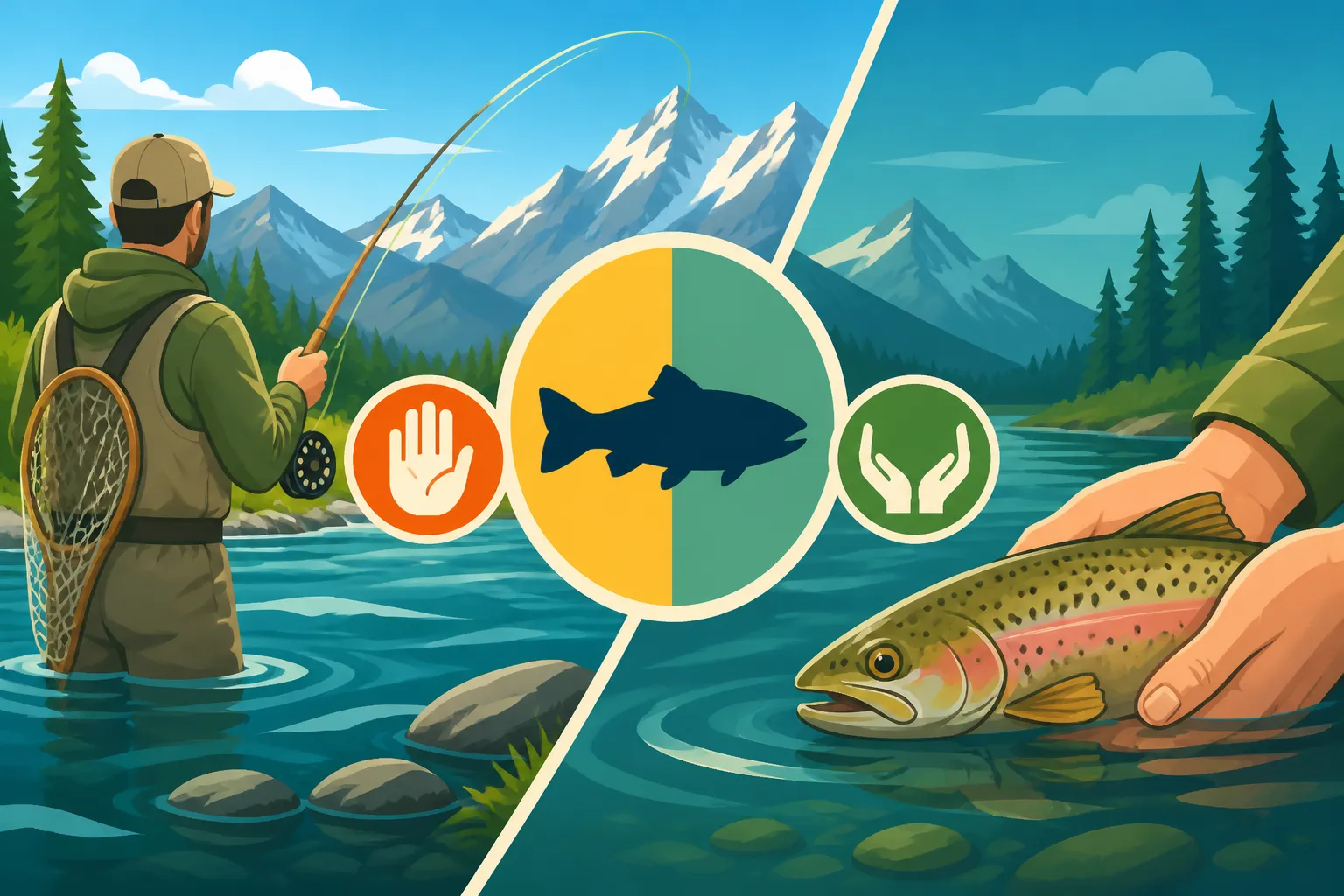
- Keep the Fish in the Water: This is paramount. Avoid taking the fish out of the water, especially larger trout, for photos. If you must, do it quickly, holding your breath for the duration, and keep your hands wet. The protective slime coat on fish is easily damaged by dry hands or contact with hot, dry surfaces, making them susceptible to disease.
- Handle with Care: Support the fish horizontally with wet hands. Avoid squeezing its belly or gills. If using a net, opt for a rubberized, knotless net which is much gentler on scales and fins than traditional nylon nets.
- Remove Hook Quickly: Use forceps or pliers to remove the hook as gently and quickly as possible. If the fish is deeply hooked, it’s often best to cut the line as close to the hook as possible rather than tearing internal organs.
- Revive Properly: If the fish seems lethargic, hold it upright in the water, facing upstream in a gentle current, until it can swim away under its own power. Don't try to "pump" it back and forth, as this can force water the wrong way through its gills. Just hold it gently until it kicks strongly. More detailed guidelines can be found in Catch and Release Best Practices for Trout and How to Handle a Trout to Keep It Alive After Release.
Common Misconceptions and FAQs About Catch-and-Release in Wyoming
Even with the best intentions, questions and confusion can arise when fishing catch-and-release waters. It's totally normal to have these, and addressing them can make your angling experience smoother and more ethical.
The "Accidental" Keep and What to Do
One of the most common anxieties for anglers on catch-and-release waters is what happens if a fish is accidentally injured so severely that it's unlikely to survive, or if it dies during the unhooking process.
In most catch-and-release scenarios in Wyoming, if a fish is caught on mandatory catch-and-release water and it dies, it must still be counted toward your daily bag limit if that species has an allowable bag limit elsewhere. If the species is protected with a zero bag limit on all waters, then unfortunately, there’s little you can do but release it, and it's considered an unfortunate loss. The WGFD regulations generally emphasize that "fish that are hooked and landed must be immediately released unharmed." The implication is that if it's not unharmed, it's a complication.
The best course of action is always to prioritize prevention through best practices. However, if a fish is truly mortally wounded and you're in a section of a river where some harvest is allowed (just not for larger fish, for example, like the "The One-Over-16-Inch Rule on Wyoming Trout Streams"), you might be able to keep it and count it towards your legal limit, assuming it falls within the size and species parameters for harvestable fish. But if you're on a strictly "all trout released" section, the fish cannot be legally possessed. It's a tough situation, but it underscores the importance of careful handling. If in doubt and you can reach them, contacting a local WGFD office or game warden is always the safest bet.
The Role of Barbless Hooks in Catch-and-Release
We touched on this briefly, but it's worth emphasizing the critical role of barbless hooks. On many of Wyoming's premier catch-and-release trout rivers, barbless hooks aren't just a suggestion; they are a legal requirement. This is particularly true on many sections of the North Platte River and the Snake River system.
- Why They're Required: Barbs, while designed to keep a fish on the hook, cause significant tissue damage when removed. They tear more flesh, prolong the unhooking process, and increase the likelihood of internal injury, especially if swallowed. Barbless hooks, conversely, slide out with minimal effort, reducing stress and physical harm to the fish, vastly improving its chances of survival after release.
- Checking the Regulations: Always check the "Water Specific Regulations" section of the WGFD booklet. You'll find notes like "Artificial flies and lures with a single barbless hook are required." Ignoring this could lead to a citation, even if you’re releasing all your fish. These rules are non-negotiable on designated waters.
- Making Them Barbless: If your favorite lures or flies come with barbed hooks, it's incredibly easy to make them compliant. Just grab a pair of needle-nose pliers or a dedicated hook crimper (which you can easily find on Amazon) and gently squeeze the barb flat against the hook shank. Give it a quick test on your finger to ensure it doesn't catch. This simple step goes a long way in ensuring responsible angling.
Remember, fishing in Wyoming is a privilege, and understanding and adhering to these catch-and-release rules helps protect the very resource that makes our experiences so memorable. Always carry your current Wyoming Fishing Regulations Every Angler Should Know booklet and check for any updates. Knowledge is power, and in this case, it's also responsible angling! You can find further details about where to access these rules by reading Where to Find Current Wyoming Fishing Regulations.
Disclaimer
The information provided in this guide is for general informational purposes only and is not intended as legal advice. Fishing regulations in Wyoming are subject to change by the Wyoming Game and Fish Department (WGFD). It is the angler's responsibility to consult the most current official WGFD Fishing Regulations Booklet before fishing any waters. Failure to comply with current regulations may result in fines or penalties.