How to Read Water When Trout Fishing
Stepping up to a beautiful Wyoming trout stream or river, it's easy to feel a mix of excitement and overwhelm. You see all that moving water, the riffles, the pools, the swirling currents, and the big question looms: "Where are the fish?" It’s a common frustration, isn't it? Just casting blindly, hoping for a strike, often leads to disappointment and wasted effort. This comprehensive guide is designed to transform that uncertainty into understanding, showing you exactly how to "read the water" so you can pinpoint where trout are most likely holding, feeding, and even resting, making your time on the water far more productive and enjoyable.
Why Reading Water is Your Secret Weapon, Not Just a Skill
For many anglers, especially those new to the sprawling rivers and pristine high-alpine lakes of Wyoming, the concept of "reading water" can feel like some mystical art reserved for seasoned guides. But I'm here to tell you, it's not. It's a fundamental skill that, once learned, becomes second nature and utterly transforms your fishing experience. It's the difference between blindly casting and deliberately presenting your fly or lure exactly where a trout expects to find its next meal.
The Frustration of Blind Casting
Oh, I've been there countless times. Staring at a gorgeous stretch of the North Platte River or a pristine section of the Snake River, rod in hand, and just having absolutely no idea where to even start. You pick a random spot, make a few casts, nothing. You move on, try another random spot, still nothing. It feels like you're just throwing darts in the dark, doesn't it? That feeling of helplessness can really deflate the excitement of a day out. Blind casting isn't just inefficient; it can actually reinforce bad habits, leading you to believe there are no fish when, in reality, you're just not putting your offering in front of them. It’s a common trap, and it’s why so many of us feel like we’re missing something crucial.
Beyond Just "Where the Fish Are"
Reading water isn't solely about identifying where trout are at this very moment. It's about understanding the entire aquatic ecosystem and how trout interact with it. It’s about predicting their behavior. You learn to see how the current delivers food, where trout conserve energy, and what structures provide them with safety from predators, both avian and terrestrial. It helps you understand the nuances of a river, like how a deep pool might hold trophy brown trout in the fall, or how a riffle could be teeming with hungry rainbow trout on a warm summer afternoon. You're essentially learning the language of the river, which allows you to anticipate rather than just react. This deep understanding also helps you adapt your approach if, say, the water levels change or a new hatch begins.
Conservation Through Understanding
A frequently overlooked benefit of reading water is its contribution to conservation. When you can accurately identify where fish are holding, you reduce the number of unproductive casts, which in turn minimizes your impact on the stream environment. Less wading through non-productive areas means less disturbance to insect populations and stream beds. It also means you’re more likely to catch fish efficiently, leading to less stress on individual fish if you're practicing catch-and-release. Knowing the right spots also means you spend less time flogging the water and more time observing, appreciating the delicate balance of nature. This nuanced understanding is part of being a responsible angler in places like Wyoming, where fisheries are a precious resource.
Decoding the River's Language: Essential Features to Look For
The river speaks in currents, depths, and structures. Learning its language means understanding these key features and what they signal about trout presence and behavior. It's like learning to read a map, but instead of towns and roads, you're looking for signs of life.
Riffles, Runs, and Pools
These are the foundational elements of any trout stream, and recognizing them is your first step to reading water effectively.
- Riffles: Picture a section of shallow, turbulent water, often with a rocky bottom, where the current is broken and bubbly. These are like fast-food drive-thrus for trout. The broken surface provides excellent oxygenation, and more importantly, the fast current dislodges insects and pushes them downstream. Trout will often position themselves just downstream of the fastest water in a riffle, or in the slightly slower water along its edges, waiting for food to be delivered. They don't typically hold directly in the heaviest current because it expends too much energy. Think of a sunny morning on a stretch of the Big Laramie River; the riffles will be buzzing with activity as aquatic insects become dislodged and trout actively feed. For specific tactics, you might want to explore articles like Reading Riffles and Runs on Wyoming Trout Streams.
- Runs: These are typically deeper, smoother, and more uniform sections of current compared to riffles. The water flows at a moderate to fast pace, offering a steady conveyor belt of food. Trout love runs because they can hold comfortably without fighting extreme currents, while still having a constant supply of nymphs and small fish washing past. They often position themselves along the bottom or near any submerged structure within the run. This is prime water for nymphing techniques. On many Wyoming rivers, especially the smaller ones, long runs can be incredibly productive, often holding a good number of fish spread out along the bottom.
- Pools: Pools are the deeper, slower-moving sections of a river, often found below riffles or runs where the river has eroded a deeper depression. They are the living rooms and bedrooms for trout. Here, fish can rest, hide from predators in the deeper water, and often find larger food items like baitfish. While the current is slower, there's still a food source, often brought in from the upstream runs. The deepest parts of pools are typically resting areas, while the heads (where the fast water enters) and tails (where the water exits into a riffle or run) are key feeding zones. In cooler months or during a midday lull, you'll often find bigger fish hunkering down in the deep pockets of pools.
Seams and Current Breaks
These are often the most productive, yet easily overlooked, features. Think of them as the natural "trout highways" and "rest stops."
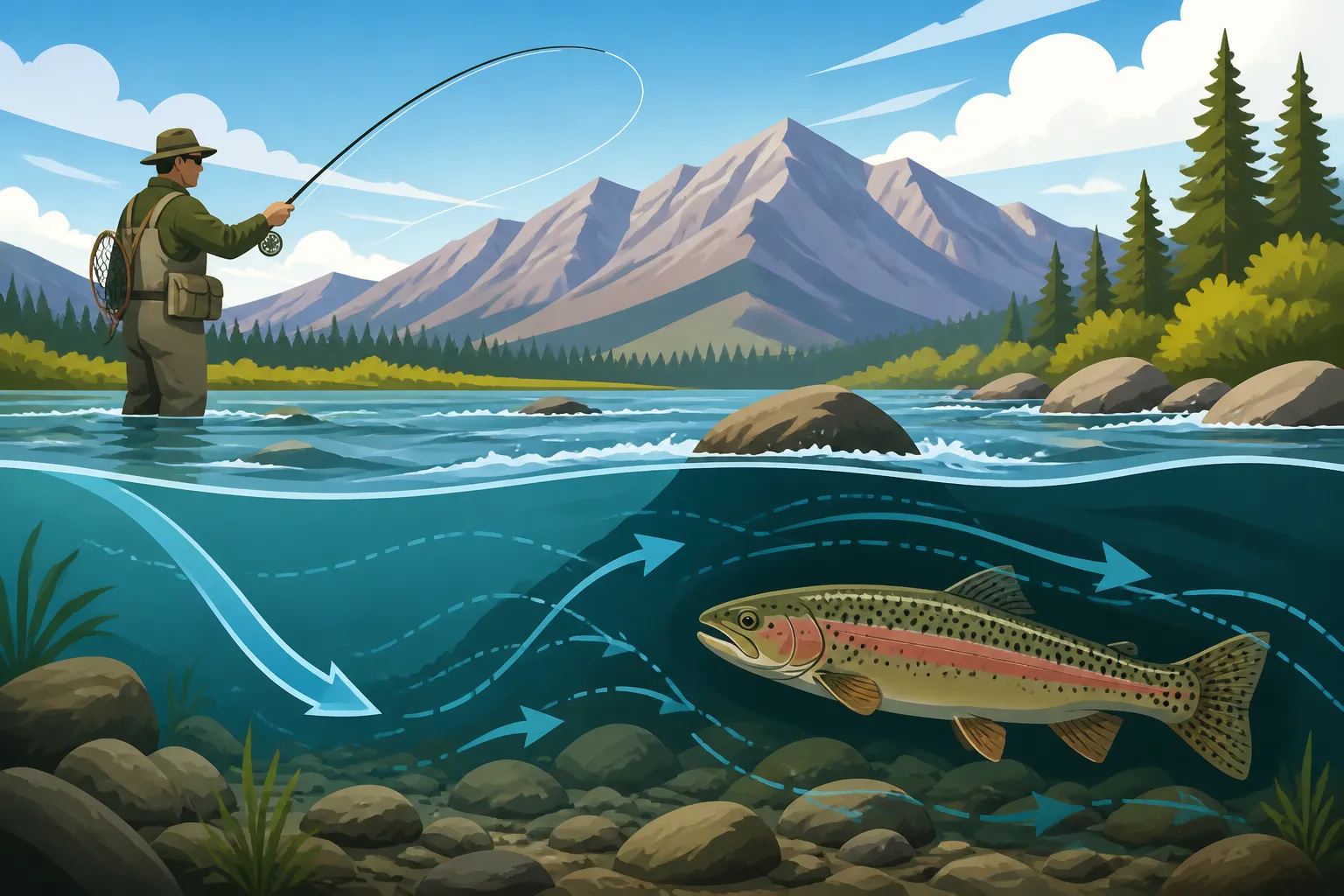
- Seams: A seam is the visible line where two different currents meet, or where fast water rubs up against slow water. Imagine the main current of a river flowing quickly, and then a slower eddy or a patch of calmer water along the bank. The boundary between these two is a seam. Trout absolutely love seams because they can sit comfortably in the slower water, expending minimal energy, while waiting for food to drift past in the adjacent fast current. It’s like standing at a buffet without having to run around. These are textbook ambush points. You'll often see distinct foam lines or debris collected along seams, indicating where these currents converge. Learning to identify these subtle lines, whether along a bank or behind a large boulder, is critical.
- Current Breaks: Any obstruction that breaks the main flow of water creates a current break. This could be a large rock, a submerged log, a gravel bar, or even a slight change in the riverbed contour. Downstream of these breaks, the water forms a calm "cushion" where trout can hold. They get a reprieve from the strong current and a reduced profile for predators, while still being perfectly positioned to dart out into the main current to intercept food. The "pocket water" created by numerous boulders in a Wyoming freestone stream is essentially a series of current breaks, each holding potential for a trout. This is where you might find multiple fish tucked away, one behind each significant obstruction.
Eddies and Backwaters
These areas are often overlooked but can be incredibly productive, especially during certain times or conditions.
- Eddies: An eddy is a swirling current that moves in a circular pattern, often upstream, usually found behind a large obstruction or in a bend of the river. Eddies act like natural traps, collecting debris and, more importantly, insects and other food items that drift into them. Trout will often hold at the very edge of the eddy, where the upstream current meets the main downstream flow, or even within the slower, swirling water itself. They are resting spots and places where food concentrates. On a day with a strong hatch, the foam lines of an eddy can be absolutely covered in adult insects, making it a prime target for opportunistic trout.
- Backwaters: These are areas of slack or very slow-moving water, usually separated from the main river by a shallow bar, vegetation, or simply a deep bend. Backwaters are often warmer and can hold different species, but trout will use them, especially larger ones, for resting or finding refuge during high water. They can also be excellent places for finding juvenile fish or for targeting species like brook trout that prefer slower, calmer environments. During intense heat, the slightly cooler, deeper water of a backwater might attract trout seeking refuge. However, food delivery here is less consistent than in a seam or run, so trout in backwaters are often less actively feeding unless there’s a specific hatch or terrestrial fall.
The Subtleties: Structure, Cover, and Depth
Beyond the major flow patterns, the finer details of the riverbed and banks offer critical clues. Trout are masters of camouflage and survival, always seeking out advantages in their environment.
Rocks, Boulders, and Submerged Logs
These are the foundational elements of underwater architecture that provide both shelter and sustenance.
- Rocks and Boulders: These are essentially miniature current breaks, creating pockets of slower water where trout can rest without expending much energy. The rough surfaces of rocks also provide a habitat for aquatic insects like caddis larvae and stonefly nymphs. Trout will often lie just behind a boulder, out of the main current, waiting for food to drift by. The larger the boulder, the larger the current break, and often, the larger the trout it can hold. Think of fishing the freestone sections of the Green River below Flaming Gorge; every large rock creates a potential holding lie. Anglers often miss the fish directly in front of the boulder, not just behind it, where the cushion of water is also a key position. You'll often find that even small rocks can create enough of a micro-eddy to hold a smaller trout.
- Submerged Logs and Root Wads: These are goldmines for trout. Logs and branches that have fallen into the water offer excellent overhead cover from avian predators (like ospreys and eagles) and strong currents. Their complex structure also provides a fantastic habitat for a variety of aquatic invertebrates and baitfish, which are prime food sources for trout. The bigger, older brown trout are particularly fond of these hideouts. Casting your fly or lure tight to a submerged log can be tricky, but it’s often where the biggest rewards lie. However, be prepared to lose some gear, as snags are common. An old, gnarled root wad creates dozens of tiny current breaks and hiding spots. When you're fishing a Wyoming stream with plenty of downed timber, these spots should be high on your list, especially if you're trying Streamer Fishing for Wyoming Brown Trout.
Undercut Banks and Overhanging Vegetation
These features offer crucial overhead cover and shade, often leading to surprising encounters.
- Undercut Banks: These are areas where the river's current has eroded the bank underneath the waterline, creating a hollowed-out space. They are fantastic hiding spots for trout, offering deep, dark refuge from predators and strong currents. Trout often sit deep within these undercuts, darting out to snatch food drifting by. They can be tricky to fish because you need to get your fly or lure deep under the bank without snagging. Sometimes, a precise roll cast or a high-stick nymphing technique is necessary. Many of the larger, more cautious trout in Wyoming's rivers will make these their primary homes.
- Overhanging Vegetation: Bushes, trees, and grass that hang over the water provide crucial shade and cover. On bright, sunny days, trout will seek the cooler, darker water under this vegetation. More importantly, overhanging branches are a constant source of terrestrial insects – grasshoppers, beetles, ants – that accidentally fall into the water. If you see a lot of overhanging willows or cottonwoods along the bank, especially on a breezy day, expect trout to be holding underneath, looking for a terrestrial meal. Presenting a hopper pattern tight to these banks can be incredibly effective, particularly during the summer months. It's a key tactic when fly fishing on the Miracle Mile or other open stretches of river where terrestrials are abundant.
Varying Depths and Bottom Composition
The depth of the water and what lies on the riverbed are important factors in trout preference.
- Varying Depths: Trout will use different depths for different purposes. Deep water offers security from predators and often holds larger, more wary fish. It also stays cooler in the summer and warmer in the winter, providing thermal refuge. Shallower water, especially riffles, is often where active feeding occurs. Knowing how to adjust your weight and presentation to target various depths is crucial. For instance, in a large pool, the deepest section might hold resting fish, while the slightly shallower edges of the head and tail are prime feeding lies. Understanding the various depths within a river section helps you tailor your approach, from using deep nymph rigs to lighter dry fly presentations.
- Bottom Composition: The type of material on the riverbed – gravel, sand, silt, or bedrock – tells you a lot about the water's productivity and what food sources might be present.
- Gravel bottoms in riffles and runs are ideal for insect larvae and nymphs, making them highly productive feeding areas. Trout will often pick these clean.
- Sandy or silty bottoms are generally less productive for insect life but can be found in slower pools or backwaters. These might hold different types of food, or simply be areas for resting.
- Large bedrock formations offer substantial current breaks and can be excellent holding spots, especially if they create deep crevices. When fishing a clear Wyoming stream, pay attention to the color and texture of the bottom – it’s not just scenery; it’s a detailed map of trout habitat.
Reading the Flow: Current Speed and How Trout Position Themselves
The speed of the current is perhaps the single most important factor influencing where trout hold and how they feed. Trout are energy conservationists, always looking for the best caloric return for the least effort.
Fast Water vs. Slow Water
Understanding the trade-offs between these two extremes is key to locating active fish.
- Fast Water: While fast currents carry abundant food, they require a lot of energy for a trout to hold station. Therefore, trout in fast water will typically position themselves in "cushions" or "lanes" of slightly slower water, often behind or alongside obstructions. They dart out into the main current to grab food and then retreat to their low-energy holding spot. You won't often find a trout battling the absolute fastest current for extended periods unless there's a huge hatch on and food is overwhelmingly abundant. When you're fly fishing for Wyoming trout, remember that fast water often demands heavier nymphs or streamers to get down to the fish quickly, or a very quick presentation if they're looking up.
- Slow Water: Very slow or slack water, like that found in large, deep pools or backwaters, requires minimal energy for trout to hold. However, it also delivers less consistent food. Trout in these areas might be resting, seeking refuge, or targeting larger, slower-moving prey like baitfish or leeches. During a major hatch, however, a slow-moving pool can become a buffet, as insects congregate on the surface. When the river is high or muddy, slow water areas near the banks often become sanctuaries where trout can escape the turbid main flow. Your approach will differ greatly, perhaps requiring more subtle presentations or smaller flies.
The "Sweet Spot" in Moderate Currents
This is where trout truly thrive, and it's often where you'll find the most consistent action.
- Optimal Energy-to-Food Ratio: Trout prefer moderate currents that deliver a steady supply of food without demanding excessive energy expenditure. These "sweet spots" are often found in the main body of runs, at the heads and tails of pools, or in the calmer edges of riffles. The current is strong enough to bring a continuous stream of nymphs and drifting insects, but not so strong that the trout has to fight constantly. This is the ideal balance. When you approach a river, actively seek out these Goldilocks zones – not too fast, not too slow, but just right. These areas are often prime for a variety of techniques, from nymphing to swinging soft hackles.
- Strategic Positioning: In these moderate currents, trout will often position themselves facing upstream, slightly off the bottom, perfectly angled to intercept food. They might be in a slight depression in the riverbed, behind a small rock, or along a subtle seam. Their exact position can change based on the specific food source. For example, during a strong mayfly hatch, they might rise higher in the water column. During a nymph migration, they'll hug the bottom. Observing these subtle shifts is part of the ongoing process of reading water. Knowing how to read these positions is invaluable, especially when trying to land a trophy fish in a location known for them, like The Miracle Mile Stretch of Wyoming's North Platte River.
Micro-Currents and Food Delivery
Don't just look at the big picture; zoom in on the subtle movements of the water.
- Invisible Food Lanes: Even in seemingly uniform runs, there are micro-currents – subtle variations in flow that act as invisible food lanes. These can be caused by slight changes in depth, small rocks, or even irregularities in the bank. Debris floating on the surface (like foam, leaves, or a single dandelion seed) can be your best indicator of these subtle currents. Watch how they move; where they accelerate, slow down, or converge often indicates a prime feeding lane. A perfectly presented fly that drifts naturally down one of these micro-currents is much more likely to be intercepted by a trout than one that's slightly off.
- Understanding Drift: Reading micro-currents is crucial for achieving a natural, drag-free drift with your fly or lure. If your line is in a faster current than your fly, it will pull the fly unnaturally, signaling to the trout that something is amiss. This is why mending your line is so important in fly fishing. By watching how tiny particles on the surface move, you can anticipate how your fly will drift and make the necessary adjustments to ensure it looks as natural as possible. For detailed understanding, consider studying Fly Fishing Techniques for Wyoming Trout Streams to refine your presentation. This level of detail can be the difference between an empty net and a memorable catch.
Environmental Clues: Light, Weather, and Time of Day
The river's immediate conditions, like light, weather, and the time on your watch, profoundly influence trout behavior and where they position themselves. Ignoring these external factors is like trying to guess a poker hand without seeing any cards.
Sunlight Penetration and Trout Behavior
Light plays a massive role in how trout perceive their environment and how exposed they feel.
- Bright Sun, Deep Cover: On bright, sunny days, trout become very wary. They seek refuge in deeper water, under undercut banks, beneath submerged logs, or in the shade of overhanging vegetation. The harsh overhead light can make them feel exposed to predators, and it also penetrates the water more, making them more visible. In these conditions, you'll need to approach cautiously, stay low, and present your fly or lure accurately into shaded, protected areas. Fishing early morning or late evening often becomes more productive on sunny days, as the light is softer.
- Cloud Cover and Surface Activity: Overcast days are often a trout angler's best friend. The diffused light makes trout feel more secure, and they are more likely to move into shallower water and feed actively throughout the day. With less harsh light penetrating the water, they also feel more comfortable looking up for surface insects. This is prime time for dry fly fishing, especially during a hatch. Similarly, a slight ripple on the water from a gentle breeze can break up the surface, making it harder for trout to see you and easier for them to feed on the surface.
Wind and Its Effect on the Surface and Food
Wind isn't just an annoyance; it's a dynamic force that can dramatically shift feeding patterns.
- Surface Chop and Visual Advantage: A light to moderate breeze creates a chop on the water's surface, which breaks up the angler's silhouette and makes it harder for wary trout to spot you. This can allow for a closer approach. It also makes it harder for trout to discern artificial flies from natural insects, which is a huge advantage. However, strong winds can make casting nearly impossible, especially with light fly gear. It's a balance.
- Terrestrial Delivery System: Wind is a crucial delivery system for terrestrial insects. Gusts can blow grasshoppers, beetles, ants, and other land-based insects off banks and into the water. If you're fishing on a windy day, especially along grassy banks or beneath trees, definitely consider using terrestrial patterns. Trout know this and will often shift their positions to areas where wind-blown insects are likely to accumulate, such as in eddies or against windward banks. This is particularly relevant in Wyoming's wide-open spaces, where a stiff breeze is a common occurrence.
Time of Day and Seasonal Changes
Trout behavior is cyclical, influenced by the sun's position and the time of year.
- Dawn and Dusk Activity: These are often "magic hours" for trout fishing. At dawn, insects are becoming active, water temperatures are often ideal, and the low light provides cover. At dusk, rising insects, especially caddis and mayflies, often create a frenzy of surface feeding. Large trout that are wary during the day often become much more active and less cautious under the cloak of low light. Plan your trips to coincide with these prime periods whenever possible.
- Seasonal Shifts: Trout habitat and feeding habits change drastically with the seasons. In spring, after ice-out, trout might be more focused on subsurface food as water temperatures rise. During the intense heat of summer, they'll seek cooler, deeper water or feed most actively during early mornings and late evenings. Fall brings cooler temperatures and often a major push of larger brown trout upstream to spawn, making certain runs and pools incredibly productive for Fall Fishing for Browns on the Miracle Mile. Winter fishing often means targeting deep, slow pools or tailwaters below dams where water temperatures are more stable. Understanding the broader Wyoming Fishing Seasons Month by Month is essential context for reading water. Each season tells a different story about where the trout will be. Furthermore, understanding How Water Temperature Affects Trout Feeding is critical for predicting activity levels throughout the year.
Putting It All Together: A Step-by-Step Approach to Analyzing a Stretch
Okay, so you've learned about riffles, seams, undercuts, and the impact of wind. Now, how do you actually apply this on the water? It's a systematic process that combines observation, deduction, and action.
The "Silent Approach" and Initial Observation
Before you even make a cast, observe. This is arguably the most crucial step.
- Approach Like a Hunter: Walk slowly and deliberately, staying low, and avoiding sudden movements that might spook fish. Trout are incredibly sensitive to vibrations and shadows. If you're wading, minimize splashing. If you're fishing from the bank, stay back from the edge and use available cover. Think of it as stalking prey. Many an angler has ruined a great spot by simply tromping up to the bank.
- Scan the Water from a Distance: Before committing to a spot, pause and look. Take in the entire stretch of water you're about to fish. Look for surface activity: rising fish, insects on the water, subtle disturbances. Identify the major features: Where are the riffles, runs, and pools? Where are the obvious current breaks? Are there any visible seams or foam lines? What kind of cover is present – overhanging trees, submerged logs? Consider the light and wind conditions. This initial assessment, done from a distance and without disturbance, gives you a blueprint of the fishy water. Is it the Best Time of Year to Fish the North Platte River? This overall context will influence your initial strategy.
Prioritizing Water Features
Based on your initial observations and the current conditions, you need to decide where to focus your efforts first.
- Start with the Obvious (and Often Best) Spots: Generally, start by targeting current seams, the heads and tails of pools, and the edges of productive runs. These are typically the highest-percentage spots. If there's an active hatch, focus on water where fish are visibly rising. If it's a bright day, target shaded areas or deep cover. If it's windy, look for banks with overhanging vegetation that might be dropping terrestrials.
- Consider the Present Food Source: What's hatching? Are there nymphs active? Are baitfish present? Your choice of fly or lure should dictate where you concentrate your efforts. If you're seeing a lot of caddis adults fluttering around, focus on riffles and runs where they're emerging. If you're after larger brown trout, target deeper, more complex structure with streamers. Knowing Best Wyoming Fly Patterns for Cutthroat Trout can guide your choice of presentation for specific areas. The choice of where to cast should always tie back to what the fish are likely eating.
Adjusting Your Approach Based on Feedback
Fishing isn't static; it's a dynamic conversation between you and the river.
- The River Tells You Everything: If your initial spots aren't producing, don't get discouraged, get analytical. The lack of bites is feedback. Is your fly/lure getting deep enough? Is your drift natural? Are you seeing fish but they aren't taking? This might indicate you need to change your fly pattern, size, or presentation. For example, if you're nymphing and not getting bites, try adding more weight or switching to a different nymph pattern, or even adjusting your Nymphing Techniques for Wyoming Tailwaters.
- Expand Your Search and Refine Your Focus: If the primary spots are slow, start exploring secondary holding lies: deeper pockets in runs, the slower water along the far bank, or even seemingly "dead" water. Sometimes, fish are simply not where you expect them to be. Pay attention to changes in current, subtle depth variations, or new sources of cover you might have initially overlooked. Maybe you need to switch from a dry fly to a subsurface pattern or try swinging a streamer through a different part of the run. This continuous adjustment based on what the water and fish are (or aren't) telling you is the essence of effective angling.
Advanced Water Reading: Beyond the Obvious
Once you've mastered the basics, there's a whole new layer of subtlety to discover in reading water that can unlock even greater success, especially on challenging days or in specific environments.
Reading the Surface for Hatches and Rises
Surface activity is the most exciting and often most frustrating aspect of trout fishing.
- Understanding Rise Forms: Not all rises are created equal, and deciphering them can tell you exactly what a trout is eating.
- Sip/Dimple: A subtle rise, often just a disturbance on the surface, indicates the trout is eating tiny insects (midges, small mayflies) in the film or just below it. This usually means a delicate presentation with small dry flies or emergers.
- Gulper: A more pronounced, often noisy rise where the trout's head and sometimes tail break the surface, suggests they are actively eating larger adult insects (larger mayflies, caddis, hoppers) on the surface. This is when you can often get away with a larger, more visible dry fly.
- Splash/Smash: A very aggressive, often noisy and splashy rise, indicates the trout is chasing down fast-moving insects, terrestrials, or even small baitfish. This might call for a larger, more imitative dry fly, a terrestrial pattern, or even a small popper.
- Matching the Hatch: Once you identify the rise form and ideally, the insect, your next step is to choose a fly that "matches the hatch." This means selecting a fly that mimics the size, shape, and color of the natural insect. This is a skill unto itself, but watching what insects are flying around, drifting on the surface, or even turning over rocks to see what nymphs are present, will give you critical clues. Remember, even if fish aren't visibly rising, understanding what's hatching (or about to hatch) can inform your subsurface fly selection. Always be prepared for Matching the Hatch on Wyoming Rivers, as it can be the key to a banner day.
Understanding Subsurface Currents and Thermoclines
While often more relevant for stillwater fishing, these concepts still apply to larger river systems and especially tailwaters.
- Subsurface Currents: The current you see on the surface isn't always the same as the current deeper down. Different water layers can move at different speeds or even in different directions. This is particularly true in deeper pools, reservoirs, or large rivers like Flaming Gorge Reservoir. Understanding these subsurface currents is vital for achieving a truly natural drift with nymphs or streamers. If your fly is moving at a different speed than the surrounding water, trout will often reject it. This is where experience and observation (and sometimes a bit of trial and error with different weights) come into play.
- Thermoclines (for deeper lakes/reservoirs): While not typically a "river reading" factor, if you're fishing a deep section of a river that acts like a reservoir or a large tailwater system, understanding thermoclines can be important. A thermocline is a distinct layer where water temperature changes rapidly with depth. In summer, trout will often congregate just above or within the thermocline, seeking cooler, oxygenated water. This is more critical for lake fishing, but can be applied to large, deep river sections or for targeting fish like lake trout which hold deep. Learning How to Fish Deep Structure for Lake Trout involves this exact knowledge of depth and temperature.
Predicting Trout Behavior in Different Water Levels
Wyoming's rivers can fluctuate dramatically with snowmelt, rainfall, and dam releases. How trout react is predictable.
- High Water/Runoff: During high water periods, like Fishing Wyoming During Spring Runoff, the river becomes faster, murkier, and often colder. Trout will move out of the main current and seek refuge in slower, more protected areas along the banks, in eddies, behind large obstructions, or in newly flooded areas. The edges of the river become prime targets. They’ll also often hug the bottom to avoid the strongest currents. This is a time for heavier flies, brighter colors, and fishing very close to cover.
- Low Water: Conversely, during periods of very low water, trout become extremely skittish and concentrated. They retreat to the deepest pools, runs, and areas with the most overhead cover. Access to shallower areas might be limited, and fish will be hyper-aware of your presence. Long, stealthy casts and light leaders are paramount. This is also when you might spot fish more easily, but spooking them is a constant threat. Your ability to read depth and cover becomes even more critical in low water.
Common Pitfalls and How to Avoid Them
Even with all this knowledge, it's easy to fall into habits that can hinder your success. Being aware of these common mistakes will help you stay on track.
Overlooking the "Dead" Water
It's tempting to only focus on the obvious, fast-moving, "fishy" looking water, but that can be a big mistake.
- The Power of Slow Water: Many anglers overlook slow-moving water, thinking trout only live in fast currents. But large, wary trout, especially brown trout, often hold in the deepest, slowest parts of pools, especially during bright midday sun or cold winter months. They are resting, digesting, or waiting for larger food items. Don't be afraid to probe these slower, deeper sections with streamers or nymphs, allowing them to sink and drift naturally. You might be surprised at what's lurking in the seemingly "dead" water.
- Edges and Transitional Zones: The very edges of the river, even shallow ones, where the main current meets the bank, can hold fish. These are often overlooked because they don't look as "sexy" as a raging riffle. But these transitional zones offer subtle current breaks and can be surprisingly productive. Always give the edges a few casts, especially if there's any overhanging vegetation or an undercut bank.
Focusing Too Much on One Type of Feature
Sticking to what's comfortable or what worked yesterday can limit your catches.
- Be Adaptable: The river is constantly changing, and so are the fish. If you're only casting into riffles, you're missing the fish in the pools. If you're only focused on dry flies, you're missing the fish feeding on nymphs. Be willing to explore different types of water and adapt your techniques. Carry a variety of flies and be prepared to switch from a dry fly setup to a nymph rig, or even to Trolling Techniques for Wyoming Reservoirs if you move to a large lake section. The best anglers are versatile.
- The "Whole River" Approach: Rather than just jumping from one riffle to the next, try to mentally (or physically) fish a whole section of river. Start at the head of a pool, work your way through the deepest parts, then fish the tailout into the next riffle, and finally the riffle itself. This methodical approach ensures you're covering all potential holding lies and gives you a more complete picture of what the fish are doing.
Ignoring the Hatch
This is a classic blunder, especially for fly anglers, but it applies to all methods.
- The Obvious Clue: If you see fish rising, and especially if you see insects on the water, the trout are telling you exactly what they want to eat. Ignoring this clear signal and continuing to throw a fly that's not matching the hatch is a recipe for frustration. Always carry a small magnifying glass or even a field guide to help you identify the insects you're seeing. For fly anglers, having a good selection of patterns, even a simple emergency kit from Amazon, can save the day.
- Subsurface Focus: Even if fish aren't rising, hatches are still happening subsurface. Emergers are drifting, nymphs are migrating, and pupae are wiggling. Knowing what insects are likely to be active in the water column based on the season and time of day (e.g., stoneflies in early spring, caddis pupae year-round) will greatly improve your nymphing success. For deeper understanding, consult resources on Matching the Hatch on Wyoming Rivers.
Table: Trout Water Feature Quick Reference Guide
| Water Feature | Characteristics | Trout Behavior/Likely Presence | Optimal Fishing Strategy |
|---|---|---|---|
| Riffles | Shallow, turbulent, oxygenated, rocky bottom | Feeding on dislodged nymphs/larvae; often smaller fish | Dry flies, emergers, unweighted nymphs; short, precise drifts |
| Runs | Moderate depth, steady current, uniform flow | Actively feeding; resting along subtle current breaks | Nymphs (weighted), wet flies, small streamers |
| Pool Heads | Where fast water enters a pool; transition zone | Active feeding; intercepting food from upstream | Nymphs, streamers; dry flies during hatches |
| Pool Tails | Where water exits a pool; transition zone | Active feeding; ambushing prey moving downstream | Nymphs, streamers; dry flies during hatches |
| Deep Pools | Slow, deep water; often darker bottom | Resting, seeking thermal refuge; larger, wary fish | Weighted nymphs, large streamers, bait (where legal) |
| Current Seams | Boundary between fast/slow water | Ambush points; trout conserving energy while feeding | Nymphs, dry flies (if rising), streamers; precise drifts |
| Eddies/Backwaters | Swirling/slack water; food accumulation | Resting; opportunistic feeding on concentrated food | Dry flies (if hatch), soft hackles, small nymphs, terrestrials |
| Undercut Banks | Eroded banks forming overhead cover | Hiding from predators/current; larger, cautious fish | Nymphs, streamers; accurate casts deep under the bank |
| Submerged Logs/Roots | Complex structure, current breaks, cover | Prime hideouts for large, territorial trout | Streamers, large nymphs; high risk of snags |
| Overhanging Vegetation | Provides shade, drops terrestrials | Feeding on terrestrials; seeking cooler water | Terrestrial dry flies (hoppers, ants, beetles) |
Disclaimer
The information provided in this guide is for educational and informational purposes only and is not intended as legal advice. Fishing regulations in Wyoming are subject to change by the Wyoming Game and Fish Department (WGFD). It is the responsibility of every angler to consult the most current official Wyoming Fishing Regulations booklet or the WGFD website before fishing any waters in Wyoming. Always practice safe boating and wading techniques, and adhere to all local, state, and federal laws.